 BECE Past Questions
BECE 2020 Integrated Science Past Questions and Answers
40 objective questions and 6 theory questions from the 2020 BECE Integrated Science paper. Answers and worked solutions for questions 1 to 10 are below; the rest are free in the app.
Practise this paper free, online or offline


On an iPhone? Download on the App Store
On Android? Get it on Google Play
Paper 1: Objectives
-
Which of the following parts of the tooth is embedded in the jaw bone?
- A. Gum
- B. Neck
- C. Root
- D. Crown
Answer: C -
Which part of the human body stores sperms temporarily?
- A. Epididymis
- B. Scrotum
- C. Prostate gland
- D. Sperm duct
Answer: A -
An advantage of soft water over hard water is that soft water
- A. is good for formation of strong bones in humans
- B. prevents heart diseases
- C. has a pleasant smell
- D. saves a lot of soap when used in washing
Answer: D -
The work done by force of 20 N on a body is 60 J. Calculate the distance through which the force moved
- A. 8.0 m
- B. 4.0 m
- C. 3.0 m
- D. 2.0 m
Answer: C -
Which of the following processes removes carbon from the atmosphere?
- A. Respiration
- B. Burning
- C. Decomposition
- D. Photosynthesis
Answer: D -
A substance which is made up of the same kind of atoms is called
- A. a compound
- B. an element
- C. a mixture
- D. an ion
Answer: B -
Which of the following statement(s) is/are true of a shadow? A shadow is formed
I. by a transparent object,
II. by an opaque object,
III. on a screen.- A. I only
- B. II only
- C. I and III only
- D. II and III only
Answer: D -
Which of the following diseases results from malnutrition?
- A. Scurvy
- B. Measles
- C. Malaria
- D. Gonorrhoea
Answer: A -
The chemical formula for aluminium sulphide is AlyS₃. Determine the value of y.
- A. 1
- B. 2
- C. 3
- D. 4
Answer: B -
Which of the following sources of energy is/are renewable?
I. Wind
II. Coal
III. Crude oil- A. I only
- B. I and II only
- C. II and III only
- D. I, II and III
Answer: A
Answers and solutions for questions 11 to 40 are free in the BECE Past Questions app, with timed practice and offline study.
-
Soils are described as heavy because they
- A. have high water holding capacity
- B. contain a lot of stones
- C. have large air spaces
- D. are difficult to till
-
An example of a legume is
- A. Groundnut
- B. Millet
- C. Sorghum
- D. Sweet potato
-
The process used to separate a mixture of iron filings and sulphur is
- A. magnetic attraction
- B. sublimation
- C. distillation
- D. evaporation
-
The colour of a soil profile determines the
- A. depth at which implements are set
- B. drainage ability of the soil
- C. fertility of the soil
- D. type of tool to use
-
The end-product of digestion of fats and oils is
- A. Amino acid
- B. Glucose
- C. Maltose
- D. Fatty acid and glycerol
-
The unit of potential difference is
- A. Ampere
- B. Watt
- C. Ohm
- D. Volt
-
A stone displaced 20cm³ of water when immersed in the water. If the mass of the stone is 40g, find the density of the stone.
- A. 60gcm-³
- B. 40gcm-³
- C. 2gcm-³
- D. 0.5gcm-³
-
One similarity of physical and chemical changes is that both
- A. are easily reversible
- B. result in change of state of matter
- C. produce no change in mass
- D. are accompanied by great heat change
-
Which of the following elements is a macro-nutrient?
- A. Copper
- B. Manganese
- C. Zinc
- D. Sulphur
-
The process by which metabolic wastes are removed from the body is called
- A. Respiration
- B. Excretion
- C. Ingestion
- D. Egestion
-
The part of the flower that produces pollen grains is the
- A. stamen
- B. filament
- C. petal
- D. anther
-
Which of the following statement(s) about pressure in fluids is/are correct? Pressure
I. decreases with depth
II. increases with depth
III. does not depend on the area- A. I only
- B. II only
- C. I and II only
- D. II and III only
-
A boy who is seventeen years old is an
- A. adult
- B. adolescent
- C. old person
- D. infant
-
The mode of heat transfer in which no material is involved is known as
- A. conduction
- B. convection
- C. expansion
- D. radiation
-
Which of the following factors are used to describe a fertile soil?
I. Amount of organic matter
II. Color
III. Texture- A. I and II only
- B. I only and III only
- C. II and III only
- D. I, II and III only
-
The major charge carriers in p-type semiconductors are
- A. anions
- B. electrons
- C. holes
- D. neutral
-
The dry season in Ghana is mainly from
- A. January to March
- B. April to June
- C. July to September
- D. October to December
-
The practice that excess branches of growing plants are removed is termed
- A. mulching
- B. pruning
- C. thinning
- D. staking
-
Which of the following soil type has the highest capillarity?
- A. Clay
- B. Loam
- C. Sand
- D. Silt
-
Which of the following farming practices promote soil erosion
I. Alley cropping
II. Bush burning
III. Over grazing- A. I and II only
- B. I and III only
- C. II and III only
- D. I, II and III
-
The nearest planet to the sun in the solar system is
- A. Earth
- B. Mars
- C. Mercury
- D. Venus
-
In which of the following devices is electrical energy transformed into light energy
- A. Electric bell
- B. Fluorescent tube
- C. Lantern
- D. Radio
-
An example of a semi-metal is
- A. silicon
- B. carbon
- C. beryllium
- D. argon
-
The elements in the periodic table are arranged according to their
- A. atomic number
- B. atomic mass
- C. mass number
- D. neutron number
-
Which of the following states of matter are fluids
I. Solid
II. Liquid
III. Gas- A. I and II only
- B. I and III only
- C. II and III only
- D. I, II and III
-
A liquid-liquid mixture can be separated by
- A. filtration
- B. evaporation
- C. sublimation
- D. distillation
-
When an unknown solution reacted with magnesium, a gas was produced. Which of the following solutions could be the unknown solution
- A. Sodium chloride solution
- B. Sodium hydroxide solution
- C. Hydrochloric acid
- D. Calcium nitrate solution
-
Which of the following statements about acids correct
I. They react with calcium carbonate to give a gas
II. They turn red litmus paper blue
III. They react with reactive metals to give a gas
IV. They turn blue litmus paper red- A. I, II and IV only
- B. I, II and III only
- C. II, III and IV only
- D. I, III and IV only
-
The structure which enables a fish to breathe in water is
- A. buccal cavity
- B. gills
- C. swim bladder
- D. lungs
-
A fruit in which the pappus has been modified into a parachute structure is dispersed by
- A. explosion
- B. mammals
- C. water
- D. wind
Paper 2: Theory
- (a) The diagrams below are illustrations of two cells labelled A and B.
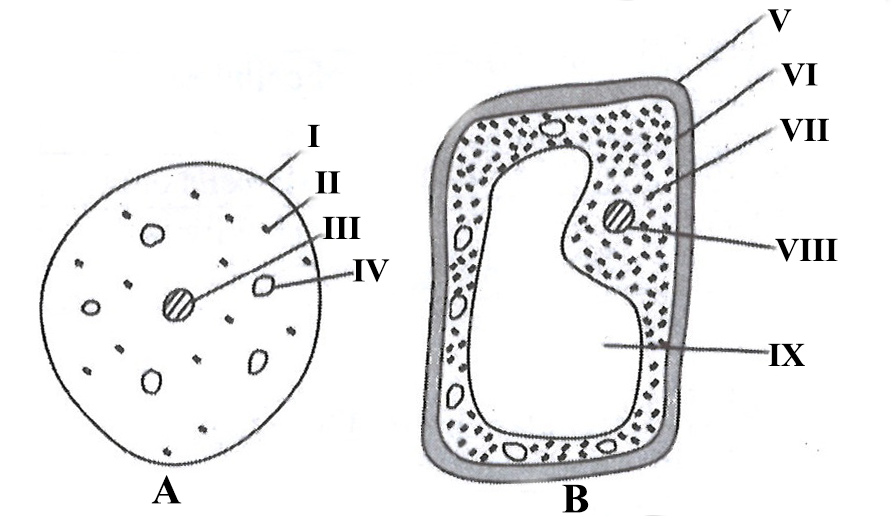
(i) Name each of the parts labelled I, II, III and IV.
(ii) Which of the parts named in (a)(i) is the same as the parts labelled VI and IX in cell B?
(iii) Which of the cells is a plant cell?
(iv) Give two reasons for the answer given in (a)(iii).
(v) Tabulate two differences between the parts labelled I and V.
(b) The diagram below is an illustration of an experiment carried out in the laboratory.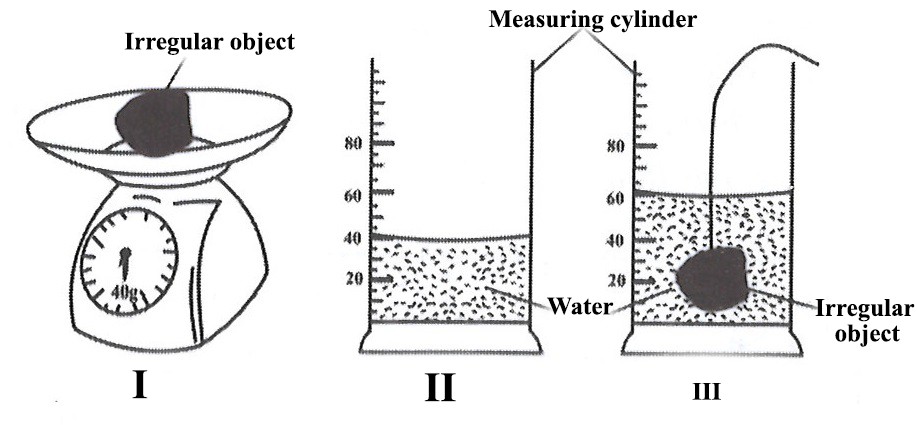
(i) Read and record the:
α) mass of irregular object (M) in I
β) Volume of water (V1) in II
γ) Volume of water (V2) in III
(ii) Determine the volume of the irregular object.
(iii) Calculate the density of the irregular object.
(iv) Name the instrument that could be used to measure the mass of an irregular object.
(v) State one precaution to be taken in performing the experiment.
(c) The following activities were performed in the laboratory by groups of pupils:
(i) Camphor was heated.
(ii) Wood was burnt.
(iii) Iron nails were heated strongly.
(iv) Sodium chloride was dissolved in water.
(i) Which of the activities are:
α) chemical processes
β) physical processes
(ii) Give two reasons why the activities listed in (α) and (β) are chemical and physical processes respectively.
(iii) Give two examples of physical change that take place in your environment.
(d) A farmer cultivated soya bean, yam, and maize on a farm in a rotational programme.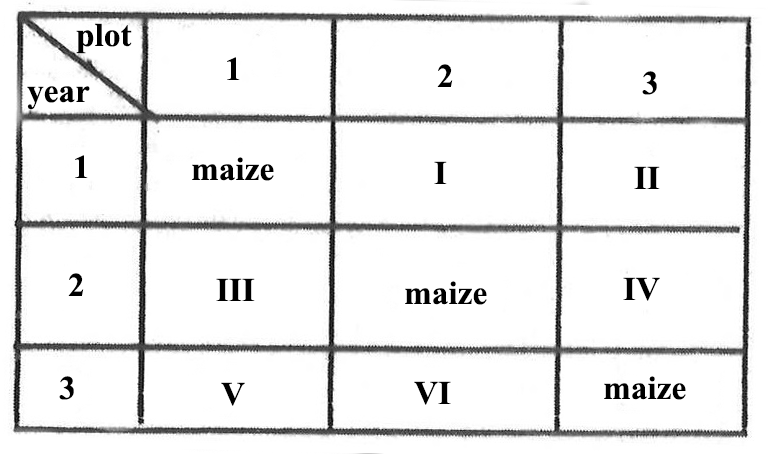
(i) Copy and complete the table.
(ii) List three principles to consider when planning this rotational programme.
(iii) Give two reasons for selecting the crop named for V in plot 1, year 3.
(iv) State one advantage of practising this farming system. - (a) State three external features of the weaver bird that adapt it to its environment.
(b) List four harmful effects of air pollution.
(c) (i) Draw the magnetic lines of force around a bar magnet.
(ii) If the work input of a machine is 30 joules, what would be its efficiency when the work output is 25 joules?
(d) Outline three principles involved in vegetable crop production. - (a) (i) State two differences between an ecosystem and a habitat.
(ii) What is meant by the term blood?
(b) Explain why it is difficult to separate iron and sulphur mixture after strong heating.
(c) Draw and label a diagram of a ray of light making an angle of 35° with a plane mirror.
(d) State two
(i) advantages of land rotation
(ii) disadvantages of land rotation. - (a) State one symptom each of the following infectious diseases:
(i) cerebrospinal meningitis
(ii) chicken pox
(iii) typhoid
(b) (i) What is energy?
(ii) Give two reasons why it is necessary to conserve energy.
(c) (i) State two methods of restoring soil resources.
(ii) Explain one of the methods.
(d) (i) What is a binary compound?
(ii) Write the chemical formula of compounds formed between:
α) Oxygen and lithium
β) Magnesium and chlorine
(iii) Name the compound formed in (ii) α. - (a) (i) State two uses of water in agriculture.
(ii) Name two crops that are deep-rooted.
(b) (i) Explain the term circulatory system in humans.
(ii) Classify each of the following as diffusion or osmosis:
α) absorption of water by plant roots
β) movement of food into the bloodstream
(c) (i) What is mass?
(ii) A box of size 3 cm has a density of 2.0 g/cm³. What is its mass?
(d) Give the state of each of the following substances:
(i) ash
(ii) carbon dioxide. - (a) State three functions of the female reproductive system.
(b) (i) What is the role of a capacitor in a circuit?
(ii) Give two examples of compound machines.
(c) (i) What is Integrated Pest Management?
(ii) State two advantages of practicing integrated pest management.
(d) (i) State two classes of mixtures.
(ii) Classify the following under the classes:
α) bronze
β) perfume sprayed into the air.
Worked solutions to the theory questions are free in the app.
More BECE Integrated Science papers
All 38 Integrated Science papers
 All answers free on Google Play