 BECE Past Questions
BECE 2021 Integrated Science Past Questions and Answers
40 objective questions and 6 theory questions from the 2021 BECE Integrated Science paper. Answers and worked solutions for questions 1 to 10 are below; the rest are free in the app.
Practise this paper free, online or offline


On an iPhone? Download on the App Store
On Android? Get it on Google Play
Paper 1: Objectives
-
Which of the following substances is a compound?
- A. Oxygen
- B. Magnesium
- C. Water
- D. Sodium
Answer: CA compound consists of two or more different elements chemically combined in a fixed ratio. Oxygen, magnesium and sodium are all elements but water is a compound made up of hydrogen and oxygen (H₂O). -
An atom of an element has a neutral charge because the
- A. Protons and electrons are the same particles.
- B. Proton number and electron number are the same.
- C. Neutron number and proton number are equal.
- D. Electron number and neutron number are equal.
Answer: BA neutral atom has a charge balance, which means that it has an equal number of protons and electrons. -
Which of the following organisms is an ecto-parasite of animals?
- A. Fleas
- B. Tapeworm
- C. Liver fluke
- D. Roundworm
Answer: AEctoparasites live on the surface of the host or in the skin and do not invade the inner body, e.g. fleas, head lice and bed bugs.
Endoparasites live inside the host (gut, lungs, heart, blood vessels), e.g. tapeworm, fluke and roundworm. -
An atom has 20 nucleons and 9 protons. What is its neutron number?
- A. 9
- B. 10
- C. 11
- D. 12
Answer: CNucleon = Proton + Neutron
Neutron = Nucleon - Proton
Neutron = 20 - 9 = 11 -
Which of the following statements about aerobic and anaerobic respiration is not correct?
- A. Water is produced as a by-product in anaerobic respiration.
- B. Alcohol or lactic acid is produced in anaerobic respiration.
- C. No oxygen is required in anaerobic respiration.
- D. Very little energy is released in anaerobic respiration.
Answer: AIn aerobic respiration oxygen is present and glucose breaks down into carbon dioxide and water, releasing more energy.
In anaerobic respiration oxygen is absent and glucose breaks down into ethyl alcohol (or lactic acid), carbon dioxide and energy, releasing less energy. Water is not a product of anaerobic respiration. -
An aluminium cube of side 2 m has a mass 24 kg. Determine the density of the aluminium.
- A. 3 kg m-3
- B. 12 kg m-3
- C. 24 kg m-3
- D. 48 kg m-3
Answer: ADensity = Mass / Volume
Volume of a cube = Length x Length x Length = 2 x 2 x 2 = 8 m3
Density = 24 kg / 8 m3 = 3 kg m-3 -
An example of the process of osmosis is
- A. Selective reabsorption
- B. Absorption of digested food
- C. The spread of petrol scent
- D. Gaseous exchange in living things
Answer: A -
What is the systematic name of the compound CO?
- A. Carbon (I) oxide
- B. Carbon (II) oxide
- C. Carbon dioxide
- D. Carbon (IV) oxide
Answer: BCO (carbon monoxide) has the systematic name carbon (II) oxide. -
Which of the following methods can be used to prevent iron from rusting?
I. Painting
II. Alloying
III. Keeping the iron in a desiccator
IV. Keeping iron in a moist environment- A. I and II only
- B. II and IV only
- C. I, II and III only
- D. II, III and IV only
Answer: CMethods of preventing rusting include painting, plating or galvanizing, alloying, and greasing or oiling. Rusting needs both air and water, so keeping iron dry in a desiccator also prevents it; a moist environment promotes rusting. -
The proper way of maintaining soil structure and fertility is termed as soil
- A. conservation
- B. depletion
- C. profile
- D. erosion
Answer: A
Answers and solutions for questions 11 to 40 are free in the BECE Past Questions app, with timed practice and offline study.
-
The instrument that can be used to measure accurately the mass of a substance is
- A. beam balance.
- B. spring balance.
- C. eureka can.
- D. measuring cylinder.
-
Which of the following chemical symbols can be used to remove permanent hardness of water?
- A. NaHCO₃
- B. Na₂CO₃
- C. Ca(HCO₃)₂
- D. CaCO₃
-
Which of the following chemical symbols is that of an element with seven electrons in the outermost shell?
- A. ₂₀Ca
- B. ₁₇Cl
- C. ₁₀Ne
- D. ₁₆S
-
Which of the following statements about the base of a transistor are correct? The base is
I. made very thin
II. made very wide
III. responsible for activating the transistor
IV. made of n-type semiconductor- A. I and III only
- B. II and IV only
- C. I, III and IV only
- D. II, III and IV only
-
Which of the following instruments is connected in parallel across a resistor in an electrical circuit?
- A. Ammeter
- B. Voltmeter
- C. Ohmmeter
- D. Galvanometer
-
Which of the following fruits is dispersed by water?
- A. Coconut
- B. Mango
- C. Maize
- D. Cocoa
-
A farming system which involves the growing of rice and the rearing of fowls is known as
- A. crop rotation.
- B. mixed farming.
- C. mixed cropping.
- D. organic farming.
-
Which of the following activities are cultural practices in vegetable production?
I. Application of fertilizer
II. Harvesting
III. Mulching- A. I and II only
- B. I and III only
- C. II and III only
- D. I, II and III
-
The function of the white blood cells in humans is to
- A. produce haemoglobin.
- B. ensure blood clot during an injury.
- C. produce antibodies to engulf disease-causing organisms.
- D. produce digestive enzymes.
-
Mosquito pupa breathes through tubes called
- A. trachea.
- B. siphon.
- C. lungs.
- D. gills.
-
An advantage of practicing organic farming is that it
- A. increases soil fertility.
- B. reduces pest infestation.
- C. reduces toxicity levels in plants.
- D. increases resistance to plant disease.
-
Which of the following is at the centre of the solar system?
- A. Earth
- B. Venus
- C. Mars
- D. Sun
-
Determine the potential energy of a block of mass 2 kg placed on a building 10 m tall. [g = 10 ms-2]
- A. 20 J
- B. 50 J
- C. 100 J
- D. 200 J
-
Which of the following organisms attacks crops in storage?
- A. Crickets
- B. Grasshoppers
- C. Millipedes
- D. Weevils
-
One of the properties of acids is that they
- A. turn wet blue litmus paper red.
- B. have no effect on blue litmus paper.
- C. turn wet red litmus paper blue.
- D. are neutral to litmus paper.
-
The instrument used to measure potential difference across a resistor is
- A. ammeter.
- B. barometer.
- C. hydrometer.
- D. voltmeter.
-
A machine lifts a load of 100 N through a vertical distance of 2 m in 10s. What is the work done by the machine?
- A. 50 J
- B. 100 J
- C. 200 J
- D. 400 J
-
A machine lifts a load of 100 N through a vertical distance of 2 m in 10s. What is the power of the machine?
- A. 50 W
- B. 20 W
- C. 10 W
- D. 2 W
-
Which of the following elements is a macro-nutrient of plants?
- A. Copper
- B. Manganese
- C. Molybdenum
- D. Sulphur
-
When an atom loses an electron, the ion formed is called
- A. an anion.
- B. a cation.
- C. a molecule.
- D. a compound.
-
Which of the following chemical equations is balanced?
- A. H2 + Cl2 → HCl
- B. K2O → K + O2
- C. Mg + O2 → MgO
- D. 2Na + Cl2 → 2NaCl
-
Purple colouration of leaves of plant is a major symptom of deficiency in
- A. Calcium
- B. Nitrogen
- C. Potassium
- D. Phosphorus
-
Which of the following diseases is not a deficiency disease?
- A. Scurvy
- B. Cholera
- C. Beriberi
- D. Goiter
-
In an experiment to determine the various particle sizes of soil sedimentation, the particle above clay suspension are
- A. Loam
- B. Organic
- C. Gravels
- D. Silt
-
A person urinates more often in the rainy season than in the dry season because
- A. more sweat evaporates from the skin.
- B. less sweat evaporates from the skin.
- C. his kidney works faster.
- D. he drinks less water.
-
Heat from the sun is transferred by
I. Conduction
II. Convection
III. Radiation- A. I only
- B. II only
- C. III only
- D. I, II and III
-
Which of the following machines are complex machines?
I. Tractor
II. Mist blower
III. Sewing machine- A. I and II only
- B. I and III only
- C. II and III only
- D. I, II and III
-
Calcium oxide and water react to form calcium hydroxide. The formula for the product is
- A. Ca2OH
- B. Ca(OH)2
- C. CaH2O
- D. Ca(H2O)2
-
The current flowing through a resistor of resistance 10 ohms is 2.5 A. What is the potential difference between the two terminals of the resistor?
- A. 4V
- B. 12.5 V
- C. 25 V
- D. 50 V
-
If a soil is smooth and sticky, it means that the soil has a large amount of
- A. Clay
- B. Loam
- C. Sand
- D. Silt
Paper 2: Theory
- (a) The diagrams below are illustrations of a set-up used to study the conditions for seed germination. The flasks are kept at 25°C during the experiment. Study the diagrams carefully and answer the questions that follow.
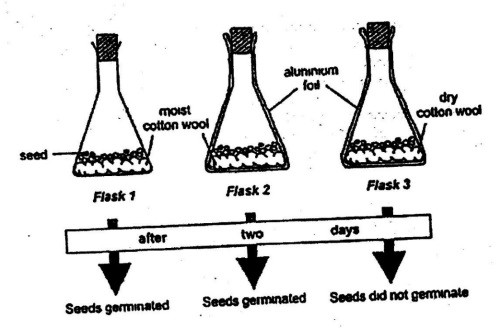
(i) What conclusion can be drawn from the results of flask 1 and flask 2?
(ii) What conclusion can be drawn from the results of flask 2 and flask 3?
(iii) The seedlings in flask 2 died after two weeks. What can be the reasons for this occurrence?
(iv) A candidate concluded that light was an important factor for germination. Did the candidate make a correct conclusion?
(v) Give a reason for the answer stated in (iv) and state which of the flasks in the experiment could be used to support your answer.
(b) The diagram below is an illustration of an experimental set-up. Study the diagram carefully and answer the questions that follow.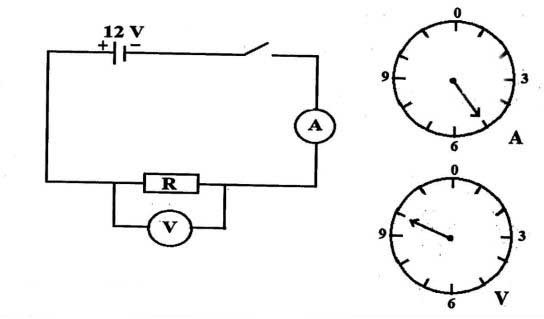
(i) Name the measuring instrument that is in:
α) parallel;
β) series;
With the resistor R
(ii) What quantity does each of the named instruments in (i) measure?
(iii) Read and record the values as indicated on:
α) A in amperes;
β) V in volts.
(iv) Use the values read in (iii) to calculate the value of R.
(v) State one precaution to be taken in performing this experiment.
(c) The diagrams below are illustrations of soil. Study the illustrations carefully and answer the questions that follow.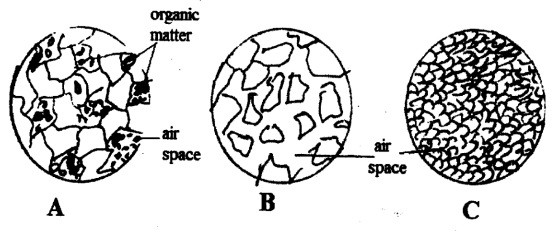
(i) Identify each of the soil types labelled A, B, and C
(ii) Describe each of the soils under the following properties:
α) Particle size
β) Air space
(iii) State two ways of improving soil type B for vegetable cultivation.
(d) The diagrams below is a set-up for preparation of common salt in the laboratory. Study the diagrams carefully and answer the questions that follow.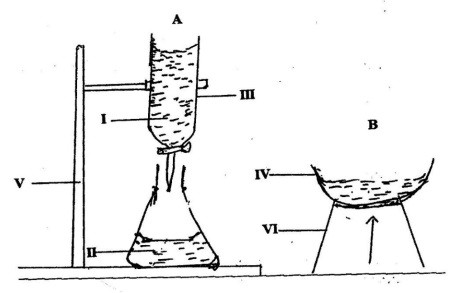
(i) Name each of the parts labelled IV, V, and VI.
(ii) Name two possible solutions that can react to produce salt.
(iii) Name the process that takes place when the two solutions named in (ii) react.
(iv) Name the process that takes place in set-up B.
(v) Write a balanced chemical equation for the reaction between the two solutions named in (ii). - (a) (i) State what happens when photosynthesis occurs in a leaf.
(ii) What is pollination?
(b) Explain briefly why the mass of lumpy charcoal remains unchanged when ground into powder but the mass of the same lump changes when heated to burn.
(c) (i) What is a physical quantity?
(ii) State two physical quantities.
(d) (i) State two importance each of:
(i) light;
(ii) temperature;
In crop production. - (a) (i) What is hardness of water?
(ii) Give an example of a natural source of water that is:
α) hard water;
β) soft water.
(b) What is the end-product of the digestion of each of the following?
(i) Meat;
(ii) Cassava;
(iii) Palm-oil.
(c) Give one effect of each of the following factors considered in vegetable crop production:
(i) soil type;
(ii) nearness to market;
(iii) nearness to source of water.
(d) (i) Explain briefly why an eclipse occurs.
(ii) Name the two types of eclipse. - (a) (i) Explain the term convection as applied to heat transfer.
(ii) Give two reasons why convection does not occur in solids.
(b) Give two effects of each of the following soil physical properties on maize cultivation:
(i) texture;
(ii) water holding capacity.
(c) Use any three of the following organisms to construct a food chain: Hawk, grasshopper, man, grass, toad, grasscutter.
(d) (i) Consider the following elements and state which elements are metals: 11Na, 7N, 6C, 3Li
(ii) Explain briefly what is observed when pieces of each of the following metals are dropped into separate test tubes containing dilute hydrochloric acid:
α magnesium;
β silver. - (a) State two important components each of soils that helps:
(i) Crops to grow well;
(ii) To maintain good soil structure.
(b) (i) Explain how energy in a windmill is obtained.
(ii) State one source of renewable energy.
(c) (i) Explain why steel is preferred to iron in building construction.
(ii) State two ways of preventing rusting.
(d) State three ways of preventing indigestion. - (a) State three ways by which the atmosphere in an industrial area is polluted.
(b) (i) Write the word equation for each of the following reactions between:
α) calcium and oxygen;
β) nitrogen and hydrogen.
(ii) State the hazard that could be prevented when each of the following protective materials are used in the laboratory:
α) gas mask;
β) goggles.
(c) If a cuboid of weight 100 N, has sides 5 cm by 10 cm, calculate the:
(i) Area of the cuboid;
(ii) Pressure exerted by the cuboid when it lies on its side.
(d) (i) Explain the term mixed farming.
(ii) State two advantages of mixed farming.
Worked solutions to the theory questions are free in the app.
More BECE Integrated Science papers
All 38 Integrated Science papers
 All answers free on Google Play