 BECE Past Questions
BECE 2019 Integrated Science Past Questions and Answers
40 objective questions and 6 theory questions from the 2019 BECE Integrated Science paper. Answers and worked solutions for questions 1 to 10 are below; the rest are free in the app.
Practise this paper free, online or offline


On an iPhone? Download on the App Store
On Android? Get it on Google Play
Paper 1: Objectives
-
Steel is an alloy of iron and
- A. aluminium
- B. carbon
- C. silicon
- D. gold
Answer: B -
An atom that has lost one or more electron(s) is called
- A. a molecule
- B. a proton
- C. an ion
- D. a negative particle
Answer: C -
In all machines, the efficiency is
- A. always 100%
- B. less than 100%
- C. more than 100%
- D. always 0%
Answer: B -
In electronic circuits, LEDs are used to indicate the absence or presence of
- A. voltage source
- B. electric current
- C. p-n junction
- D. emitter and collector
Answer: B -
Which of the following statements about the scientific method is/are correct? It provides
I. logical procedure for arriving at knowledge.
II. knowledge that can be verified.
III. knowledge that can never be changed.- A. I only
- B. I and II only
- C. I and III only
- D. II and III only
Answer: B -
Which of the following substances is a compound?
- A. Hydrogen
- B. Nitrogen
- C. Oxygen
- D. Water
Answer: D -
Which of the following source(s) of energy is/are renewable?
I. Solar
II. Crude oil
III. Wind- A. I only
- B. I and II only
- C. I and III only
- D. I, II and III
Answer: C -
The pressure in fluids
- A. increases with depth
- B. decreases with depth
- C. acts upwards at any point
- D. acts differently in all directions
Answer: A -
Which of the following chemical equations is balanced?
- A. N2+H2→NH3
- B. N2+3H2→NH3
- C. N2+H2→2NH3
- D. N2+3H2→2NH3
Answer: D -
Lime juice tastes sour because it is
- A. acidic
- B. alkaline
- C. basic
- D. salty
Answer: A
Answers and solutions for questions 11 to 40 are free in the BECE Past Questions app, with timed practice and offline study.
-
A metal block has a mass of 1.0kg. What is the volume of the block if its density is 10kg/m³?
- A. 0.01m³
- B. 0.10m³
- C. 1.00m³
- D. 10.00m³
-
It is easier to move a heavy load with a crowbar when the
- A. effort distance is shorter than the load distance
- B. effort distance is longer than the load distance
- C. effort distance is equal to the load distance
- D. effort is equal to the load
-
Benedict's solution was added to a mixture in a test tube and it turned brick red when heated. The mixture is likely to contain
- A. glucose
- B. vitamin
- C. protein
- D. oil
-
Chlorine gas is an example of
- A. an atom
- B. an element
- C. a compound
- D. a molecule
-
Which of the following statements about a force are correct? It
I. is measured in newtons.
II. is measured in newton-metre.
III. can start a motion.
IV. can change the direction of a moving body.- A. I and II only
- B. I and III only
- C. I, III and IV only
- D. I, II, III and IV
-
Kerosine is able to reach the other end of a wick by
- A. diffusion
- B. suction pressure
- C. capillary action
- D. osmosis
-
Which of the following chemical compounds is used in removing hardness in water?
- A. NaCl
- B. Na2CO3
- C. NaOH
- D. NaHCO3
-
Which of the following processes is used to separate insoluble solids from liquids?
- A. Sublimation
- B. Filtration
- C. Evaporation
- D. Crystallization
-
When a thermometer is put in hot water, the mercury level rises because the mercury increases in
- A. density
- B. mass
- C. volume
- D. weight
-
The work done when a force moves a body through a distance of 12m is 720J. The force applied is
- A. 8640N
- B. 732N
- C. 708N
- D. 60N
-
Which of the following compounds is neutral to litmus paper?
- A. HCL
- B. H2O
- C. NaOH
- D. KOH
-
A balanced diet is one which is made up of
- A. right proportions of protein, carbohydrates and oils.
- B. equal amounts of protein, carbohydrates and oil.
- C. enough water and iodated salt.
- D. vegetables, fruits and water.
-
The ovules in a flower develop to form the
- A. fruit.
- B. leaf.
- C. seed.
- D. stem.
-
Water drains faster through sand than clay because
- A. sand particles are rougher.
- B. sand contains more air space.
- C. clay particles are smoother.
- D. clay particles are bigger.
-
The best method for checking erosion on a slope is
- A. cover cropping.
- B. mixed cropping.
- C. contour ploughing.
- D. mulching.
-
The housefly is an agent for the spread of
- A. cholera.
- B. malaria.
- C. measles.
- D. tuberculosis.
-
Which of the following substances are carried by the blood?
I. Nutrients
II. Urine
III. Oxygen
IV. Carbon dioxide- A. II and III only
- B. I, II and IV only
- C. I and III only
- D. I, III and IV only
-
Which of the following statements about a plant cell is correct? It
- A. does not have a nucleus.
- B. contains large vacuoles.
- C. is surrounded by the cell membrane only.
- D. does not have a definite shape.
-
The study of the soil profile of an area helps the farmer to
- A. control weed growth.
- B. determine the soil temperature.
- C. determine the types of crops to grow.
- D. know the pesticides to use.
-
The term leaching in soils refers to
- A. accumulation of organic matter.
- B. decomposition of plant materials.
- C. fixation of nitrogen.
- D. removal of soil nutrients by water.
-
How many stages does the mosquito go through in its life cycle of development?
- A. 1
- B. 2
- C. 3
- D. 4
-
Which of the following enzymes helps in digestion of protein in the human stomach?
I. Proteases
II. Amylase
III. Lipases- A. I only
- B. II only
- C. I and II only
- D. II and III only
-
Kidneys absorb water from the blood stream of humans through the processes of
- A. diffusion.
- B. egestion.
- C. osmosis.
- D. assimilation.
-
An example of soil micro-nutrients is
- A. copper.
- B. calcium.
- C. phosphorus.
- D. potassium.
-
The vegetable crop that requires staking during its growth is
- A. sweet pepper.
- B. garden eggs.
- C. tomatoes.
- D. hot pepper.
-
The function of the white blood cells in humans is to
- A. produce haemoglobin.
- B. produce digestive enzymes.
- C. ensure blood clot during an injury.
- D. produce antibodies to fight disease-causing organisms.
-
The carpel of a flower is made up of the following parts except
- A. filament.
- B. ovary.
- C. style.
- D. stigma.
-
A food web shows how
- A. food produced by plants is distributed to other parts of the plant.
- B. an organism protects itself in its environment.
- C. organisms depend on one another for shelter.
- D. food produced by green plants is distributed among organisms in a community.
-
Balanced ration enables animals to
- A. increase fertility rate.
- B. maintain normal growth.
- C. increase meat production.
- D. maintain energy level of work animals.
-
Cultural practices are activities undertaken on a farm
- A. after harvesting and before processing.
- B. before maturity and after harvesting.
- C. after planting and before harvesting.
- D. before transplanting seedling.
Paper 2: Theory
- (a)
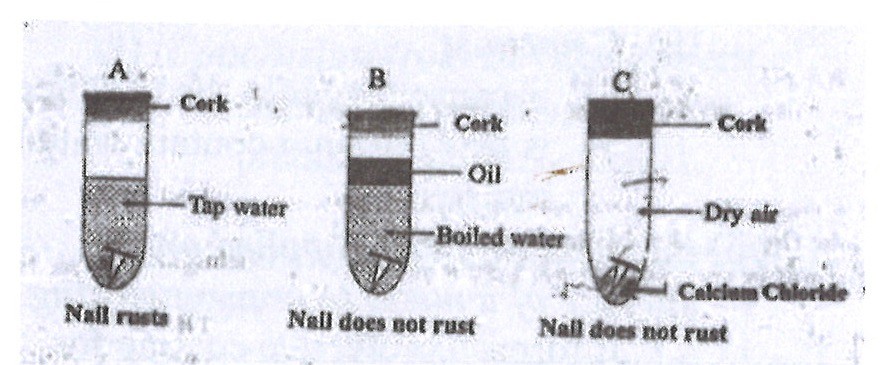
In an experiment the surfaces of three iron nails were cleaned dry and placed in three separate test tubes A, B and C as shown in the diagram above. After three days the nail in test tube A was found to have rusted while the nail in test tubes B and C did not rust.
(i) Suggest an aim for the experiment.
(ii) Why was the water in test tube B boiled?
(iii) State the function of the oil on top of the water in test tube B.
(iv) What is the purpose of the calcium chloride in test tube C?
(v) Why did the nail in test tube A rust?
(vi) Why did the nail in test tube:
α) B not rust?
β) C not rust?
(vii) From the experiment, explain why oil is applied on the surface of a metal to prevent rusting.
(b) In an experiment, the following activities were carried out on two green leaves A and B. Leaf A was taken from a plant placed in the sunlight for some time while leaf B was taken from a plant placed in a dark cupboard for 24 hours.
Activity
I. Leaves dipped in boiling water for 1 minute
II. Leaves dipped in warm alcohol
III. Leaves washed in cold water
IV. Leaves dipped in iodine solution
After dipping in the iodine solution, it was observed that leaf A changed colour. Study the activities carefully and answer the questions that follow.
(i) Suggest an aim for the experiment.
(ii) Explain briefly why each of the following activities were carried out:
α) I;
β) II;
γ) III.
(iii) State the colour change of leaf A.
(iv) Explain why leaf A changed colour.
(v) Why is it necessary to de-starch the plant before starting the experiment?
(vi) From the above experiment, what conclusion(s) can be drawn.
(c) You are provided with two dry soil samples A and B, a measuring cylinder, beakers, funnels, filter paper, beam balance, stopwatch, and water. Describe an experiment to find out which soil sample can hold more water.
(d) The diagram below illustrates an experiment where three pins 1, 2, and 3 were fixed with candle wax onto a metal bar, and one end was heated by boiling water. A, B, and C are thermometers along the bar.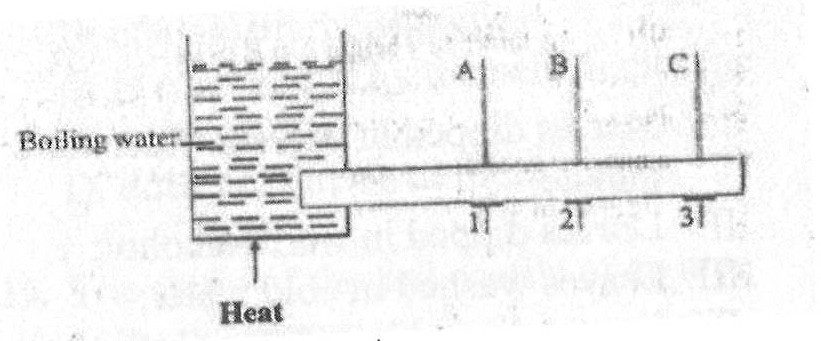
(i) Suggest an aim for the experiment.
(ii) What is the temperature of the boiling water?
(iii) State the observation that would be made about the pins 1, 2, and 3.
(iv) State the observation that would be made about the temperatures recorded by thermometers A, B, and C.
(v) State how heat from the sun is transmitted to the earth. - (a) (i) What is a food chain?
(ii) Why is the plant in any food chain referred to as a producer?
(iii) What is the term given to organisms that depend on the producer for food?
(b) The diagram illustrates shadows cast by an opaque object in the path of a light source.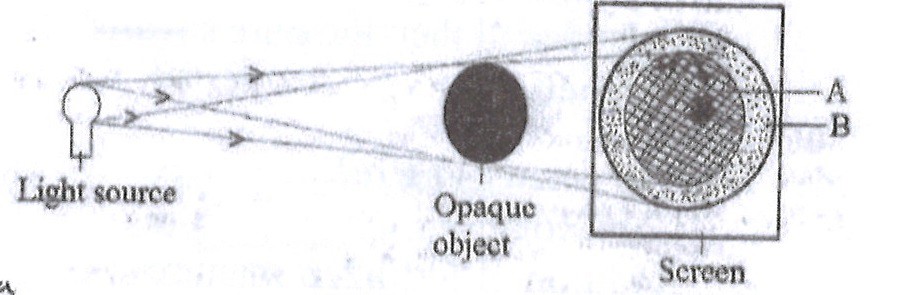
(i) Name each shadow:
α) A;
β) B.
(ii) What does the shadow illustrate?
(c) Describe briefly how a sample of pure sugar could be obtained from a mixture of sugar and sand.
(d) State three ways by which soil can be conserved. - (a) A body of mass 100kg is raised 2m above ground.
(i) Name the energy possessed by the object.
(ii) Calculate the energy value.
(b) (i) What is matter?
(ii) State two states of matter.
(c) (i) Describe loamy soil.
(ii) Name two plant nutrients.
(d) (i) State the causative organism for each disease:
α) cholera;
β) tuberculosis.
(ii) State one method of prevention for cholera. - (a) Why might a tomato plant wilt if too much fertilizer is applied?
(b) State dangers in the lab:
(i) Eating/drinking;
(ii) Walking barefoot;
(iii) Washing hands in unknown liquid.
(c) A child cannot see at night.
(i) Name the deficiency disease.
(ii) What nutrient is lacking?
(iii) State three food sources for this nutrient.
(d) (i) Define force.
(ii) Why might brakes fail on a slippery road? - (a) Describe how to measure volume of an irregularly shaped lead ball.
(b) State three characteristics of living things.
(c) (i) Define pollution.
(ii) Name one air pollutant.
(d) State three factors influencing vegetable crop production. - (a) State three benefits of crop rotation.
(b) State three properties of an image formed by a plane mirror.
(c) (i) What is photosynthesis?
(ii) Why is a digestive system necessary in humans?
(d) Give systematic names for the following:
α) MgCl2;
β) FeS.
(ii) Define element.
(iii) Name for a solid mixture.
Worked solutions to the theory questions are free in the app.
More BECE Integrated Science papers
All 38 Integrated Science papers
 All answers free on Google Play