 BECE Past Questions
BECE 2018 Integrated Science Past Questions and Answers
40 objective questions and 6 theory questions from the 2018 BECE Integrated Science paper. Answers and worked solutions for questions 1 to 10 are below; the rest are free in the app.
Practise this paper free, online or offline


On an iPhone? Download on the App Store
On Android? Get it on Google Play
Paper 1: Objectives
-
The space occupied by matter is its
- A. area
- B. mass
- C. volume
- D. weight
Answer: C -
Which of the following structures contain cellulose?
- A. Cell wall
- B. Cell membrane
- C. Chloroplast
- D. Mitochondrion
Answer: A -
Which of the following activities are cultural practices used in tomato cultivation?
I. Pest control
II. Picking out
III. Fertilizer application- A. I and II only
- B. I and III only
- C. II and III only
- D. I, II and III
Answer: B -
The farming system that makes effective use of available soil nutrients in a growing season is
- A. crop rotation
- B. land rotation
- C. mixed cropping
- D. mixed farming
Answer: A -
Which of the following members in a food chain will receive the least energy?
- A. Lizard
- B. Grass
- C. Grasshopper
- D. Hawk
Answer: D -
Digestion of fats and oils in humans starts in the
- A. colon
- B. gullet
- C. mouth
- D. duodenum
Answer: D -
What is the chemical symbol for silver?
- A. Ag
- B. Au
- C. Si
- D. S
Answer: A -
The process by which gas changes to liquid is known as
- A. melting
- B. evaporation
- C. condensation
- D. boiling
Answer: C -
Which of the following substances is acidic?
- A. Wood ash
- B. Salt-petre
- C. Bee strings
- D. Bicarbonate of soda
Answer: C -
The basic unit of life is the
- A. cell
- B. nucleus
- C. organ
- D. tissue
Answer: A
Answers and solutions for questions 11 to 40 are free in the BECE Past Questions app, with timed practice and offline study.
-
Useful materials in food that provide growth and repair of worn out tissues are called
- A. carbohydrates
- B. vitamins
- C. proteins
- D. fats
-
In human reproduction, the sperm fertilizes the female egg to form the
- A. zygote
- B. follicle
- C. ovary
- D. ovum
-
A solid X reacted with a liquid Y to form a salt and water only. A portion of liquid Y turned blue litmus paper red. Solid X did not dissolve when a portion of it was placed in water and stirred. Solid X could be said to be
- A. an acid
- B. an alkali
- C. a base
- D. a salt
-
A solid X reacted with a liquid Y to form a salt and water only. A portion of liquid Y turned blue litmus paper red. Solid X did not dissolve when a portion of it was placed in water and stirred. Liquid Y is
- A. an acid
- B. an alkali
- C. a base
- D. a metal
-
A solid X reacted with a liquid Y to form a salt and water only. A portion of liquid Y turned blue litmus paper red. Solid X did not dissolve when a portion of it was placed in water and stirred. If red litmus paper is placed in liquid Y, the colour of the paper will
- A. remain the same
- B. change to blue
- C. change to purple
- D. become brighter
-
The type of soil which becomes water-logged after rainfall is made up of a large amount of
- A. silt
- B. sand
- C. gravel
- D. clay
-
Ringworm is a disease which attacks the
- A. skin
- B. lungs
- C. liver
- D. kidneys
-
The most appropriate method to adopt when growing vegetables in the dry season is
- A. watering
- B. transplanting
- C. pest control
- D. fertilizer application
-
Which of the following organisms improves soil fertility?
- A. Caterpillar
- B. Millipede
- C. Nematode
- D. Rat
-
The introduction of natural enemies to control pests on a field is a
- A. physical control method
- B. cultural control method
- C. chemical control method
- D. biological control method
-
A body has a density of 30gcm-3 and a volume of 6cm3. Determine the mass of the body.
- A. 180.0g
- B. 24.0g
- C. 5.0g
- D. 0.2g
-
The force which tends to pull an object in a circular motion towards the centre of the circle is called
- A. Centripetal force
- B. Electrostatic force
- C. Gravitational force
- D. Magnetic force
-
The swollen shoot disease of cocoa is caused by
- A. Fungus
- B. Virus
- C. Bacteria
- D. Protozoa
-
The instrument used to measure atmospheric pressure is called
- A. Thermometer
- B. Force meter
- C. Barometer
- D. Anemometer
-
The systematic name of NO2 is
- A. Nitrogen oxide
- B. Nitrogen (I) oxide
- C. Nitrogen (II) oxide
- D. Nitrogen (IV) oxide
-
Which of the following simple machines is a second-class lever?
- A. Bottle top opener
- B. Claw hammer
- C. Fishing rod
- D. Pair of pliers
-
A cylinder metal has a radius of 7cm and a height of 2cm. Determine the volume of the cylinder. [Take π = 3.143]
- A. 44cm3
- B. 107cm3
- C. 308cm3
- D. 1078cm3
-
Which of the following statements are true of compounds?
I. They are homogenous
II. Their constituents are present in fixed ratio by mass
III. Their constituents keep their individual properties- A. I and II only
- B. I and III only
- C. II and III only
- D. I, II and III
-
Which of the following factors contribute to early parenthood?
I. Illiteracy
II. Poverty
III. Peer pressure
IV. Lack of parental care- A. I and II only
- B. II and III only
- C. III and IV only
- D. I, II, III and IV
-
Which of the following statements about the negative use of Science and Technology is correct? It
- A. Promotes good health
- B. Promotes easy communication
- C. Enables humans to use less energy in working
- D. Creates things that are dangerous to the environment
-
Which of the following nutrients is needed by plants in small quantities?
- A. Calcium
- B. Iron
- C. Potassium
- D. Magnesium
-
Which of the following statements about shadow formation is correct? It shows that light rays can
- A. Be diffused
- B. Travel in a straight line
- C. Be refracted
- D. Be reflected
-
The colour of the neutral wire in an electrical circuit is
- A. Blue
- B. Brown
- C. Green
- D. Yellow
-
A metal displaces 5.0cm3 of water when it is totally immersed. If the mass of the metal is 35.0g, calculate its density.
- A. 7.0gcm-3
- B. 30.00gcm-3
- C. 40.00gcm-3
- D. 175.00gcm-3
-
Which of the following physical properties of water are correct? Water
I. is a colourless liquid
II. is a universal solvent
III. boils at 100°C at standard atmosphere pressure
IV. has a density of 5kgcm-3 at 4°C- A. I and II only
- B. II and III only
- C. I, II and III only
- D. II, III and IV only
-
The relative proportions of the different particle sizes in a soil sample refer to soil
- A. Temperature
- B. Texture
- C. Structure
- D. Porosity
-
Which of the following chemical equations is balanced?
- A. K + O2 → K2O
- B. Mg + O2 → MgO
- C. Na + Cl2 → NaCl
- D. H2 + Cl2 → 2HCl
-
Heat is transferred along an iron bar by
- A. Absorption
- B. Conduction
- C. Convection
- D. Radiation
-
The second stage in the life cycle of a mosquito is the
- A. Egg
- B. Imago
- C. Larva
- D. Pupa
-
The function of the platelets in the circulatory system of humans is to
- A. Transport oxygen
- B. Transport carbon dioxide
- C. Defend the body
- D. Clot the blood
Paper 2: Theory
- (a) The diagram below is an illustration of a fish.
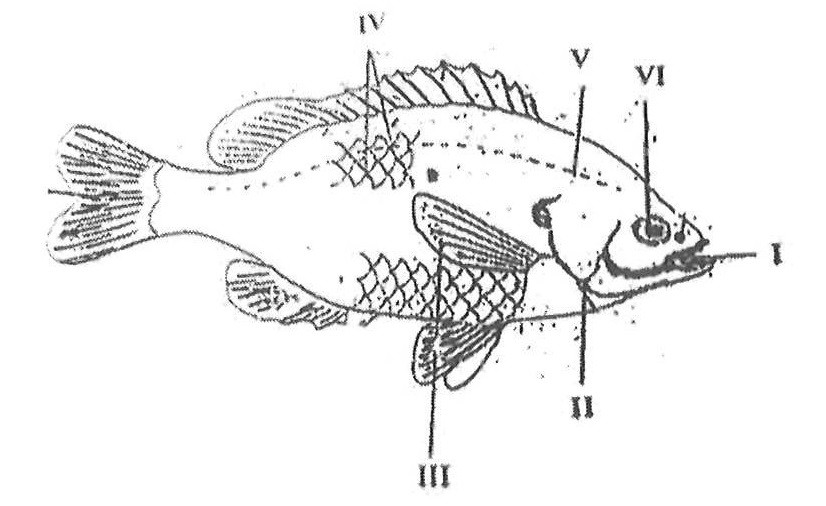
(i) Identify the fish.
(ii) Name each of the parts labeled I, II, III, V.
(iii) Name the habitat of the fish.
(iv) Explain how each of the parts labeled III and VI enables the fish to adapt to its habitat.
(b) The diagram below is an illustration of a section through the soil.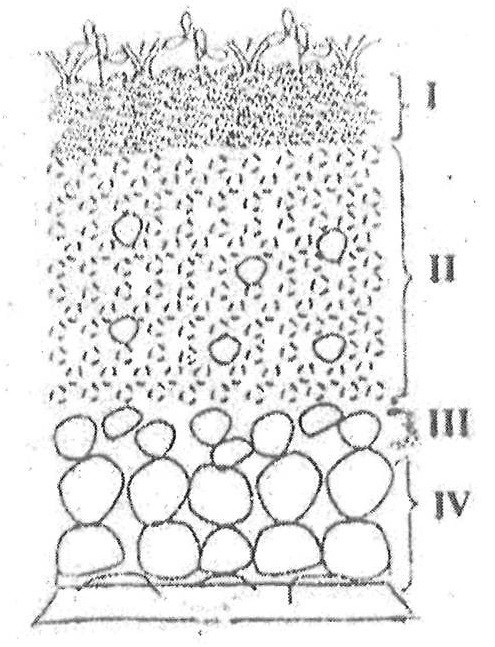
(i) What does the diagram represent?
(ii) Name each of the parts labeled I, II, III, IV.
(iii) Which part of the diagram:
α) is the richest in humus?
β) is the habitat for soil organisms?
γ) undergoes weathering?
(iv) What is the effect of heavy rainfall on the part labeled I?
(c) The diagram below is an illustration of an electrical circuit.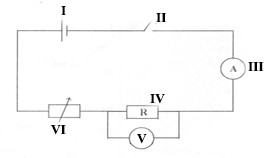
(i) Name each of the parts labeled I, II, IV, VI.
(ii) State the energy transformation that takes place in:
α) I
β) IV
(iii) State the S.I units of the quantity measured by each of the parts labeled:
α) III
β) V
(iv) State the function of the part labeled VI.
(d) In an experiment, equal volumes and equal concentrations of dilute hydrochloric acid and dilute sodium hydroxide solutions were each placed in different test tubes.
(i) Explain briefly how you can identify each of the solutions
α) Hydrochloric acid
β) Sodium hydroxide
(ii) State the type of reaction that occurred when the two solutions were mixed.
(iii) What type of solution was formed when the reaction occurred?
(iv) State what would be observed when both red and blue litmus papers were dipped into the third solution.
(v) Explain how the solid portion of the solution could be obtained. - (a) (i) What is an ion?
(ii) State two methods of softening hard water.
(b) (i) Differentiate between pest and parasite in agriculture.
(ii) Give an example each of a pest and a parasite.
(c) (i) What is work?
(ii) A force of 10N causes a body to move a distance of 5.2m. Calculate the work done.
(d) Name two diseases associated with the circulatory system of humans. - (a) (i) What is malnutrition?
(ii) State one symptom each of scurvy and rickets.
(b) Draw the potassium atom and show the electron distribution [K = 19].
(c) (i) Define potential energy.
(ii) An object of mass 10kg is moving at 2ms-1. Calculate its kinetic energy.
(d) State one example each of macro and micro nutrients. - (a) (i) Define hazard.
(ii) List two safety precautions in science labs.
(b) State three differences between osmosis and diffusion.
(c) (i) What is weather?
(ii) State two differences between weather and season.
(d) (i) Define fertile soil.
(ii) State two factors that cause loss of soil fertility. - (a) (i) Define magnetic field.
(ii) Name two methods of making magnets.
(b) Explain teenage pregnancy.
(c) Write the formula for each compound:
(i) calcium chloride
(ii) copper (I) oxide
(iii) nitrogen (IV) oxide
(iv) ammonia
(d) (i) List three physical properties of soil.
(ii) What is the texture of clayey soil? - (a) (i) What are derived quantities?
(ii) State the S.I units of:
α) area
β) volume
(b) (i) State two factors necessary for photosynthesis.
(ii) Explain the functions of each factor.
(c) Explain:
(i) Soft water
(ii) Hard water
(d) State three reasons why some seeds are nursed.
Worked solutions to the theory questions are free in the app.
More BECE Integrated Science papers
All 38 Integrated Science papers
 All answers free on Google Play