 BECE Past Questions
BECE 2017 Integrated Science Past Questions and Answers
40 objective questions and 6 theory questions from the 2017 BECE Integrated Science paper. Answers and worked solutions for questions 1 to 10 are below; the rest are free in the app.
Practise this paper free, online or offline


On an iPhone? Download on the App Store
On Android? Get it on Google Play
Paper 1: Objectives
-
The instrument used to measure relative humidity is the
- A. hydrometer
- B. hygrometer
- C. rain gauge
- D. wind vane
Answer: B -
The S.I unit for density is
- A. ms-1
- B. ms-2
- C. kg m-3
- D. m3kg-1
Answer: C -
When light travels from glass to air, its speed is
- A. increased
- B. reduced
- C. halved
- D. unchanged
Answer: A -
When a piece of iron rod is brought near a permanent magnet for a while it becomes magnetised by
- A. stroking method
- B. electrical method
- C. friction
- D. induction
Answer: D -
A rheostat is used in an electric circuit in order to
- A. increase electric current only
- B. decrease electric current only
- C. keep electric current constant
- D. increase and decrease electric current
Answer: D -
Which of the following statements about an opaque object is correct? An opaque object
- A. allows light to pass through it partially
- B. allows light to pass through it fully
- C. forms a shadow
- D. does not form a shadow
Answer: C -
One of the characteristics of a solid is that
- A. its particles are tightly packed
- B. it assumes the shape of the container it occupies
- C. it has no fixed volume
- D. its particle can easily be separated
Answer: A -
The instrument used to measure current in an electric circuit is the
- A. ammeter
- B. photometer
- C. thermometer
- D. voltmeter
Answer: A -
The bottom of a pool of water appears closer to the surface than it is. Which of the following properties accounts for this observation?
- A. Reflection
- B. Transparency water
- C. Refraction
- D. Rectilinear propagation
Answer: C -
An example of a source of energy which is non-renewable is
- A. petroleum
- B. solar
- C. tide
- D. wind
Answer: A
Answers and solutions for questions 11 to 40 are free in the BECE Past Questions app, with timed practice and offline study.
-
Which of the following apparatus is not required in the process of distillation in the laboratory?
- A. Condenser
- B. Evaporating dish
- C. Bunsen burner
- D. Round bottom flask
-
The number of oxygen atoms present in three molecules of carbon dioxide is
- A. 3
- B. 4
- C. 5
- D. 6
-
The chemical formula Cl₂ represents two
- A. atoms of chlorine
- B. neutrons of chlorine
- C. ions of chlorine
- D. molecules of chlorine
-
Which of the following substances can rust?
- A. Aluminium
- B. Bauxite
- C. Copper
- D. Steel
-
Energy stored in food is referred to as
- A. chemical energy
- B. heat energy
- C. solar energy
- D. kinetic energy
-
Which of the following substances is a mixture?
- A. Water
- B. Sodium chloride
- C. Sodium chloride solution
- D. Iron filing
-
The mole is the S.I unit of
- A. amount of substance
- B. luminous intensity
- C. temperature
- D. mass of substance
-
An atom has a proton number of 17 and neutron number 18. Determine the number of electrons in the third shell of the atom.
- A. 1
- B. 3
- C. 5
- D. 7
-
An example of mixtures that can be separated by the method of filtration is
- A. sugar in water
- B. sand in water
- C. oil in water
- D. ink in water
-
Which of the following liquids would turn blue litmus paper red?
- A. Vinegar
- B. Ammonia solution
- C. Water
- D. Kerosene
-
Which of the following particles constitute matter?
I. Atoms
II. Molecules
III. Ions- A. I only
- B. II only
- C. II and III only
- D. I, II and III
-
An example of inheritable characteristics in humans is
- A. Shape of nose
- B. Knowledge
- C. Ability to speak different languages
- D. Handwriting
-
Which of the following statements about aerobic respiration is correct?
- A. The by-products are carbon dioxide and water
- B. Little amount of energy is produced
- C. Oxygen is not required
- D. The by-products are alcohol and carbon dioxide
-
Sperms produced by the testes in humans are temporarily stored in the
- A. Epididymis
- B. Prostate gland
- C. Seminal vesicles
- D. Sperm duct
-
Which of the following changes normally occur during old age in humans?
- A. Grey hair starts appearing
- B. Mental alertness increases
- C. Broadening of the chest
- D. Attraction to the opposite sex
-
One of the characteristics of wind pollinated flowers is that they
- A. Are large and conspicuous
- B. Are usually scented
- C. Have nectar
- D. Have feathery stigma
-
The testes are normally located outside the body of the male because
- A. The temperature of the body is too high for effective sperm production
- B. They cannot increase in size when in the body
- C. They can absorb moisture from the atmosphere
- D. They occupy too much space
-
The organelle which occupies the largest portion of a plant cell is the
- A. Chloroplast
- B. Mitochondrion
- C. Nucleus
- D. Vacuole
-
Movements of the ribs is brought about by the
- A. Pleural cavity
- B. Intercostal muscle
- C. Larynx
- D. Trachea
-
Fertilisation in humans usually occurs in the
- A. Ovary
- B. Uterus
- C. Vagina
- D. Fallopian tube
-
Which of the following processes is an example of osmosis?
- A. Spreading of perfume in a room
- B. Absorption of food nutrients into the small intestines
- C. Spreading of potassium permanganate in water
- D. Absorption of water into the root hairs
-
The part of a living cell which is semi-permeable is the
- A. Cytoplasm
- B. Nucleus
- C. Protoplasm
- D. Cell membrane
-
Which of the following statements about soil profile is/are correct? It helps the farmer to determine
I. soil fertility
II. water-holding capacity of the soil
III. depth of the soil- A. I only
- B. I and II only
- C. II and III only
- D. I, II and III
-
Which of the following practices is not a principle of crop rotation?
- A. Legumes should be added to the rotation programme
- B. Deep rooted crops should be followed by shallow rooted crops
- C. Crops that are closely related should follow each other
- D. Fallow period should be allowed during the time of rotation
-
The relative proportion of sand, silt and clay in a given sample of soil is soil
- A. Profile
- B. Porosity
- C. Structure
- D. Texture
-
The first factor to be considered when deciding to cultivate a particular vegetable is
- A. Cultural practice
- B. Selection of land
- C. Harvesting
- D. Method of propagation
-
Which of the following should be considered when selecting a site for vegetable crop production?
I. Nearness to the market
II. Topography of the land
III. Nearness to the sea- A. I and II only
- B. I and III only
- C. II and III only
- D. I, II and III
-
Which of the following activities are cultural practices in the cultivation of cabbage?
I. Pruning
II. Weeding
III. Watering- A. I and II only
- B. I and III only
- C. II and III only
- D. I, II and III
-
An example of a vegetable crop is
- A. Cocoa
- B. Cotton
- C. Potato
- D. Tomato
-
The majority charge carriers in a p-type semiconductor are
- A. Electrons
- B. Holes
- C. Neutrons
- D. Protons
Paper 2: Theory
- (a) The diagram below is an illustration of a longitudinal section of a canine tooth in humans.
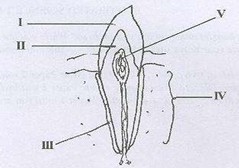
(i) Name each of the parts labelled I, II, III and IV.
(ii) What is the function of each of the parts labelled I and III?
(iii) Which of the labelled parts could be affected by tooth decay?
(iv) State three ways by which tooth decay may be prevented.
(b) The diagram below is an illustration of a scientific phenomenon which occurs in nature.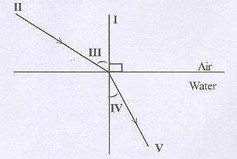
(i) What phenomenon does the diagram illustrate?
(ii) Identify each of the parts labelled I, II, III, IV and V.
(iii) Explain why an object at the bottom of a pond appears closer to the surface than it actually is.
(c) The diagram below is an illustration of an experiment performed to separate the components of muddy water.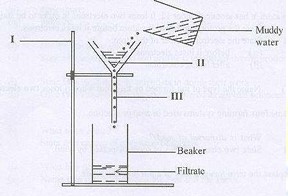
(i) Name each of the parts labelled I, II and III.
(ii) State the function of the part labelled II.
(iii) Name the substance obtained as the filtrate.
(iv) State three physical properties of the filtrate.
(v) Name two other materials that could be used in place of the part labelled II.
(d) The diagram below illustrates a farmland on a slope.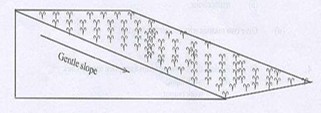
(i) What process is likely to occur on the farmland when it rains heavily?
(ii) State two farming practices that can lead to the process in (i).
(iii) List four farming practices that could control the process in (i).
(iv) Mention three soil resources that would be depleted from the farmland when it rains heavily. - (a) An atom Y has atomic number 12. It loses two electrons to become stable.
(i) State the proton number before it loses electrons.
(ii) State the electron number of the atom:
α) before it loses electrons.
β) after losing electrons.
(iii) Name the type of ion formed when the atom loses two electrons.
(b) Name four farming systems in crop production.
(c) (i) What is dispersal of seed?
(ii) State two characteristics of seeds dispersed by wind.
(d) Explain the term 'forward bias' of a p-n junction diode. - (a) (i) What is an acid?
(ii) Give two differences between an acid and a base, in terms of taste and feel.
(b) (i) Define pressure.
(ii) A force of 200N is exerted on an area of 50 m². Calculate the pressure exerted by the force.
(c) Explain the following terms as associated with living organisms:
(i) unicellular;
(ii) multicellular.
(d) Give two reasons why soil air is important. - (a) (i) Explain the terms as applied to machines:
α) work input;
β) work output.
(ii) State one factor that limits work output for a given work input.
(b) (i) What is chloroplast?
(ii) Differentiate between aerobic and anaerobic respiration.
(c) State the color change when blue litmus paper is dipped in:
(i) vinegar;
(ii) wood ash.
(d) List two benefits of vegetables to humans. - (a) (i) Differentiate between egestion and digestion.
(ii) What are the end-products of digestion?
(b) Give an example of a chemical compound used in:
(i) medicine;
(ii) agriculture;
(iii) industry.
(c) (i) Define soil profile.
(ii) State two ways soil profile is important in crop production.
(d) (i) State two steps scientists use in their work.
(ii) Give two subjects considered as applied sciences. - (a) (i) What is an alloy?
(ii) State two causes of corrosion.
(b) (i) What is a planet?
(ii) Name two planets between the Sun and Earth.
(c) State four functions of the circulatory system in humans.
(d) (i) Define crop rotation.
(ii) Give one example of a chemical pest control method in crop farming.
Worked solutions to the theory questions are free in the app.
More BECE Integrated Science papers
All 38 Integrated Science papers
 All answers free on Google Play