 BECE Past Questions
BECE 1996 Social Studies Past Questions and Answers
40 objective questions and 6 theory questions from the 1996 BECE Social Studies paper. Answers and worked solutions for questions 1 to 10 are below; the rest are free in the app.
Practise this paper free, online or offline


On an iPhone? Download on the App Store
On Android? Get it on Google Play
Paper 1: Objectives
-
In which of the following belts in Ghana is cocoa commonly grown?
- A. Mangrove forest
- B. Tropical rainforest
- C. Sudan savanna
- D. Guinea savanna
- E. Semi-deciduous forest
Answer: E -
Which of the following places of interest attracts most tourists to Ghana?
- A. Kotoka International Airport
- B. Tema Harbour
- C. Kakum National Park
- D. Takoradi Harbour
- E. Accra Sports Stadium
Answer: C -
In the matrilineal system of inheritance, children inherit the property of their
- A. father's mother
- B. mother's brother
- C. own mother
- D. mother's father
- E. own father
Answer: B -
Which of the following is not a man-made feature?
- A. Bridge
- B. Settlement
- C. Farm
- D. Road
- E. River
Answer: E -
The time in Ghana is different from the time in Nigeria because of differences in
- A. geological size
- B. longitudinal position
- C. population size
- D. climate condition
- E. latitudinal position
Answer: B -
Some rivers meander in their lower course because
- A. the land there is almost flat
- B. the land there is very steep
- C. the river erodes vertically at that stage
- D. deposition is very low at this stage
- E. the land there is strongly undulating
Answer: A -
Aburi is normally cooler than Nsawam because
- A. Nsawam is nearer the coast
- B. Nsawam is in the Savanna zone
- C. Nsawam is an industrial town
- D. Aburi is on a highland
- E. Aburi is in the forest belt
Answer: D -
The main reason for encouraging farmers in Ghana to produce more cocoa is to
- A. promote the manufacture of more cocoa products
- B. generate more foreign exchange
- C. make the farmer happy
- D. set up more factories
- E. help determine the best farmer
Answer: B -
In Ghana, Odwira festival usually serves all the following purposes except
- A. providing entertainment
- B. community development planning
- C. pouring libation to the ancestors
- D. purification of the ancestral stools
- E. outdooring of new-born babies
Answer: E -
The main purpose of the Economic Community of West African States (ECOWAS) is to
- A. achieve political freedom
- B. achieve political unity
- C. expand the size of West Africa
- D. achieve free movement of peoples, goods and services
- E. reduce migration problems
Answer: D
Answers and solutions for questions 11 to 40 are free in the BECE Past Questions app, with timed practice and offline study.
-
The League of Nations was formed soon after the
- A. Middle West War
- B. First World War
- C. Second World War
- D. Falkland War
-
How many seats were in the Legislative Assembly when Ghana became independent?
- A. 204
- B. 200
- C. 120
- D. 104
- E. 100
-
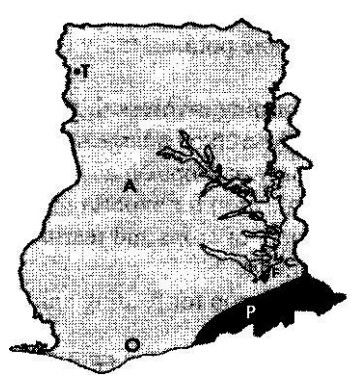
The administrative region marked A on the sketch map is- A. Central Region
- B. Ashanti Region
- C. Western Region
- D. Northern Region
- E. Brong Ahafo Region
-
The river marked R on the sketch map is- A. Afram
- B. Oti
- C. Ankobra
- D. Pra
- E. Densu
-
The town marked T on the sketch map is- A. Tamale
- B. Bawku
- C. Sunyani
- D. Wa
- E. Axim
-
What feature is marked F on the map?- A. Rubber plantation
- B. Dam
- C. Airport
- D. Railway Station
- E. Quarry
-
The people who live in the area shaded P on the map are- A. Ewes
- B. Akans
- C. Ga-Adangmes
- D. Mamprusis
- E. Sissalas
-
The town marked O on the map is a/an- A. mining town
- B. harbour town
- C. historic town
- D. gap town
- E. industrial town
-
The town lettered C is a/an- A. district capital
- B. national capital
- C. regional capital
- D. rail terminus
- E. industrial centre
-
One of the works of a Member of Parliament (MP) is to
- A. make laws
- B. judge criminals
- C. arrest criminals
- D. conduct state elections
- E. administer laws
-
Which of the following is a land-locked country in West Africa?
- A. Burkina Faso
- B. Ghana
- C. Nigeria
- D. Sierra Leone
- E. Liberia
-
Power in a democratic state is exercised by the
- A. majority
- B. judiciary
- C. military
- D. monarch
- E. parliament
-
Which of the following is produced on a large scale in the Middle East?
- A. Gold
- B. Diamond
- C. Coal
- D. Petroleum
- E. Iron
-
The Panama Canal links the Pacific Ocean to the
- A. Indian Ocean
- B. North Atlantic Ocean
- C. Arctic Ocean
- D. South Atlantic Ocean
- E. Antarctic Ocean
-
Which governor ruled the country between 1919 and 1927?
- A. Commander Hill
- B. Sir Gordon Guggisberg
- C. Sir Alan Burns
- D. Lord Luggard
- E. Sir Charles Maclean
-
The Mamprusi are believed to have come from
- A. Northern Mali
- B. Western Nigeria
- C. Southern Ghana
- D. The east of Lake Chad
- E. The south of Lake Victoria
-
The Poll Tax Ordinance was passed in
- A. 1820
- B. 1825
- C. 1852
- D. 1874
- E. 1896
-
Which of the following cannot be considered as an economic activity?
- A. Farming
- B. Manufacturing
- C. Teaching
- D. Learning
- E. Driving
-
The system of trade in which goods are directly exchanged for goods is known as
- A. monetary economy
- B. exchange economy
- C. barter economy
- D. primitive economy
- E. socialist economy
-
Which of the minerals is not mined in Ghana?
- A. Gold
- B. Bauxite
- C. Tin
- D. Manganese
- E. Diamond
-
Trade between two countries is called
- A. barter trade
- B. surplus trade
- C. domestic trade
- D. multilateral trade
- E. bilateral trade
-
The only West African country which produces more cocoa than Ghana is
- A. Togo
- B. Cote d'Ivoire
- C. Benin
- D. Sierra Leone
- E. Liberia
-
The main objective of the Economic Community of West African States (ECOWAS) is to
- A. promote political freedom
- B. reduce political conflicts
- C. promote economic integration
- D. increase industrialization in West Africa
- E. promote political unity in West Africa
-
Mixed farming involves the growing of a
- A. single crop on a large scale
- B. variety of crops on a large scale
- C. single crop for export only
- D. variety of crops and rearing of animals
- E. single crop for feeding animals
-
The person who led the Gonjas to settle at their present home in Northern Ghana was
- A. Ndewura Jakpa
- B. Naa Dariziogo
- C. Naa Sitobu
- D. Naa Zirile
- E. Tohazie
-
The United Nations Organization has all the following as its aims except to
- A. maintain international peace and security
- B. promote friendliness among nations
- C. remove all unpopular Heads of States of member countries
- D. promote international economic development
- E. promote respect for human rights
-
All the following are metallic minerals except
- A. bauxite
- B. copper
- C. gold
- D. diamond
- E. manganese
-
There is a large population of white settlers in the highland areas of East Africa because
- A. of the beautiful natural vegetation
- B. it is safe to travel along the steep slopes
- C. of sufficient sunshine and warmth
- D. of the availability of rainfall
- E. of the cool and healthy atmosphere
-
The struggle for Ghana's independence from 1951 to 1957 was led by
- A. Dr J. B. Danquah
- B. Mr Ako Adjei
- C. Dr K. A. Busia
- D. Dr Kwame Nkrumah
- E. Mr K. A. Gbedemah
-
Most of the lakes in East Africa were formed as a result of the
- A. rift valley system
- B. fold mountain system
- C. action of volcanoes
- D. action of tropical wind
- E. action of waves
Paper 2: Theory
- Use the data below to answer the questions that follow
Months Jan Feb Mar Apr May Jun Jul Aug Sep Oct Nov Dec Temperature (°C) 25 27 27 27 26 26 24 23 24 26 26 26 Rainfall (mm) 43 53 137 145 183 234 127 74 178 201 99 30
a) Calculate the mean monthly temperature for the first half of the year
b) What is the annual temperature range?
c) Find the total annual rainfall
d) Describe the pattern of rainfall distribution. - With the aid of contours, describe the following types of slope:
a) Gentle slope
b) Steep slope
c) Concave slope
d) Convex slope - Explain the importance of rivers in Ghana.
- a) Describe three duties of a citizen of Ghana.
b) Explain any two rights of a citizen of Ghana. - a) State four conditions necessary for economic growth and high productivity.
b) Give three reasons why Ghana's economy is not growing. - a) State any four aims of the United Nations Organization (U.N.O).
b) Explain two problems facing the United Nations Organization (U.N.O).
Worked solutions to the theory questions are free in the app.
 All answers free on Google Play