 BECE Past Questions
BECE 1997 Social Studies Past Questions and Answers
40 objective questions and 6 theory questions from the 1997 BECE Social Studies paper. Answers and worked solutions for questions 1 to 10 are below; the rest are free in the app.
Practise this paper free, online or offline


On an iPhone? Download on the App Store
On Android? Get it on Google Play
Paper 1: Objectives
-
Our environment is made up of
- A. plants and animals
- B. roads and rivers
- C. natural and man-made things
- D. vegetation and climate
- E. only non-living things
Answer: C -
Protection of the environment in Ghana must be the responsibility of
- A. the government
- B. the Environmental Protection Agency
- C. all people within the community
- D. the Forestry Department
- E. the Department of Game and Wildlife
Answer: C -
The first Ghanaian member of the legislative council was
- A. James Kwegyir Aggrey
- B. George Kuntu Blankson
- C. John Sey
- D. Nana Sir Ofori Atta I
- E. King Aggrey
Answer: B -
The main duty of the police in a community is to
- A. arrest criminals
- B. terrorize little children
- C. direct traffic
- D. settle disputes
- E. keep law and order
Answer: E -
A model of the earth is called
- A. a globe
- B. an atlas
- C. a map
- D. a longitude
- E. an equator
Answer: A -
Latitude normally marked zero on maps is called the
- A. Capricorn
- B. Cancer
- C. Equator
- D. Hemisphere
- E. Meridian
Answer: C -
Latitudes and longitudes are used to
- A. decorate maps
- B. locate objects on maps
- C. show the direction of streams flow
- D. show heights of mountains on maps
- E. show pressure distribution on maps
Answer: B -
A teacher explained to his class that Kete Krachi is sited at the meeting place of two rivers. Kete Krachi can therefore be described as
- A. group town
- B. delta town
- C. ridge settlement
- D. riverine settlement
- E. confluence town
Answer: E -
An escarpment has
- A. gentle slope on all sides
- B. a round top and steep sides
- C. a steep slope on one side and a gentle slope on the other
- D. steep slope on all sides
- E. gentle slope on all sides and a broad flat top
Answer: C -
Latitude 66.5° South is also known as
- A. Antarctic Circle
- B. Arctic Circle
- C. Greenwich Meridian
- D. Prime Meridian
- E. Great Circle
Answer: A
Answers and solutions for questions 11 to 40 are free in the BECE Past Questions app, with timed practice and offline study.
-
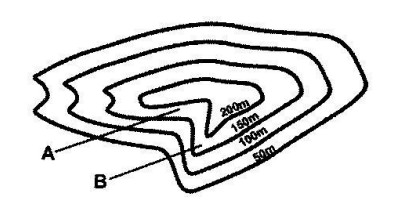
The feature marked A in the diagram above is a- A. valley
- B. spur
- C. ridge
- D. elbow
- E. gap
-
The feature marked B in the diagram can best be described as a- A. spur
- B. ridge
- C. plateau
- D. mountain
- E. elbow
-
The diagram represents a- A. mountain
- B. ridge
- C. plateau
- D. plain
- E. valley
-
The South-Western corner of Ghana has rains throughout the year because it is mostly influenced by the
- A. North-East Trade Winds
- B. Overhead Sun
- C. Easterly Winds
- D. South-West Monsoon
- E. Inter-tropical Convergence Zone
-
Which of the following vegetation types cannot be found in Ghana?
- A. Mangrove Forest
- B. Temperate Woodland
- C. Tropical Deciduous Forest
- D. Guinea Savanna
- E. Sudan Savanna
-
The Asante were in 1900, led to war against the British by
- A. Osei Tutu
- B. Osei Kwadwo
- C. Kwasi Obodum
- D. Nana Afriyie
- E. Yaa Asantewaa
-
The people of Ghana were freed from Colonial rule on
- A. 28th February, 1948
- B. 6th March, 1957
- C. 1st July, 1961
- D. 4th June, 1979
- E. 31st December, 1980
-
Kofi is a Member of Parliament, he therefore contributes to
- A. administration of laws
- B. arresting criminals
- C. making of laws
- D. judging criminals
- E. conducting state elections
-
The main purpose of the Economic Community of West African States (ECOWAS) is to
- A. achieve political freedom
- B. achieve political unity
- C. expand the size of West Africa
- D. achieve economic integration
- E. reduce migration problems
-
The body that is working to prevent another world war is the
- A. United Nations Organization (UNO)
- B. League of Nations
- C. Non-Aligned Movement (NAM)
- D. Organization of African Unity (OAU)
- E. Economic Community of West African States (ECOWAS)
-
The leading producer of gold in West Africa is
- A. Ghana
- B. Nigeria
- C. Liberia
- D. Sierra Leone
- E. Mali
-
The Jos Plateau in Nigeria is noted for the production of
- A. gold
- B. bauxite
- C. tin
- D. diamond
- E. coal
-
Which of the following prevents desertification?
- A. Overgrazing
- B. Shortage of water
- C. Excessive use of fuel
- D. Afforestation
- E. Rapid population increase
-
The first republic of Ghana covered the period
- A. 1957 to 1960
- B. 1960 to 1966
- C. 1966 to 1969
- D. 1969 to 1972
- E. 1972 to 1979
-
The Education Act of 1961
- A. reduced the school-going age
- B. introduced the Junior Secondary School System
- C. made Primary Education free and compulsory
- D. made Basic Education universal
- E. increased accessibility to Secondary School
-
The settlement often described as the industrial city of Ghana is
- A. Accra
- B. Kumasi
- C. Tamale
- D. Takoradi
- E. Tema
-
Cape Verde Island is found off the coast of
- A. South Africa
- B. West Africa
- C. North Africa
- D. East Africa
- E. Central Africa
-
The Poll tax ordinance failed because
- A. chiefs did not agree with the British to levy tax
- B. people had no money to pay the tax
- C. British used the money to support the Asantes against the Fantes
- D. tax was too high for the people
- E. chiefs did not inform their people about the levy before the law was passed
-
All the following are weekly newspapers in Ghana except the
- A. Spectator
- B. Ghanaian Times
- C. Mirror
- D. Voice
- E. People and Places
-
The official seat of the government of Ghana is the
- A. Flagstaff House
- B. Peduase Lodge
- C. Osu Castle
- D. State House
- E. Black Star Square
-
The Meteorological Services Department deals with
- A. water
- B. stars
- C. power
- D. minerals
- E. weather
-
General Pardon for offences against the state is
- A. amnesty
- B. freedom
- C. grant
- D. libel
- E. treason
-
Which of the following towns is well noted for Manganese mining?
- A. Obuasi
- B. Nyinahin
- C. Tarkwa
- D. Akwatia
- E. Nsuta
-
Laws for the country are made by
- A. the President
- B. Parliament
- C. Supreme Court
- D. District Assembly
- E. the Attorney-General
-
The liquid rock beneath the earth's surface is called the
- A. mantle
- B. crust
- C. magma
- D. layer
- E. atmosphere
-
On the maps, the sea is normally shown with the colour
- A. green
- B. yellow
- C. white
- D. blue
- E. brown
-
The Organization of African Unity (OAU) is made up of only
- A. Independent African States
- B. Dependent African States
- C. Colonial African States
- D. Warring African States
- E. Black African States
-
The Danes defeated the Anlos in the
- A. Sagbrade war
- B. Srogbo war
- C. Sagreni war
- D. Dodowa war
- E. Datsutagba war
-
The festival of harvest of the people of Navrongo is known as the
- A. Ohum festival
- B. Foo festival
- C. Odehuro festival
- D. Ahwie festival
- E. Ngmayem festival
-
The Mediterranean lands are well known for the production of
- A. minerals
- B. textiles
- C. citrus
- D. metals
- E. chemicals
Paper 2: Theory
- a)
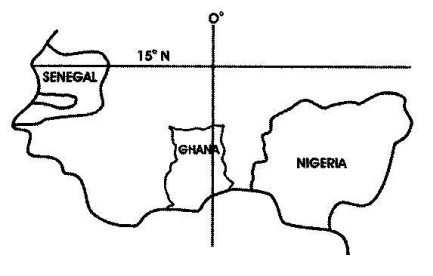
On the outline map of West Africa provided, insert the following features:
i) Accra ii) Lagos iii) River Senegal iv) River Volta v) River Niger vi) Jos Plateau
b) Mention any two reasons why most rivers in West Africa are not navigable. - a) How are the following features shown on topographical maps?
i) Railway ii) Marshy area iii) Court House iv) Mosque v) Market vi) Farm
b) Mention two elements of the weather and the instrument used to measure each of them. - Explain any five achievements of Sir Alan Burns in the Gold Coast.
- a) Mention five types of timber found in the forests of Ghana.
b) Give five reasons that make the timber industry important in Ghana. - Explain five reasons why the Moroccans defeated the Songhai Empire at the battle of Tondibi.
- Describe five achievements of the Organization of African Unity (OAU).
Worked solutions to the theory questions are free in the app.
 All answers free on Google Play