 BECE Past Questions
BECE 1996 Mathematics Past Questions and Answers
40 objective questions and 5 theory questions from the 1996 BECE Mathematics paper. Answers and worked solutions for questions 1 to 10 are below; the rest are free in the app.
Practise this paper free, online or offline


On an iPhone? Download on the App Store
On Android? Get it on Google Play
Paper 1: Objectives
-
U = {0, 1}. How many subsets does U have?
- A. 1
- B. 2
- C. 3
- D. 4
- E. 5
Answer: DThe number of subsets = 2ⁿ, where n is the number of elements in the set. U has 2 elements, so 2² = 4. -
The following addition is done in base ten. What number represents abc?
2 2 2
+
3 4 3
+
a b c
=
1 0 0 0- A. 324
- B. 242
- C. 423
- D. 435
- E. 234
Answer: D222 + 343 + abc = 1000. So, abc = 1000 - 565 = 435. -
In the mapping 2³ → 8, 2² → 4, 2¹ → 2, 2⁰ → a, 2⁻¹ → b, what is the value of a?
- A. 0
- B. ½
- C. 1
- D. 16
- E. 32
Answer: CThe rule is dividing by 2. Thus, 2⁰ = 1. -
In the mapping 2³ → 8, 2² → 4, 2¹ → 2, 2⁰ → a, 2⁻¹ → b, what is the value of b?
- A. −2
- B. ¼
- C. ½
- D. 1
- E. 2
Answer: CThe rule is dividing by 2. Thus, 2⁻¹ = ½. -
Write two hundred thousand and fifty-seven in figures.
- A. 20,057
- B. 200,057
- C. 2,000,057
- D. 20,000,057
- E. 200,570
Answer: BTwo hundred thousand = 200000, fifty-seven = 57, so the number is 200,057. -
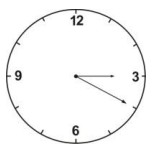
What time is the clock showing if the short hand points to 3 and the long hand points to the fourth division?- A. 4:30
- B. 4:15
- C. 3:40
- D. 3:20
- E. 3:04
Answer: DEach division represents 5 minutes. The long hand points to 20 minutes, making the time 3:20. -
Kojo, Ebo, and Ama share ₵14,000. Kojo had twice as much as Ebo, and Ebo had twice as much as Ama. How much did Ebo get?
- A. ₵8,000
- B. ₵6,000
- C. ₵4,000
- D. ₵3,000
- E. ₵2,000
Answer: CEbo's share = x, Kojo's = 2x, Ama's = x/2. Solving for x, we find Ebo's share is ₵4000. -
At what rate of simple interest will ₵5,000 amount to ₵7,500 in 5 years?
- A. 5%
- B. 6⅔%
- C. 7½%
- D. 10%
- E. 12½%
Answer: DInterest = ₵7,500 - ₵5,000 = ₵2,500. Using the formula, rate = 10%. -
Simplify ⅓ − ½ + ⅖.
- A. ¹⁷⁄₃₀
- B. ¹³⁄₃₀
- C. ⁷⁄₃₀
- D. −⁷⁄₃₀
- E. −¹⁷⁄₃₀
Answer: CUsing common denominators, the result is ⁷⁄₃₀. -
If 2ˣ = 8, what is the value of x?
- A. 0
- B. 1
- C. 2
- D. 3
- E. 4
Answer: D8 = 2³, so x = 3.
Answers and solutions for questions 11 to 40 are free in the BECE Past Questions app, with timed practice and offline study.
-
The relation between Celsius (C) and Fahrenheit (F) is C = ⁵⁄₉(F - 32). If C is 40, find F.
- A. 104.0
- B. 78.4
- C. 72.0
- D. 65.6
- E. 40.0
-
The relation between Celsius (C) and Fahrenheit (F) is C = ⁵⁄₉(F - 32). If C is –40, find F.
- A. -104.0
- B. -78.4
- C. -72.0
- D. -65.6
- E. -40.0
-
The ages in years of 9 children at a party are 2, 3, 3, 3, 4, 5, 5, 5, 6. What is the mean age?
- A. 3.0
- B. 3.5
- C. 4.0
- D. 4.5
- E. 5.0
-
The ages in years of 9 children at a party are 2, 3, 3, 3, 4, 5, 5, 5, 6. What is the median age?
- A. 2.0
- B. 3.0
- C. 3.5
- D. 4.0
- E. 5.0
-
The ages in years of 9 children at a party are 2, 3, 3, 3, 4, 5, 5, 5, 6. If a child is picked at random, what is the probability they are 5 years old?
- A. ²⁄₉
- B. ¹⁄₃
- C. ⁴⁄₉
- D. ⁵⁄₉
- E. ²⁄₃
-
P(2, 5) and Q(-2, 3) are points on the Cartesian plane. Find the vector PQ.
- A. (4, 2)
- B. (-4, -2)
- C. (4, -2)
- D. (-4, 2)
- E. (0, -2)
-
Find k in the vector equation (3, 4) + k(3, 4) = (-3, -4).
- A. -3
- B. -2
- C. -1
- D. -¾
- E. 2
-
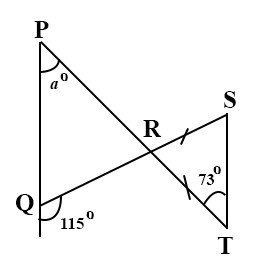
In the diagram, |RS| = |RT|. Find angle a.- A. 146°
- B. 81°
- C. 73°
- D. 65°
- E. 34°
-
If a² – b² = (a + b)(a – b), evaluate 9.32² – 0.68².
- A. 87.32
- B. 86.4
- C. 74.65
- D. 10.0
- E. 8.64
-
Simplify 6² / (2² × 3).
- A. 1
- B. 2
- C. 3
- D. 6
- E. 9
-
The sum of the ages of Kwaku and Kojo is 30 years. Kwaku is 4 years older than Kojo. How old is Kojo?
- A. 19
- B. 17
- C. 13
- D. 11
- E. 9
-
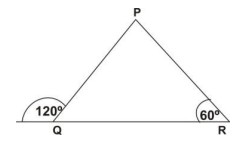
What type of triangle is ∆PQR?- A. Equilateral
- B. Isosceles
- C. Scalene
- D. Right-angled
- E. Obtuse-angled
-
Use the equation y = (x + 2)(x - 2) to answer the question below. If x = -1, find y.
- A. -4
- B. -3
- C. 3
- D. 4
- E. 9
-
Use the equation y = (x + 2)(x - 2) to answer the question below. Find the set of values of x for which y is zero.
- A. {0}
- B. {0, 2}
- C. {0, -2}
- D. {-2, 2}
- E. {2}
-
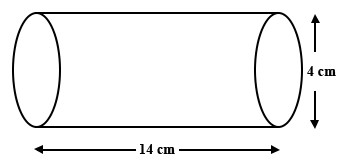
In the diagram above, the cylinder has diameter 4 cm and length 14 cm. [Take π = 22/7] Find the circumference of the base.- A. 44 cm / 7
- B. 88 cm / 7
- C. 176 cm / 7
- D. 44 cm
- E. 176 cm
-
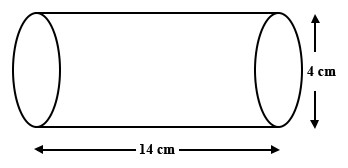
In the diagram above, the cylinder has diameter 4 cm and length 14 cm. [Take π = 22/7] The area of the base is:- A. 176 cm²
- B. 44 cm²
- C. 176 cm² / 7
- D. 88 cm² / 7
- E. 44 cm² / 7
-
In the diagram above, the cylinder has diameter 4 cm and length 14 cm. [Take π = 22/7] What is the volume of the cylinder?- A. 176 cm³
- B. 44 cm³
- C. 176 cm³ / 7
- D. 88 cm³ / 7
- E. 44 cm³ / 7
-
A woman bought 210 oranges for ₵650.00. She sold all of them at 3 for ₵20.00. How much profit did she make?
- A. ₵350.00
- B. ₵450.00
- C. ₵550.00
- D. ₵650.00
- E. ₵750.00
-
The ratio of boys to girls in a school is 9 : 11. If there are 400 pupils in the school, how many boys are there?
- A. 80
- B. 120
- C. 180
- D. 220
- E. 280
-
Express the product of 162.5 x 0.5 in standard form.
- A. 81.25 x 10⁻¹
- B. 81.25 x 10
- C. 8.125 x 10⁻¹
- D. 8.125 x 10
- E. 0.8125 x 10⁻²
-
What is 16% of ₵500,000.00?
- A. ₵80
- B. ₵8,000
- C. ₵80,000
- D. ₵420,000
- E. ₵492,000
-
Simplify 0.24 x 14.3 / 5.2.
- A. 66
- B. 6.60
- C. 0.70
- D. 0.66
- E. 0.60
-
The product of 2x and 3 is 138. Find x.
- A. 23
- B. 33
- C. 68
- D. 69
- E. 138
-
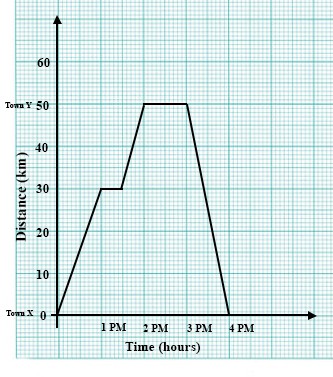
What was the average speed for the return journey from town Y to town X?- A. 100 km/h
- B. 50 km/h
- C. 33.33 km/h
- D. 25 km/h
- E. 20 km/h
-
State the period within which he traveled to town Y after his first rest.- A. 1:00 – 2:00 pm
- B. 1:00 – 4:00 pm
- C. 1:15 – 1:30 pm
- D. 1:30 – 2:00 pm
- E. 2:00 – 4:00 pm
-
How many minutes did the cyclist spend at town Y?- A. 15 minutes
- B. 20 minutes
- C. 30 minutes
- D. 45 minutes
- E. 60 minutes
-
200 bottles of equal capacity hold 350 litres of water. How much water does each bottle hold?
- A. 1750 litres
- B. 175 litres
- C. 17.5 litres
- D. 1.75 litres
- E. 0.17 litres
-
Find the solution set of 2x + 4 > -6.
- A. {x = -5}
- B. {x < 5}
- C. {x > 5}
- D. {x < -5}
- E. {x > -5}
-
A rectangular field 50 metres wide and x metres long requires 260 metres of fencing. Which of the following statements is true?
- A. x + 100 = 260
- B. 2x + 50 = 260
- C. 4x + 200 = 260
- D. 2x + 100 = 260
- E. 4x + 100 = 260
-
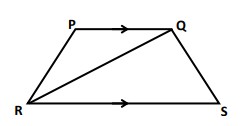
In the diagram above, PQSR is a trapezium. PQ is parallel to RS. ∠PQR = ∠QRS. What type of triangle is triangle RQS?- A. Isosceles
- B. Scalene
- C. Equilateral
- D. Right-angled
- E. Obtuse-angled
Paper 2: Theory
- a) Kofi is n years old now:
(i) How old was he 5 years ago?
(ii) How old will he be 10 years from now?
(iii) If his age in 10 years time will be four times his age 5 years ago, how old is he now?
b) Convert 2342₅ to a base ten numeral.
c) Given that f = (vu) ÷ (v + u), find v, if f = 20 and u = 5. - a) A man deposited ₵350,000.00 in his account in a bank. A simple interest of 4% per annum was paid on his deposit. Calculate the total amount at the end of 4 years.
b) The cost of sending a telegram is ₵500 for the first 12 words and ₵25.00 for every extra word. Find the cost of sending a telegram containing 20 words. - The table below shows the distribution of pupils in a JSS form one class who speak some of the Ghanaian languages:
Ghanaian Language No. of Students Nzema 5 Ga 20 Twi 30 Ewe 25 Fante 10
a) Draw a pie chart for the distribution.
b) What is the modal Ghanaian language?
c) If a pupil is selected at random, what is the probability that they speak Ga? - Using a ruler and a pair of compasses only:
a) Construct triangle ABC such that |AB| = 6 cm, |AC| = 10 cm, and |BC| = 8 cm. Measure angle ABC.
b) Construct the perpendicular bisectors (mediators) of |AB| and |BC|. Let the bisectors meet at O.
c) Construct a circle with centre O and radius OA. Measure the radius of the circle. - a) Using a scale of 2 cm to 2 units on both axes, draw two perpendicular axes OX and OY on a graph sheet.
b) Mark the x-axis from −10 to 10 and the y-axis from −12 to 12.
c) Plot the points A(2, 1), B(3, 4), and C(4, 2). Join them to form triangle ABC.
d) Draw an enlargement A1B1C1 of triangle ABC with scale factor 2 from the origin O(0, 0), such that A → A1, B → B1, and C → C1. Indicate the coordinates of triangle A1B1C1. Show all lines of transformation.
e) Using the x-axis as the mirror line, draw the image A2B2C2 of triangle ABC, where A → A2, B → B2, and C → C2. Indicate the coordinates of triangle A2B2C2.
Worked solutions to the theory questions are free in the app.
 All answers free on Google Play