 BECE Past Questions
BECE 2019 Pre-Technical Skills Past Questions and Answers
30 objective questions and 4 theory questions from the 2019 BECE Pre-Technical Skills paper. Answers and worked solutions for questions 1 to 10 are below; the rest are free in the app.
Practise this paper free, online or offline


On an iPhone? Download on the App Store
On Android? Get it on Google Play
Paper 1: Objectives
-
The plan of a cylinder is a
- A. circle
- B. rectangle
- C. square
- D. triangle
Answer: A -
The first stage of the design process is
- A. brief
- B. evaluation
- C. situation
- D. specification
Answer: C -
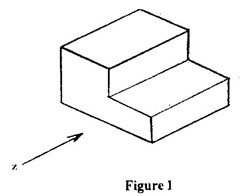
Which of the following represents the front view in the direction of arrow Z?- A.
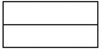
- B.

- C.

- D.

Answer: C - A.
-
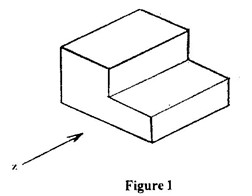
Which of the following represents the right end elevation?- A.

- B.

- C.

- D.

Answer: A - A.
-
In the design process, the selected idea is developed in order to
- A. determine the cost
- B. evaluate final product
- C. improve upon it
- D. reduce its beauty
Answer: C -
The most suitable pencil for drawing construction lines is
- A. B
- B. HB
- C. 2B
- D. 2H
Answer: D -
A common method of cooking used for most Ghanaian staple foods is
- A. steaming
- B. boiling
- C. frying
- D. stewing
Answer: B -
A seam that is often used for outer garment is
- A. plain seam
- B. French
- C. Machine felled seam
- D. overlaid seam
Answer: A -
When setting a table, the first course cutlery should be placed
- A. at the top edge of the dinner plate
- B. on the dinner plate
- C. near the dinner plate
- D. further away from the dinner plate
Answer: DCutlery is laid from the outside in, so the first course goes furthest from the plate. -
Stranded cotton thread is used for
- A. decorative stitches
- B. neatening seams
- C. joining seams
- D. temporary stitches
Answer: A
Answers and solutions for questions 11 to 30 are free in the BECE Past Questions app, with timed practice and offline study.
-
Red, orange and yellow are
- A. warm colours
- B. cool colours
- C. opposite colours
- D. neutral colours
-
The inscription BB on a pencil indicates that, it
- A. is hard
- B. is soft
- C. breaks easily
- D. sharpens well
-
A circle is
- A. a form
- B. a principle of design
- C. a sphere
- D. an element of design
-
The colour violet symbolizes
- A. wealth
- B. peace
- C. aggression
- D. royalty
-
The primary colours are
- A. red, violet, yellow
- B. green, yellow, red
- C. red, yellow, blue
- D. violet, yellow, green
-
Goggles are worn when working on a grinding machine in order to protect the
- A. ears
- B. eyes
- C. head
- D. nose
-
The binding agent in mortar is
- A. cement
- B. sand
- C. stone
- D. water
-
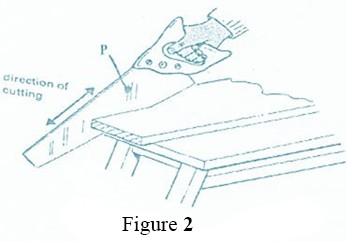
The figure shows the procedure for cutting- A. across the grain of timber
- B. along the grain of timber
- C. the shoulders of a joint
- D. the tenon of a joint
-
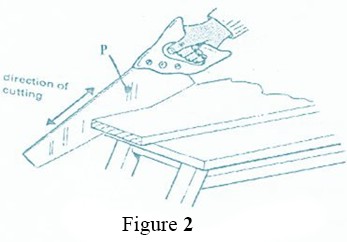
The tool labelled P is called- A. crosscut saw
- B. hacksaw
- C. rip saw
- D. tenon saw
-
The process of keeping blocks damp is
- A. batching
- B. bonding
- C. curing
- D. rendering
-
The figure shows the procedure for- A. levelling a wall
- B. measuring a wall
- C. setting out a wall
- D. plumbing a wall
-
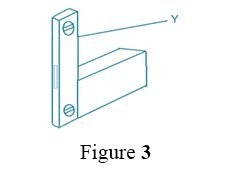
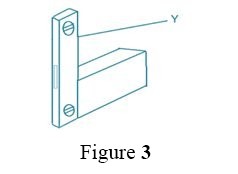
The tool labelled Y is a- A. gauge rod
- B. spirit level
- C. straight edge
- D. tamping rod
-
Soft solder is an alloy of
- A. lead and copper
- B. lead and zinc
- C. tin and zinc
- D. tin and lead
-
Which of the following is a quality of a good mortar? It should
- A. be easily workable
- B. develop cracks easily
- C. contains impurities
- D. allow water to pass through
-
Cable insulators are made from
- A. acrylic
- B. polyvinyl chloride
- C. nylon
- D. urea formaldehyde
-
In order to oppose the flow of electric current in a circuit, use
- A. a capacitor
- B. LED
- C. an indicator
- D. a resistor
-
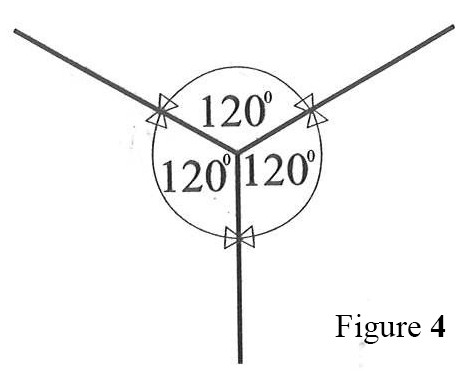
Figure 4 illustrates the principle of- A. Isometric axes
- B. Oblique axes
- C. Orthographic axes
- D. Perspective axes
-
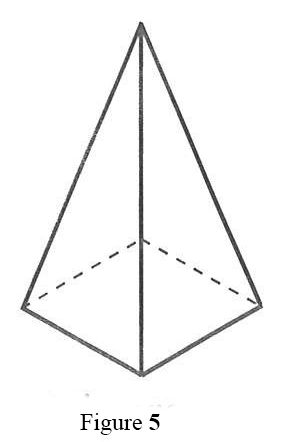
The figure 5 shows a- A. triangular prism
- B. triangular pyramid
- C. square prism
- D. square pyramid
-
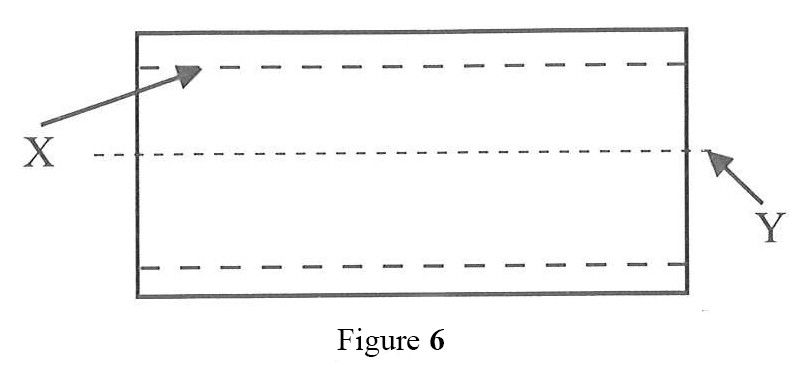
The line labelled X is a- A. center line
- B. cutting plane
- C. dimension line
- D. hidden line
-
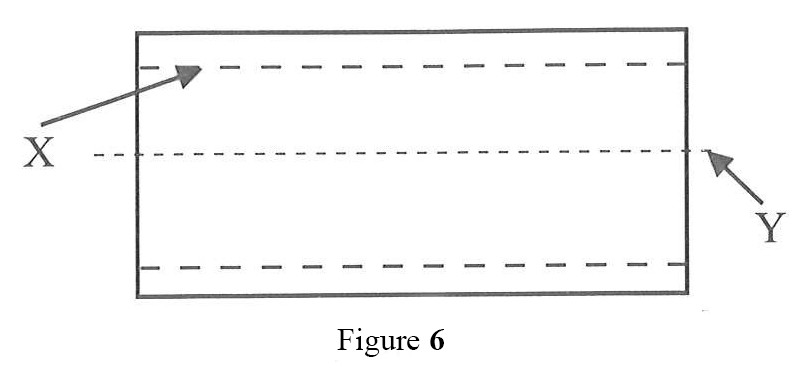
The line labelled Y is used for- A. dimensional
- B. indicating the centre of an object
- C. indicating the hidden detail of an object
- D. sectioning
Paper 2: Theory
- a) List two uses of a table napkin.
b) State four causes of food spoilage.
c)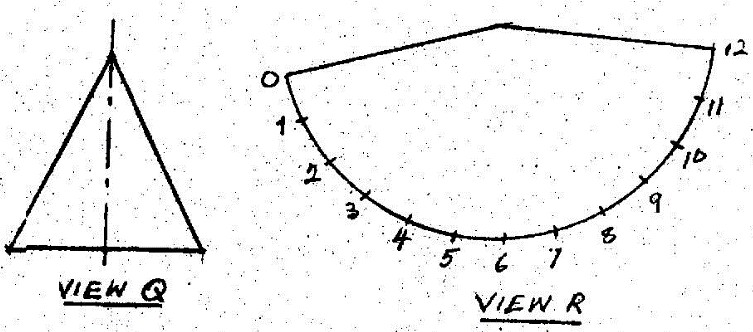
Figure 1 shows two views of a solid.
i) Name the type of solid presented as view Q.
ii) State the type of view represented as view R.
iii) List any three equipment that are used to draw the views Q and R.
d) i) List the primary colours.
ii) Name four types of line. - a) i) State three uses of mortar.
ii) List three tools used for moulding bricks.
b) i) Make a sketch of a spirit level.
ii) State one use of the spirit level.
iii) State two care and maintenance measures to be observed when using the spirit level.
c) i) List two types of screwdrivers.
ii) State one use of a screwdriver. - a) Figure 2 shows the pictorial view of a block prepared from odum. Use it to answer question (a)(i) to (a)(iii).
i) Draw full size the view in the direction of arrow X.
ii) List three tools required to prepare the wooden block.
iii) List two finishes that would be applied to make the wooden block attractive.
b) i) Make a freehand pictorial sketch of a spade.
ii) Label any two parts of the spade sketched in question (b)(i).
iii) State two uses of the spade. - a) Copy and complete the table below with the following tools where appropriate: Spirit level, straight edge, tape measure, trowel, float, gauge rod, builder’s square and mortar board.
S/N Operation Two Tools Required
I Set out a wall
II Pick and spread mortar
III Lay end blocks
IV Gauge the blocks
V Level the blocks.
b) i) Make a freehand pictorial sketch of a bolster.
ii) State one use of the bolster.
c) Sketch the representative symbols of the following components:
i) Battery
ii) Bulb.
Worked solutions to the theory questions are free in the app.
More BECE Pre-Technical Skills papers
All 8 Pre-Technical Skills papers
 All answers free on Google Play