 BECE Past Questions
BECE 2016 Integrated Science Past Questions and Answers
40 objective questions and 6 theory questions from the 2016 BECE Integrated Science paper. Answers and worked solutions for questions 1 to 10 are below; the rest are free in the app.
Practise this paper free, online or offline


On an iPhone? Download on the App Store
On Android? Get it on Google Play
Paper 1: Objectives
-
An example of a third class lever is
- A. wheelbarrow
- B. sugar tongs
- C. pair of scissors
- D. crowbar
Answer: B -
The release of a mature egg from an ovary into the fallopian tube in humans is called
- A. copulation
- B. ejaculation
- C. menstruation
- D. ovulation
Answer: D -
The blood vessel that carries oxygenated blood from the lungs to the heart is known as
- A. pulmonary artery
- B. pulmonary vein
- C. vena cava
- D. aorta
Answer: B -
An example of a plant micro-nutrient is
- A. calcium
- B. copper
- C. magnesium
- D. potassium
Answer: B -
What is the colour of the neutral wire in a three-pin plug?
- A. Blue
- B. Brown
- C. Green
- D. Yellow
Answer: A -
In the pin-hole camera, the image formed is always
- A. erect and bright
- B. erect and blurred
- C. inverted and real
- D. inverted and virtual
Answer: C -
The part of the flower that develops into a fruit is the
- A. ovary
- B. ovule
- C. stamen
- D. style
Answer: A -
The number of elements in the compound Ca(OH)₂ is
- A. 2
- B. 3
- C. 4
- D. 5
Answer: B -
The reason why alum is added to water during treatment is to
- A. kill germs
- B. give taste to water
- C. make water colourless
- D. make suspended particles to settle
Answer: D -
Which of the following animal parasites could be controlled by hand picking?
- A. Liver fluke
- B. Tapeworm
- C. Tick
- D. Roundworm
Answer: C
Answers and solutions for questions 11 to 40 are free in the BECE Past Questions app, with timed practice and offline study.
-
A stick which is partially immersed in water appeared to be bent due to
- A. absorption
- B. reflection
- C. refraction
- D. transmission
-
One difference between metals and non-metals is that metals
- A. have low density
- B. are not malleable
- C. have lustre
- D. have low melting points
-
The cultivation of different crops on different plots of a farmland in a definite cycle is called
- A. land rotation
- B. shifting cultivation
- C. crop rotation
- D. mixed cropping
-
Iodine deficiency in humans could result in a disorder known as
- A. diabetes
- B. goitre
- C. kwashiorkor
- D. scurvy
-
A substance is termed combustible if it
- A. easily catches fire
- B. dissolve common salt
- C. sublimes at room temperature
- D. boils at 100°C
-
Micro-organisms that cause disease are collectively called
- A. bacteria
- B. infections
- C. pathogens
- D. viruses
-
Which type of energy is lost when sweat evaporates from the human body?
- A. Sound energy
- B. Mechanical energy
- C. Chemical energy
- D. Heat energy
-
Which of the following gases is involved in the rusting of iron?
- A. Hydrogen
- B. Oxygen
- C. Nitrogen
- D. Carbon dioxide
-
The feeling of soil between fingers is used to determine the
- A. texture of the soil
- B. drainage of the soil
- C. capillary of the soil
- D. water holding capacity of the soil
-
Sodium hydroxide is an example of a base because it
- A. has sour taste
- B. has a pH less than 7
- C. turns wet blue litmus paper red
- D. turns wet red litmus paper blue
-
Which of the following plants has its leaves modified for storing food?
- A. Ginger
- B. Onion
- C. Pineapple
- D. Tomato
-
Gases enter and leave the leaf of a plant through the
- A. Mesophyll cells
- B. Stomata
- C. Pith
- D. Palisade cells
-
Which of the following vegetable crops is cultivated for its leaves?
- A. Carrot
- B. Lettuce
- C. Okro
- D. Pepper
-
An example of a body that does not produce its own light is the
- A. Moon
- B. Sun
- C. Star
- D. Fire fly
-
Which of the following devices converts electrical energy into sound energy?
- A. Electric heater
- B. Electric fan
- C. Washing machine
- D. Loudspeaker
-
Transplanting of young seedlings is usually done in the evening because
- A. Darkness promotes rapid growth
- B. Seedlings require less nutrients
- C. Pest attack is minimal
- D. Transpiration is minimal
-
A mixture of sugar and water could be separated by
- A. Decantation
- B. Evaporation
- C. Filtration
- D. Sublimation
-
Which of the following processes results in the formation of new substances?
- A. Cooling water to form ice
- B. Adding saliva to cooked yam
- C. Dissolving sugar in water
- D. Mixing iron dust and sand
-
Photosynthesis is important to living organisms because it produces
- A. Glucose and oxygen
- B. Glucose and carbon dioxide
- C. Oxygen and carbon dioxide
- D. Water and carbon dioxide
-
Global warming is caused by the
- A. Circulation of oxygen in the atmosphere
- B. Excessive release of carbon dioxide into the atmosphere
- C. Release of hydrogen into the atmosphere
- D. Circulation of nitrogen in the atmosphere
-
The warning and safety signs on chemical containers are usually represented by a symbol placed within a
- A. Circle
- B. Rectangle
- C. Square
- D. Triangle
-
In which of the following structures in a living cell is cellulose found?
- A. Chloroplast
- B. Mitochondrion
- C. Cell membrane
- D. Cell wall
-
Elements that could easily lose electrons to form cations are
- A. Metals
- B. Non-metals
- C. Semi-metals
- D. Noble gases
-
The conversion of agricultural produce from its original form to other desirable forms is termed
- A. Preservation
- B. Processing
- C. Recycling
- D. Storage
-
The function of the hair in the nose of humans is to
- A. Make breathing easier
- B. Keep nose moist
- C. Filter dust from the air breathed in
- D. Keep the nose warm
-
A metal that is used as a thermometric liquid is
- A. Aluminium
- B. Copper
- C. Mercury
- D. Silver
-
The joule is the S.I unit for
- A. Energy
- B. Force
- C. Power
- D. Pressure
-
Which of the following gases supports combustion?
- A. Hydrogen
- B. Oxygen
- C. Carbon dioxide
- D. Carbon monoxide
-
The form of energy which flows from one point to another due to temperature differences is known as
- A. Mechanical energy
- B. Heat energy
- C. Solar energy
- D. Nuclear energy
-
Which of the following resources does not produce energy?
- A. Coal
- B. Sand
- C. Water
- D. Wind
Paper 2: Theory
- (a)
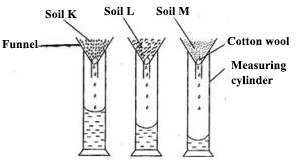
The funnels contain different types of soil labelled K, L, and M. Equal volumes of water were poured onto each soil at the same time and allowed to drain for 20 minutes.
(i) What is the aim of the experiment?
(ii) Which soil has the highest rate of drainage?
(iii) Which soil has the highest water retention capacity?
(iv) Which soil is most likely to lose water and dry faster after rainfall?
(v) Which soil is most likely to be waterlogged after rainfall?
(vi) Which soil type would be suitable for maize cultivation?
(b) Study the hazard symbols labelled I, II, III, and IV above and use it to answer the questions that follow.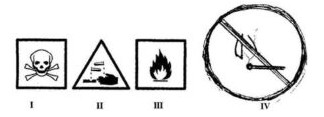
(i) What does each symbol represent?
(ii) Name one substance associated with each symbol.
(iii) Where is symbol IV often displayed?
(iv) Which symbols are found on chemical containers?
(c) Study the devices used to work below and use it to answer the questions that follow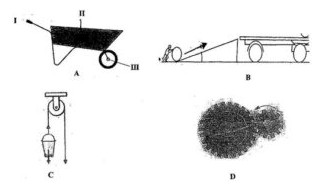
(i) Give a general name for the devices.
(ii) Identify devices A, B, C, and D.
(iii) Name parts labelled I, II, and III of device A.
(iv) What does the arrow represent in device B?
(v) Type of work done with devices C and D.
(d) Diagram of human digestive system.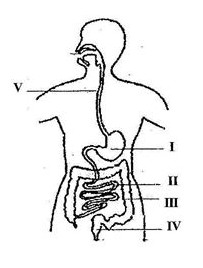
(i) Name parts I, II, III, IV, and V.
(ii) Name parts where digestion and absorption occur.
(iii) Name end-products absorbed into the bloodstream. - (a) Name four weather measuring instruments.
(b) Name the stages in the life cycle of a mosquito.
(c) (i) List two properties of water.
(ii) Explain why it is advisable to wash clothes with soft water.
(d) State three ways in which soil profile is important. - (a) List three modes of heat transfer.
(b) (i) What is a deficiency disease?
(ii) Name three deficiency diseases in humans.
(c) Two ways each of burning and leaching deplete soil resources.
(d) List three processes that change matter from one state to another. - (a) (i) What is a satellite?
(ii) Three uses of artificial satellites.
(b) State composition of alloys: Brass, Steel, and Bronze.
(c) Name three cultural practices in vegetable production.
(d) List four parts of the human respiratory system. - (a) (i) What is force?
(ii) Two ways force can affect a body.
(b) (i) Define chemical change.
(ii) Three differences between chemical and physical change.
(c) Name three physical properties of soil.
(d) List three diseases of the circulatory system in humans. - (a) Systematic names of compounds: H₂O, MgO, CaO, CaCl₂.
(b) Name instruments for measuring: length, mass, temperature, and volume.
(c) Three factors that influence vegetable crop production.
(d) Four stages in the life cycle of a flowering plant.
Worked solutions to the theory questions are free in the app.
More BECE Integrated Science papers
All 38 Integrated Science papers
 All answers free on Google Play