 BECE Past Questions
BECE 2017 Home Economics Past Questions and Answers
30 objective questions and 4 theory questions from the 2017 BECE Home Economics paper. Answers and worked solutions for questions 1 to 10 are below; the rest are free in the app.
Practise this paper free, online or offline


On an iPhone? Download on the App Store
On Android? Get it on Google Play
Paper 1: Objectives
-
A common method of cooking ripe plantain for sale is
- A. boiling
- B. roasting
- C. grilling
- D. baking
Answer: C -
To shorten the cooking time for meat,
- A. slice along the grain
- B. cut into small pieces
- C. slice into thin pieces
- D. cut across the grain
Answer: D -
In taking body measurement, a firm tape measure is needed to
- A. save time
- B. avoid wasting fabric
- C. obtain accuracy
- D. make sewing easy
Answer: C -
Which of the following principles of design is similar to proportion?
- A. Balance
- B. Perspective
- C. Rhythm
- D. Scale
Answer: D -
A preliminary design is meant to
- A. improve creativity
- B. increase production
- C. make sketches
- D. produce ideas
Answer: D -
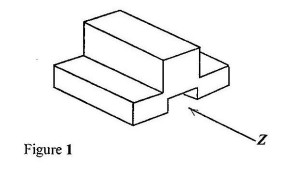
Which of the following represents the front view in the direction of arrow Z?- A.
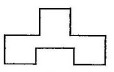
- B.

- C.

- D.

Answer: A - A.
-
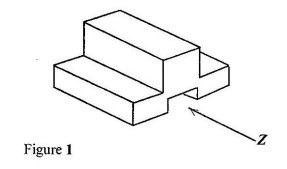
Which of the following represent the left end elevation?- A.
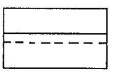
- B.
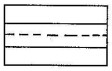
- C.
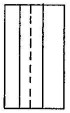
- D.
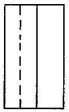
Answer: A - A.
-
A single unit of a design is known as
- A. motif
- B. pattern
- C. plan
- D. print
Answer: A -
Angles are measured by using a
- A. compass
- B. protractor
- C. rule
- D. set square
Answer: B -
In designing, the analysis question, 'what is the purpose of the unit?' falls under
- A. construction
- B. ergonomics
- C. function
- D. material
Answer: C
Answers and solutions for questions 11 to 30 are free in the BECE Past Questions app, with timed practice and offline study.
-
To repair an electrical fault, a safety precaution to observe is to
- A. disconnect live wires
- B. remove fuse
- C. remove cover of socket
- D. switch off main supply
-
Which of the following is not a cause of weakness in furniture?
- A. Loose joint
- B. Insufficient polish
- C. Overloading
- D. Removal of nail
-
The tee-square is used for drawing
- A. arcs
- B. circles
- C. horizontal lines
- D. vertical lines
-
Identify the type of lettering used for emphasis.
- A. Freestyle
- B. Gothic
- C. Italics
- D. Romans
-
Strips cut on the true cross of fabric are usually used for curved edges because they
- A. stretch easily
- B. do not fray
- C. are easily prepared
- D. are colourful
-
The best fastening for the full back opening of a fourteen year old school girl’s uniform is
- A. press studs
- B. zipper
- C. velcro
- D. tapes
-
When making a shirt sleeve, the two rows of gathering stitches are worked on the
- A. seam allowance of the sleeves
- B. hem of the sleeves
- C. side seam of the sleeves
- D. cap of the sleeves
-
The most suitable pocket found on men’s classic shirt is
- A. bound
- B. in-seam
- C. patch
- D. welt
-
In attaching a turnover to a shirt, the first process to work on is the
- A. joining and stitching of the side seam
- B. preparation and fixing of a pocket
- C. joining and stitching of the shoulder
- D. preparation and setting in of sleeve
-
The French seam is the most appropriate seam for
- A. children’s wear
- B. heavy weight fabrics
- C. light weight fabrics
- D. undergarment
-
A repair work done by weaving thread into weakened portion of article is termed
- A. renovating
- B. darning
- C. remodeling
- D. patching
-
An advantage of freehand cutting is that
- A. it is good for mass production
- B. it is good for beginners
- C. it conserves time and energy
- D. there is no need for pattern drafting
-
The most important factor to consider when buying canned food is the
- A. weight
- B. label on product
- C. colour
- D. expiry date
-
In order to retain the nutrients in leafy vegetables,
- A. cut one hour before cooking
- B. cut when ready to cook
- C. cut when the water is boiling
- D. cut few minutes before cooking
-
In table setting, a cover refers to the space
- A. beside the person’s seat
- B. left of the person’s seat
- C. in front of the person’s seat
- D. right of the person’s seat
-
The basic ingredients for preparation of batter are
- A. flour, egg and milk
- B. flour, egg and oil
- C. flour, egg and yeast
- D. flour, egg and baking powder
-
Food is preserved mainly to
- A. maintain its shape
- B. make it last longer
- C. make it palatable
- D. protect micro organism
-
A suitable flour used to prepare bread is
- A. soft flour
- B. self raising flour
- C. composite flour
- D. strong flour
-
Which of the following dishes is garnished with lemon and parsley?
- A. Grilled mackerel
- B. Grilled chicken
- C. Roast lamb
- D. Beef loaf
-
Which of the following is a white fish?
- A. Mackerel
- B. Cod
- C. Herring
- D. Tilapia
Paper 2: Theory
- a) What is temporary stitches?
b) State two reasons for setting a table for family meals.
c) i) State two places where the unit for hanging school uniforms would be placed in the workshop.
ii) State two specifications of the unit based on construction.
iii) Name one specific material to be used for making the unit.
d) i) List five important pieces of information printed onto a package.
ii) Name two other methods for making a print. - a) Identify two uses of permanent stitches.
b) State five general rules for making stitches.
c) State one use each of the following tools and equipment for sewing:
i) Tracing wheel; ii) Pressing iron; iii) Full length mirror; iv) Seam ripper; v) Stiletto.
d) Complete the definition of a patch with the appropriate words. - a) State one function each of the following nutrients:
i) Protein; ii) Carbohydrate; iii) Vitamins.
b) List three protein sources of each:
i) Animal; ii) Vegetable.
c) i) List six ingredients Ama will need for preparing chicken stew.
ii) State three accompaniments that can be served with the stew.
iii) What are the basic ingredients used in pastry making?
d) State four causes of food spoilage.
e) Explain the term Essential Amino Acids. - a) State four signs of Kwashiorkor.
b) Outline three functions of water in the body.
c) i) State one reason why dietary fibre is important in a diet.
ii) List the four fat-soluble vitamins.
d) Explain two reasons for preserving foods.
e) State the major function of iodine in the body.
Worked solutions to the theory questions are free in the app.
 All answers free on Google Play