 BECE Past Questions
BECE 2008 Integrated Science Past Questions and Answers
40 objective questions and 5 theory questions from the 2008 BECE Integrated Science paper. Answers and worked solutions for questions 1 to 10 are below; the rest are free in the app.
Practise this paper free, online or offline


On an iPhone? Download on the App Store
On Android? Get it on Google Play
Paper 1: Objectives
-
A metre rule can be used for measuring the
- A. volume of a liquid
- B. area of a ball
- C. length of a table
- D. diameter of a wire
Answer: C -
Heat travels through vacuum by
- A. conduction
- B. convection
- C. radiation
- D. convection and radiation
Answer: C -
A mirror is used to direct sunlight onto the wall of a classroom by
- A. dispersion
- B. refraction
- C. reflection
- D. radiation
Answer: C -
Which of the following energy changes takes place in ringing bell?
- A. Potential to kinetic
- B. Potential to sound
- C. Mechanical to sound
- D. Sound to light
Answer: C -
A fuse is connected in an electric circuit to
- A. prevent electric shock
- B. increase the current
- C. prevent current from increasing
- D. increase the heat generated
Answer: C -
Which of these objects is a magnetic substance?
- A. Aluminium
- B. Brass
- C. Copper
- D. Iron
Answer: D -
Which of the following bodies are natural sources of light?
I. Moon
II. Sun
III. Firefly- A. I and II only
- B. I and III only
- C. II and III only
- D. I, II and III
Answer: C -
Which of the following statements describes the nature of light?
- A. It passes through all objects
- B. It is absorbed at a polished surface
- C. It travels in a straight line
- D. It is always reflected in a medium
Answer: C -
Metals are able to conduct electricity because they possess
- A. free electrons
- B. neutrons
- C. atoms
- D. free protons
Answer: A -
Beriberi is caused by deficiency of vitamin
- A. Vitamin A
- B. Vitamin B
- C. Vitamin C
- D. Vitamin K
Answer: B
Answers and solutions for questions 11 to 40 are free in the BECE Past Questions app, with timed practice and offline study.
-
Which of the following fruits is adapted for dispersal by air?
- A. Succulent fruit
- B. Brightly coloured fruit
- C. Sticky fruit
- D. Hairy fruit
-
The food substance needed for growth and repair of tissue is
- A. Carbohydrates
- B. Oil
- C. Protein
- D. Vitamin
-
The type of teeth used for biting and cutting are the
- A. Canines
- B. Incisors
- C. Molars
- D. Premolars
-
Water is absorbed by roots in plants and transported to the leaves through the
- A. Chlorophyll
- B. Phloem
- C. Stomata
- D. Xylem
-
The outer ear consists of the
- A. Ossicles and eardrum
- B. Cochlea and pinna
- C. Ossicles and cochlea
- D. Pinna and eardrum
-
Changes in pressure in the middle ear are regulated by the
- A. Ampullae
- B. Cochlea
- C. Eustachian tube
- D. Eardrum
-
The amount of light that enters the eye is reduced by the size of the
- A. Lens
- B. Iris
- C. Pupil
- D. Retina
-
In humans, features of parents are passed on to offspring through
- A. Breastfeeding
- B. Reproduction
- C. Good training
- D. Sharing the same things
-
The taste of water changes when it is boiled because
- A. Heat is absorbed during boiling
- B. Evaporation takes place during boiling
- C. Air is lost during boiling
- D. Steam is produced during boiling
-
Arrange the following types of water in order of increasing hardness.
I. Tap water
II. Sea water
III. Distilled water
IV. Rain water- A. IV, III, II, I
- B. III, IV, I, II
- C. II, I, IV, III
- D. I, II, III, IV
-
Which of these methods is used to separate insoluble solids from liquids?
- A. Distillation
- B. Evaporation
- C. Filtration
- D. Winnowing
-
A uniform mixture of two or more metals is called
- A. An alloy
- B. A compound
- C. A solvent
- D. A suspension
-
Which of the following liquids cannot dissolve an oil paint?
- A. Kerosene
- B. Petrol
- C. Turpentine
- D. Water
-
An atom which contains more electrons than protons becomes a
- A. Positive ion
- B. Negative ion
- C. Neutral atom
- D. Binary compound
-
The following substances are mixtures except
- A. Air
- B. Carbon dioxide
- C. Salt solution
- D. Smoke
-
The fish is protected from injury by the
- A. Fins
- B. Gills
- C. Operculum
- D. Scales
-
Which of the following substances is an air pollutant?
- A. Water vapour
- B. Oxygen
- C. Nitrogen
- D. Hydrogen sulphide
-
Bathing in lakes and slow moving streams can lead to one getting
- A. Bilharziasis
- B. Cholera
- C. Dysentery
- D. River blindness
-
Some plants shed their leaves during the dry season to prevent
- A. Water loss
- B. Heat loss
- C. Catching fire
- D. Losing nutrients
-
Caterpillar is an example of
- A. An animal parasite that feeds on plant host
- B. A plant parasite that lives on an animal host
- C. An animal parasite that feeds on animal host
- D. A plant parasite that grows on plant host
-
How long does it take the moon to go completely round the earth?
- A. 1 day
- B. 28 days
- C. 30 days
- D. 365 days
-
An unripe orange is said to be acidic because it
- A. Has low sugar content
- B. Has bitter taste
- C. Turns red litmus paper blue
- D. Turns blue litmus paper red
-
The chemical symbol of potassium is
- A. K
- B. N
- C. P
- D. S
-
The property of a metal that makes it possible for it to be drawn into a wire is called
- A. Conductivity
- B. Ductility
- C. Malleability
- D. Resistivity
-
Which of the following methods of preserving food make use of heat energy?
I. Drying
II. Frying
III. Salting
IV. Canning- A. I and II only
- B. I and IV only
- C. III and IV only
- D. I, II and IV only
-
Weight is an example of
- A. Energy
- B. Force
- C. Work
- D. Power
-
Blood is prevented from flowing back into the veins by the
- A. Arteries
- B. Capillaries
- C. Heart
- D. Valves
-
The force that binds molecules of the same substances together is called
- A. Adhesion
- B. Cohesion
- C. Capillary action
- D. Surface tension
-
Soluble digested food substances enter the blood of the human body by a process called
- A. Absorption
- B. Egestion
- C. Excretion
- D. Ingestion
-
Capillary action is applied in the following activities except
- A. Blotting an ink with a blotting paper
- B. Absorption of water with a towel
- C. Rising of water in a very narrow glass tube
- D. Sticking of water droplets on the surface of a glass tube
Paper 2: Theory
- (a)
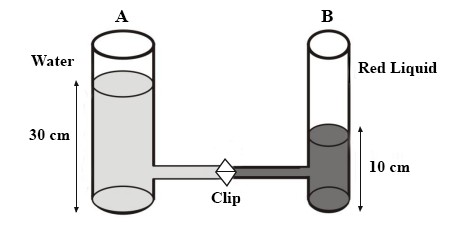 In an experiment, as in the set-up above, two glass containers A and B of different sizes are joined together with a tube and clipped.
Water is poured into container A to a height of 30 cm and a red liquid is poured into B to a height of 10 cm. The clip is then removed so that the liquids join together.
(i) State two observations that will be made immediately the clip is removed.
(ii) Explain the observations in (i).
(iii) What two observations will be made after a long time? Explain.
(b)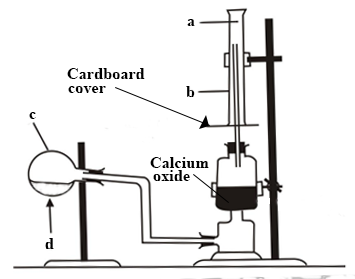
(i) Name the parts labelled a, b and c.
(ii) What is the meaning of the arrow sign d?
(iii) What is the function of the calcium oxide?
(iv) Why has c been tilted downwards?
(v) State the method by which the gas is collected.
(vi) How will you test for the gas?
(vii) Give the names and the chemical formulae of the compounds that form the content of c.
(c) In an experiment, a leaf that is partly green and partly yellow is plucked from a tree and the leaf is
I boiled for a minute,
II dipped in warm alcohol,
III washed in cold water,
IV dipped in iodine solution.
One part of the leaf turns blue-black after the dipping in iodine solution while the other part remains unchanged.
(i) Explain why each of the processes I, II and III
(ii) Which part of the leaf turns blue-black? Explain.
(iii) Why does the other part of the leaf not change colour?
(iv) What conclusion can you draw from the experiment? - (a) (i) State the difference between an opaque object and a translucent object.
(ii) Give one example each of an opaque and a translucent material.
(b) (i) What is the importance of seed dispersal?
(ii) Name two types of fruits and state their mode of dispersal.
(c) (i) What is recycling?
(ii) Give two advantages of recycling of materials.
(iii) List three recycled products in Ghana. - (a) (i) Explain the term bedwetting?
(ii) State two diseases that may result from bedwetting.
(b) (i) State the difference between hard water and impure water.
(ii) Give the stages involved in the treatment of water for a community.
(c) A piece of stone has a mass of 36.0 g. When it is put into water in a glass container, the level of water rises from 60.0 cm³ to 90.0 cm³.
(i) Calculate the density of the stone.
(ii) Explain what will be observed when the stone is put into another liquid of density 1.4 g/cm³? - (a) (i) What is an echo?
(ii) State two uses of echoes.
(b) (i) State three diseases that affect the respiratory system.
(ii) Name one method each by which the diseases you have named can be prevented.
(c) (i) What is biotechnology?
(ii) List three products that are obtained from biotechnology. - (a) (i) Define pressure.
(ii) State three applications of pressure in everyday life.
(b) State four functions of the liver in digestion.
(c) (i) What is a compound?
(ii) Give two properties of a compound.
(iii) Write down the name and the chemical formula of the compound formed between the following elements:
(α) hydrogen and chlorine
(β) magnesium and oxygen
Worked solutions to the theory questions are free in the app.
More BECE Integrated Science papers
All 38 Integrated Science papers
 All answers free on Google Play