 BECE Past Questions
BECE 2007 Integrated Science Past Questions and Answers
40 objective questions and 5 theory questions from the 2007 BECE Integrated Science paper. Answers and worked solutions for questions 1 to 10 are below; the rest are free in the app.
Practise this paper free, online or offline


On an iPhone? Download on the App Store
On Android? Get it on Google Play
Paper 1: Objectives
-
Which of the following properties is true about all matter? Matter has
- A. Volume and fixed shape
- B. Volume and mass
- C. Mass and indefinite volume
- D. Density and fixed shape
Answer: B -
The type of energy obtained when an electric bulb is connected to a battery is
- A. Chemical energy
- B. Electrical energy
- C. Light energy
- D. Magnetic energy
Answer: C -
A magnet can attract all these substances except
- A. Drawing pins
- B. Glass
- C. Steel
- D. Iron nails
Answer: B -
The process by which heat travels along a metal is called
- A. Convection
- B. Conduction
- C. Expansion
- D. Radiation
Answer: B -
The instrument used to measure temperature is the
- A. Ammeter
- B. Barometer
- C. Manometer
- D. Thermometer
Answer: D -
A stick placed in water appears to be bent because light travelling from the water to the air is
- A. Dispersed
- B. Displaced
- C. Refracted
- D. Reflected
Answer: C -
A plane mirror could be described as opaque because it
- A. Reflects all the light incident on it
- B. Absorbs all the light incident on it
- C. Allows the light incident on it to pass through it
- D. Allows some of the light incident on it to pass through it and absorbs the rest
Answer: A -
A suitable machine for loading drums of palm oil onto a truck is
- A. A screw
- B. A crowbar
- C. A wheelbarrow
- D. An inclined plane
Answer: D -
The human forearm is an example of
- A. A first class lever
- B. A second class lever
- C. A third class lever
- D. Both first and third class levers
Answer: C -
The chemical substances which help in the digestion of food are known as
- A. Enzymes
- B. Hormones
- C. Plasma
- D. Vitamins
Answer: A
Answers and solutions for questions 11 to 40 are free in the BECE Past Questions app, with timed practice and offline study.
-
Digestion of proteins starts from the
- A. Duodenum
- B. Ileum
- C. Mouth
- D. Stomach
-
A reflex action involves the
- A. Brain and nerves
- B. Bones and nerves
- C. Brain and muscles
- D. Spinal cord and nerves
-
Which of the following structures is not part of the central nervous system?
- A. Brain
- B. Spinal cord
- C. Nerves
- D. Veins
-
When the testa of a soaked bean is removed, the seed is seen to be made up of
- A. Cotyledons
- B. Embryos
- C. Micropyles
- D. Radicles
-
One function of the root system of plants is to
- A. Excrete carbon dioxide
- B. Store waste materials
- C. Hold the plant firmly in the ground
- D. Prepare food for the plant
-
Which of the following diseases is caused by a virus?
- A. Cholera
- B. Cerebro Spinal Meningitis (CSM)
- C. Measles
- D. Tuberculosis (TB)
-
The different types of teeth that an animal has gives an indication of the nature of its
- A. Digestion
- B. Environment
- C. Feeding
- D. Reproduction
-
Exchange of gases takes place in the respiratory system through the
- A. Bronchi
- B. Lungs
- C. Nostrils
- D. Trachea
-
Water that requires more soap in order to form lather is described as
- A. Clean
- B. Hard
- C. Pure
- D. Soft
-
One best way of making water safe for drinking is by
- A. Adding washing soda
- B. Filtering
- C. Adding common salt
- D. Boiling
-
The process whereby a hot saturated solution is cooled to obtain the solute is called
- A. Condensation
- B. Crystallization
- C. Distillation
- D. Evaporation
-
If a mixture of water and powdered charcoal is allowed to stand for a long time, the charcoal
- A. Raises to the top
- B. Settles at the bottom
- C. Dissolves completely in the water
- D. Continues to remain suspended in the water
-
The chemical symbol of potassium is
- A. Na
- B. K
- C. Pb
- D. S
-
The atom of an element is represented as ³⁵₁₇Cl. How many electrons are in the atom?
- A. 52
- B. 35
- C. 18
- D. 17
-
Which of the following agricultural practices prevents loss of water from the soil?
- A. Addition of manure
- B. Mulching
- C. Addition of humus
- D. Composting
-
Soil conservation is important because it prevents loss of
- A. Carbon dioxide
- B. Oxygen
- C. Minerals
- D. Humus
-
Footrot disease in animals is caused by
- A. Bacteria
- B. Fungi
- C. Protozoa
- D. Viruses
-
A patient with symptoms of diarrhoea and vomiting may be suffering from
- A. Cholera
- B. Dysentery
- C. Influenza
- D. Tuberculosis
-
Which of the following human activities pollutes the environment?
I. Release of cement dust into the atmosphere
II. Dumping of refuse into water bodies
III. Burning of rubbish- A. I and II only
- B. II and III only
- C. I and III only
- D. I, II and III
-
Which of the following feature of a parent would not be inherited by the children?
- A. Colour of eye
- B. Shape of nose
- C. Height
- D. Scar
-
Which of the following is at the centre of the solar system?
- A. Earth
- B. Mars
- C. Moon
- D. Sun
-
The chemicals used in the preparation of ammonia in the laboratory are
- A. Ammonium chloride and calcium hydroxide
- B. Ammonium nitrate and sodium chloride
- C. Ammonium sulphate and calcium chloride
- D. Ammonium sulphate and sodium chloride
-
Steel is an alloy of
- A. Iron and carbon
- B. Zinc and copper
- C. Iron and zinc
- D. Brass and zinc
-
The property of a metal that makes it possible for it to be beaten into different shapes is called
- A. Conductivity
- B. Ductility
- C. Malleability
- D. Resistivity
-
Movement of the particles of a gas from a region of higher concentration to a region of lower concentration is known as
- A. Capillarity
- B. Diffusion
- C. Osmosis
- D. Viscosity
-
Oxygen in the blood finally reaches the parts of the body through the
- A. Arteries
- B. Alveoli
- C. Capillaries
- D. Veins
-
An aluminium cube with side measuring 2 m has a mass of 24 kg. Calculate the density of the aluminium.
- A. 48 kgm-3
- B. 24 kgm-3
- C. 12 kgm-3
- D. 3 kgm-3
-
The force that opposes the motion of an object on another object is called
- A. Electrical force
- B. Frictional force
- C. Gravitational force
- D. Magnetic force
-
Water is prevented from passing through tiny holes in an umbrella by
- A. Diffusion
- B. Frictional force
- C. Capillarity
- D. Surface tension
-
Which of the following methods of preserving food makes use of heat energy from the sun?
- A. Drying
- B. Frying
- C. Salting
- D. Refrigeration
Paper 2: Theory
- (a) In an experiment, an iron bar is magnetized by dragging a magnet over the surface of the bar from end A to end B several times.
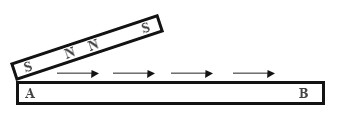
(i) Mention the method of magnetization. (ii) Give the polarity of the ends A and B of the bar after the magnetization. (iii) How will you test that the bar AB is a magnet? (iv) Indicate how you will test for the poles of A and B of the bar. (v) Give one precaution that should be taken during the magnetization process. (vi) Name one other method of magnetization.
(b) The set-up below is used to prepare gases in the laboratory.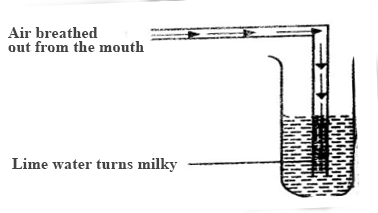
(i) Give the names of the parts labelled I, II, III and IV. (ii) Write down the two names of the method of gas collection. (iii) Explain how the gas collects over the water. (iv) Name two gases that can be prepared using the set-up.
(c) The set-up below shows air being breathed out through the mouth into a test-tube containing lime water.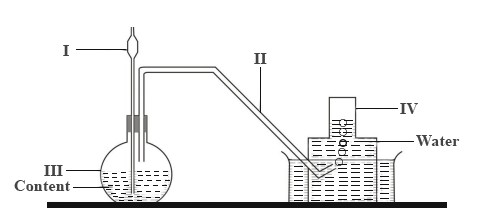
(i) Why does the lime water turn milky? (ii) Identify the milky substance produced. (iii) Write a balanced chemical equation for the reaction.
(iv) Name two other substances present in breathed-out air. (v) What is the aim of the experiment? - (a) What is a living cell?
(b) Give one function of each of the following components of a living cell:
(i) cell membrane (ii) chloroplast (iii) nucleus
(c) Make sketches to show the arrangement of the particles in each of the three states of matter.
(d) What instrument would you use to measure each of the following quantities:
(i) volume of a liquid (ii) mass of a stone (iii) time (iv) speed of the wind? - (a) Name three deficiency diseases associated with diet and state their causes.
(b) (i) What is hard water? (ii) Mention three ways by which hard water can be made soft.
(c) (i) Explain how sound is produced. (ii) State one example each of the following instruments: (α) wind instrument (β) string instrument - (a) State two examples of a (i) carnivore; (ii) herbivore.
(b) What is the difference between egestion and excretion?
(c) Explain briefly why (i) gold is used to make necklaces and earrings. (ii) steel is used instead of iron to make car bodies
(d) (i) What is surface tension? (ii) Explain why the surface of water in a container is not flat but curved. - (a) Copy and complete the table below:
Disease | Causative Agent | Prevention/Control
Cholera | Vibrio spp. | Eating hot food
(i) ............. | Plasmodium | (ii) .............
(iii) ............ | Louse | Personal hygiene
Ringworm | (iv) ............. | (v) .............
(b) Name two different particles of matter which carry (i) a negative charge; (ii) a positive charge; (iii) no charge.
(c) A simple machine moves a load of 20 N through a distance of 2 m. If it uses an effort of 25 N which moves through a distance of 4 m, calculate the (i) work input; (ii) work output; (iii) efficiency of the machine.
Worked solutions to the theory questions are free in the app.
More BECE Integrated Science papers
All 38 Integrated Science papers
 All answers free on Google Play