 BECE Past Questions
BECE 2009 Integrated Science Past Questions and Answers
40 objective questions and 5 theory questions from the 2009 BECE Integrated Science paper. Answers and worked solutions for questions 1 to 10 are below; the rest are free in the app.
Practise this paper free, online or offline


On an iPhone? Download on the App Store
On Android? Get it on Google Play
Paper 1: Objectives
-
Plants are different from animals because they
- A. have protoplasm
- B. have chlorophyll
- C. are able to respire
- D. are able to reproduce sexually
Answer: B -
Which of the following conditions is not required for a current to flow through an electric circuit?
- A. The circuit should be closed
- B. A battery must be present
- C. There must be connecting wires
- D. A bulb must be connected in the circuit
Answer: D -
Which of the following examples is a source of energy?
- A. Electricity
- B. Heat
- C. Light
- D. Wood
Answer: D -
Heat is transferred from the bottom of water in a container to the top by
- A. conduction
- B. convection
- C. radiation
- D. conduction and radiation
Answer: B -
A mercury thermometer works on the principle that
- A. solids expand on heating and contract on cooling
- B. liquids expand on heating and contract on cooling
- C. gases expand on heating and contract on cooling
- D. liquids evaporate when heated to a certain temperature
Answer: B -
In which of the positions Q, R, S, T in the diagram below will a body have the greatest potential energy?
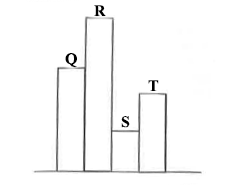
- A. Q
- B. R
- C. S
- D. T
Answer: B -
A solar cell produces electrical energy from
- A. electromagnets
- B. heat
- C. light
- D. sound
Answer: C -
In a third-class lever the
- A. pivot is between the load and effort
- B. pivot is absent
- C. load is between the effort and pivot
- D. effort is between the load and pivot
Answer: D -
At which positions S, R, Q, and P on the lever in the diagram below must a force be applied to lift the load most easily?
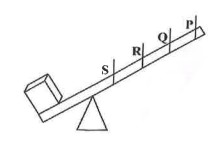
- A. P
- B. Q
- C. R
- D. S
Answer: A -
Which of the following machines works on the same principle as an inclined plane?
- A. Bottle opener
- B. Wheelbarrow
- C. See-saw
- D. Screw
Answer: D
Answers and solutions for questions 11 to 40 are free in the BECE Past Questions app, with timed practice and offline study.
-
Power is defined as the
- A. ability to do work
- B. force to move an object
- C. rate of doing work
- D. ability to replace energy used
-
Which of the following food substances is not involved in respiration?
- A. Amino acids
- B. Fatty acids
- C. Glucose
- D. Vitamins
-
Which of the following organisms is at the beginning of a food chain?
- A. Fish
- B. Grass
- C. Locust
- D. Mosquito
-
The human male sex cell that takes part in reproduction is the
- A. penis
- B. scrotum
- C. sperm
- D. testis
-
The removal of waste products from the cells of organisms is called
- A. assimilation
- B. circulation
- C. exhalation
- D. excretion
-
The central nervous system consists of the
- A. spinal cord and spine
- B. brain and the nerves
- C. brain and the spinal cord
- D. skeletal system and skull
-
Which of the following life processes is not performed by all living things?
- A. Excretion
- B. Photosynthesis
- C. Reproduction
- D. Respiration
-
All veins in the body carry blood that does not contain oxygen with the exception of the veins from the
- A. heart
- B. kidneys
- C. lungs
- D. liver
-
The method of purification of water containing very little impurities is
- A. boiling
- B. chlorination
- C. distillation
- D. filtration
-
Boiling and chlorination are used in water purification to
- A. kill germs
- B. soften water
- C. remove suspended particles
- D. make water colourless
-
The chemical symbol C is the symbol for
- A. Calcium
- B. Chlorine
- C. Carbon
- D. Sodium
-
A substance which is made up of the same kind of atoms is called
- A. A compound
- B. A mixture
- C. An element
- D. An ion
-
Which of the following processes results in the formation of new substances?
- A. Heating camphor
- B. Cooling water to form ice
- C. Adding saliva to cooked yam
- D. Mixing iron dust and sand together
-
When elements combine to form a compound the
- A. Constituents can be separated by a physical process
- B. Volume of the compound is the sum of the volumes of the constituents
- C. Reaction does not involve a heat change
- D. Reaction can be represented by a chemical formula
-
Which of the following organisms is likely to increase the oxygen content of the water in a pond?
- A. Fish
- B. Tadpole
- C. Mosquito larva
- D. Water lily
-
Which of the following parasites is a plant?
- A. Bilharzia
- B. Dodder
- C. Lice
- D. Tapeworm
-
The part of the soil that is most important for the growth of plants is
- A. Clay
- B. Humus
- C. Sand
- D. Silt
-
Which of the following diseases may be associated with water?
- A. Chicken pox
- B. Cholera
- C. Small pox
- D. Tetanus
-
The mosquito and housefly are harmful in that they
- A. Suck blood
- B. Bite and cause pain
- C. Settle on food
- D. Spread diseases
-
Which of the following diseases affects the central nervous system?
- A. Cerebro Spinal Meningitis (CSM)
- B. Poliomyelitis
- C. Measles
- D. Yellow Fever
-
Day and night occur because the earth
- A. Moves round the sun
- B. Moves from east to west
- C. Moves round the moon
- D. Rotates on its axis
-
Bronze is an alloy of
- A. Iron and carbon
- B. Zinc and copper
- C. Iron and zinc
- D. Copper and tin
-
Which of the following substances causes acid rain when released into the atmosphere?
- A. Carbon dioxide
- B. Water vapour
- C. Sulphur dioxide
- D. Cement dust
-
Which of the following gases helps in rusting?
- A. Carbon dioxide
- B. Hydrogen
- C. Oxygen
- D. Nitrogen
-
The force of attraction between molecules of different substances is called
- A. Adhesion
- B. Cohesion
- C. Tension
- D. Viscosity
-
A metal block has a mass of 0.1kg. Calculate its volume if the density is 1.0 kgm-3.
- A. 0.01 m3
- B. 0.10 m3
- C. 1.00 m3
- D. 10.00 m3
-
The food manufactured by a plant is distributed to all parts of the plant through the
- A. Chlorophyll
- B. Phloem
- C. Stomata
- D. Xylem
-
Some insects are able to walk on water because
- A. They are lighter than water
- B. Their skins cannot be penetrated by water
- C. The surface of the water acts like an elastic skin
- D. The surface of water is curved
-
Oxygen is made available to all cells of the human body by the
- A. Plasma
- B. Platelets
- C. White blood cells
- D. Red blood cells
-
The force which pulls all objects towards the centre of the earth is the
- A. Frictional force
- B. Electrostatic force
- C. Gravitational force
- D. Rotational force
Paper 2: Theory
- (a) In an experiment, four nails 1, 2, 3 and 4 are fixed with candle wax onto a metal bar and one end of the bar is heated by means of boiling water. A, B, C and D are thermometers inserted in holes along the bar to measure the temperatures at the various points.
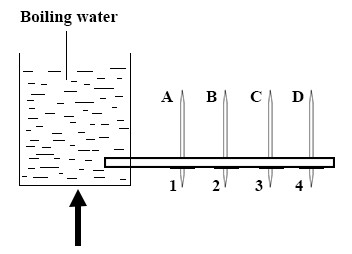
(i) What is the temperature of the boiling water?
(ii) State the observations that will be made about nails 1, 2, 3, and 4.
(iii) State the observations that will be made about the temperature recorded by thermometers A, B, C, and D.
(iv) What mode of heat transfer is demonstrated in the experiment?
(v) State one effect of heat that is associated with the experiment.
(vi) State the aim of the experiment.
(b) In an experiment, a student took three iron nails and placed them in separate test tubes labeled A, B, and C. After three days, the nail in set-up A rusted, while those in B and C did not.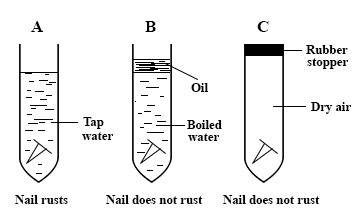
(i) Why was the water in set-up B boiled?
(ii) Explain the function of the oil on top of the water in set-up B.
(iii) State the purpose of the rubber stopper in set-up C.
(iv) Why did the nail in set-up A rust?
(v) Suggest an aim for the experiment.
(vi) Explain why oil or grease is applied to the surface of a metal to prevent rusting.
(c) In an experiment, the following activities were carried out on two green leaves A and B. Leaf A was from a plant placed in the sunlight for some time while leaf B was from a plant placed in a dark cupboard for 24 hours.
Activity
I. Leaves dipped in boiling water for 1 minute
II. Leaves dipped in warm alcohol
III. Leaves washed in cold water
IV. Leaves dipped into iodine solution
After dipping in the iodine solution, it was observed that leaf A changed colour while leaf B did not change colour.
Answer the following questions:
(i) Explain why each of the activities I, II, III, and IV was carried out.
(ii) State the color change of leaf A.
(iii) Explain why leaf A changed color but leaf B did not.
(iv) Suggest an aim for the experiment. - (a) Explain each of the following observations in nature:
(i) In the depths of the ocean where it is always dark, there are no green plants.
(ii) On an island where there are no insects and birds, the pawpaw plant produces only flowers but no fruits.
(b) Describe how soil is formed.
(c) (i) State the laws of reflection.
(ii) Draw a labeled diagram to show the reflection of light on a plane mirror. - (a) A child is found not to be able to see at night.
(i) What deficiency disease may the child be suffering from?
(ii) What food nutrient is the child lacking?
(iii) List two sources of food substances that can provide the nutrient the child lacks.
(b) (i) What is an atom?
(ii) Name the components of an atom that determine:
(α) mass of an atom,
(β) charge of an atom.
(iii) Why is an atom electrically neutral?
(c) (i) What is friction?
(ii) Give two bad effects of friction.
(iii) Give two situations where friction is advantageous. - (a) (i) Explain heredity.
(ii) Give two examples of hereditary characters.
(b) Explain whether each of the following processes is a chemical or a physical change:
(i) Rusting;
(ii) Burning;
(iii) Filtration;
(iv) Expansion of copper.
(c) (i) What is a simple machine?
(ii) Name two types of simple machines.
(iii) Explain why the efficiency of a machine cannot be equal to 100%. - (a) Study the organisms listed below: Earthworm, Sheep, Cassava plant, Grasshopper, Man, Hen. Draw a food chain using four of the organisms.
(b) (i) Name four types of forces apart from friction.
(ii) Give three effects of a force.
(c) A pupil in a classroom can only see clearly on the blackboard when sitting at the front.
(i) State the eye defect the child is suffering from.
(ii) Explain why the child is unable to see clearly when far from the blackboard.
(iii) How can the defect be corrected?
Worked solutions to the theory questions are free in the app.
More BECE Integrated Science papers
All 38 Integrated Science papers
 All answers free on Google Play