 BECE Past Questions
BECE 2006 Integrated Science Past Questions and Answers
40 objective questions and 5 theory questions from the 2006 BECE Integrated Science paper. Answers and worked solutions for questions 1 to 10 are below; the rest are free in the app.
Practise this paper free, online or offline


On an iPhone? Download on the App Store
On Android? Get it on Google Play
Paper 1: Objectives
-
The property of a rock that makes it different from water is that it has
- A. Fixed volume
- B. Fixed shape
- C. Density
- D. Mass
Answer: B -
A plane mirror can be described as opaque because it
- A. Absorbs all the light incident on it
- B. Reflects all the light incident on it
- C. Allows all the light incident on it to pass through it
- D. Partly absorbs and partly allows the light incident on it to pass through it
Answer: B -
Wood is used to make the handles of cooking utensils because it is
- A. A bad conductor of heat
- B. A good absorber of heat
- C. A good reflector of heat
- D. A bad radiator of heat
Answer: A -
Ventilation holes are made at the upper part of a door to allow air to rise by
- A. Convection
- B. Conduction
- C. Radiation
- D. Reflection
Answer: A -
When the north poles of two magnets are brought together they
- A. Attract each other
- B. Repel each other
- C. First attract and then repel each other
- D. Have no effect on each other
Answer: B -
A fuse is used in an electrical circuit to
- A. Measure the energy used up
- B. Protect appliances
- C. Provide more current
- D. Make sure current flows continuously
Answer: B -
The angle between an incident ray and a reflecting surface is 20°. Determine the angle of reflection.
- A. 60°
- B. 70°
- C. 90°
- D. 110°
Answer: B -
A screw is a machine which works in the same way as
- A. A lever
- B. An incline plane
- C. A wheel and axle
- D. A pulley
Answer: B -
Power is defined as the rate at which
- A. Energy is used
- B. Temperature rises
- C. A body travels
- D. A body cools down
Answer: A -
An example of a lever in which the effort is applied at the middle is a
- A. Wheelbarrow
- B. Pair of forceps
- C. Pair of scissors
- D. Beam balance
Answer: B
Answers and solutions for questions 11 to 40 are free in the BECE Past Questions app, with timed practice and offline study.
-
A simple way of maintaining the efficiency of a machine is by
- A. Oiling its parts
- B. Fitting new parts on the machine
- C. Making sure it is always working
- D. Making sure it works at low speed
-
The part of a seed which grows to become the shoot of a plant is the
- A. Cotyledon
- B. Plumule
- C. Radicle
- D. Testa
-
One disease that affects the nervous system of humans is
- A. Filariasis
- B. Measles
- C. Poliomyelitis
- D. Typhoid
-
Which of the following life processes leads to the release of energy?
- A. Absorption of food
- B. Digestion of food
- C. Photosynthesis
- D. Respiration
-
Mineral salts in dead organisms are released into the soil by a process called
- A. Decomposition
- B. Diffusion
- C. Leaching
- D. Osmosis
-
Spectacles fitted with concave lenses are worn by people suffering from
- A. Loss of accommodation
- B. Total blindness
- C. Long sightedness
- D. Short sightedness
-
Which of these organs in humans releases carbon dioxide as a waste product?
- A. Kidney
- B. Liver
- C. Lung
- D. Skin
-
Farmers do not plant the stems of maize because the stems
- A. Do not have buds
- B. Are difficult to obtain
- C. Dry up too quickly
- D. Do not contain food
-
Which of the following ways of treating water makes the water soft?
- A. Adding alum
- B. Adding washing soda
- C. Chlorinating
- D. Filtering
-
Water that needs a small amount of soap to form lather is described as
- A. Clean
- B. Hard
- C. Pure
- D. Soft
-
Common salt (sodium chloride) is obtained from sea water by
- A. Condensation
- B. Evaporation
- C. Precipitation
- D. Sublimation
-
The chemical formula of a compound describes the
- A. Ratio in which the elements are combined
- B. Number of molecules in a compound
- C. Nature of the bonding in the compound
- D. State of matter of the compound
-
Which of the following solvents can be used to remove grease from the hand?
- A. Alcohol
- B. Palm kernel oil
- C. Turpentine
- D. Water
-
How many different elements are present in the compound H2SO4?
- A. 2
- B. 3
- C. 6
- D. 7
-
Producers in an ecosystem are plants that
- A. Feed on other plants
- B. Feed on dead materials
- C. Manufacture their own food
- D. Attract insects
-
The disease caused by the Plasmodium parasite is
- A. Cholera
- B. Malaria
- C. Onchocerciasis
- D. Schistosomiasis
-
Vaccination is carried out to
- A. Enable sores to heal faster
- B. Increase the red blood cells of a person
- C. Enable a person's white blood cells to fight against diseases
- D. Kill germs in a person's body
-
Which of the following farming practices is likely to make the soil poor in nutrients?
- A. Adding chemical fertilizer during each planting season
- B. Planting cover crops on the land
- C. Tilling the land before planting
- D. Burning the vegetation after clearing
-
The type of cloud found closest to the earth's surface is
- A. Cirrus
- B. Cumulus
- C. Stratus
- D. Stratocumulus
-
The amount of water vapour in the atmosphere is called
- A. Fog
- B. Humidity
- C. Rain
- D. Temperature
-
The planet which is farthest away from the sun is
- A. Jupiter
- B. Mercury
- C. Mars
- D. Neptune
-
Which of the following gases is involved in the process of rusting?
- A. H2
- B. CO2
- C. O2
- D. N2
-
A non-reactive metal can be identified from other metals because its surface is
- A. Hard
- B. Shiny
- C. Smooth
- D. Rough
-
The property of a metal that makes it possible for it to be drawn into a wire is called
- A. Conductivity
- B. Ductility
- C. Malleability
- D. Resistivity
-
The main reason why food is processed is to make it
- A. Taste better
- B. Preservable for a longer period
- C. Possible to eat without cooking
- D. Richer in nutrients
-
The process by which kerosene rises up to the wick of a lantern is known as
- A. Capillarity
- B. Diffusion
- C. Surface tension
- D. Osmosis
-
Which of the following statements about friction is not true?
- A. It wears off materials
- B. It produces heat
- C. It opposes motion
- D. It increases speed
-
Arteries are blood vessels which carry
- A. Blood to the heart
- B. Carbon dioxide to the air
- C. Blood away from the heart
- D. Oxygen to the lungs
-
Which of the following structures is not involved in blood circulation?
- A. Capillary
- B. Heart
- C. Muscle
- D. Vein
-
A substance of mass 10 kg has a density of 2.0 kgm-3. Calculate its volume.
- A. 0.2 m³
- B. 5.0 m³
- C. 10.0 m³
- D. 20.0 m³
Paper 2: Theory
- (a) The diagram below shows the electrical method of magnetizing a nail.
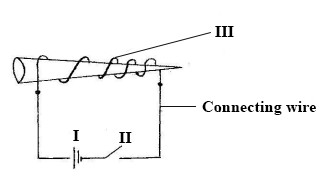
(i) Give the names of the parts of the circuit labelled I, II and III.
(ii) List two substances that can be made into a magnet.
(iii) State two other methods of making magnets.
(iv) Name one material that is used in making an electrical wire.
(v) Give two properties of the material you named in (iv) which makes it useful as a wire.
(b) The diagram below shows the set-up for the preparation of carbon dioxide in the laboratory.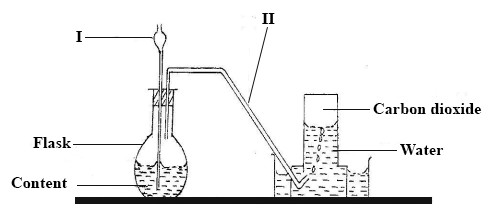
(i) Name the parts of the set-up labelled I and II.
(ii) Give the name of the method of gas collection shown in the diagram.
(iii) Give one property of gases collected over water.
(iv) What will happen if component I does not dip into the contents of the flask?
(v) List two compounds that form the content of the flask.
(vi) Write down the systematic name of carbon dioxide.
(c) In an experiment, yam pap is put into two test tubes A and B containing iodine solution. The test tubes are warmed slightly to a temperature of 37⁰C and saliva is put into test tube B.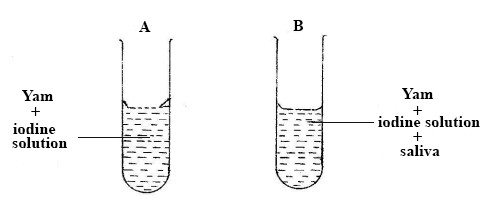
(i) State the colour of the content of test tube A.
(ii) State the colour changes of the contents in test tube B after 3 minutes.
(iii) Fehling's solution is added to the contents of test tube B after the 3 minutes and it turns brick-red. What food substance is present?
(iv) Give two functions of saliva in eating.
(v) Why was it necessary to warm the contents of the test tubes to about 37⁰C?
(vi) Give two aims of the experiment. - (a) (i) State two conditions that are required for photosynthesis to take place.
(ii) How would you show that starch is formed during photosynthesis?
(b) Write a balanced chemical equation to show the reaction between hydrogen and oxygen.
(c) (i) What is a satellite?
(ii) Give one example of a natural satellite.
(iii) List two uses of artificial satellites. - (a) Define
(i) self-pollination
(ii) cross-pollination
(b) State two ways in which cross-pollinated plants are better than self-pollinated plants.
(c) Sodium chloride is prepared by the reaction between dilute hydrochloric acid and sodium hydroxide.
(i) Write a balanced equation for the reaction.
(ii) What is the name given to this reaction?
(d) Describe an experiment to show that pressure acts in all directions in a liquid. - (a) (i) What is a vector of a disease?
(ii) State two methods each to destroy vectors of (α) river blindness, (β) malaria.
(b) Write down the systematic names of the following compounds: (i) CaCO3 (ii) FeS (iii) NaCl (iv) NaOH
(c) (i) Give two properties common to all states of matter.
(ii) A stone of mass 60 g raises water level from 60 cm3 to 75 cm3. Calculate its density. - (a) Mention five differences between plants and animals.
(b) Define each of the following terms, giving one example:
(i) Compound
(ii) Element
(c) (i) Give two differences between an electrical insulator and a conductor.
(ii) Draw and label a simple electrical circuit made up of a cell and a switch connected to two electric bulbs connected in parallel.
Worked solutions to the theory questions are free in the app.
More BECE Integrated Science papers
All 38 Integrated Science papers
 All answers free on Google Play