 BECE Past Questions
BECE 2005 Integrated Science Past Questions and Answers
40 objective questions and 5 theory questions from the 2005 BECE Integrated Science paper. Answers and worked solutions for questions 1 to 10 are below; the rest are free in the app.
Practise this paper free, online or offline


On an iPhone? Download on the App Store
On Android? Get it on Google Play
Paper 1: Objectives
-
Hydrogen is represented by the chemical symbol H2. This symbol represents
- A. Two molecules of hydrogen
- B. Two atoms of hydrogen
- C. Two elements of hydrogen
- D. Two ions of hydrogen
Answer: B -
A metal expands when there is
- A. An increase in heat energy
- B. An increase in number of electrons
- C. A decrease in potential energy
- D. A decrease in distance between atoms
Answer: A -
A safety device which opens an electric circuit to prevent too much current from passing through the circuit is the
- A. Earth wire
- B. Lightning conductor
- C. Fuse
- D. Switch
Answer: C -
An object is placed 20 cm in front of a plane mirror. The distance between the object and the image is
- A. 20 cm
- B. 40 cm
- C. 60 cm
- D. 80 cm
Answer: B -
In which of the following circuit diagrams will the bulb light?
- A.
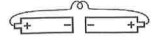
- B.
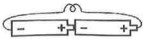
- C.
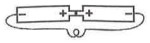
- D.
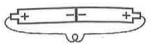
Answer: B - A.
-
The source of all forms of energy can be traced to
- A. Clouds
- B. Earthquakes
- C. Tides
- D. Sunlight
Answer: D -
When mango is falling from a tree, its potential energy is changed to
- A. Sound energy
- B. Heat energy
- C. Kinetic energy
- D. Chemical energy
Answer: C -
Electricity is used by appliances to do work. This means that electricity is a form of
- A. Energy
- B. Force
- C. Generator
- D. Machine
Answer: A -
A force of 2N moves a body through a distance of 10 m. Calculate the work done.
- A. 5 J
- B. 8 J
- C. 12 J
- D. 20 J
Answer: D -
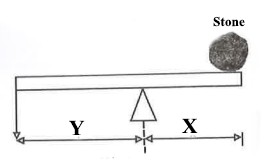
The distance X in the lever system shown is the- A. Effort distance
- B. Load distance
- C. Fulcrum
- D. Lever arm
Answer: B
Answers and solutions for questions 11 to 40 are free in the BECE Past Questions app, with timed practice and offline study.
-
Less effort is required to move the stone when the- A. Distance Y is equal to X
- B. Distance Y is greater than X
- C. Distance Y is less than X
- D. Stone is at the pivot
-
An omnivore is an animal that feeds on
- A. Raw food
- B. Fresh foods
- C. Cooked foods
- D. All kinds of food
-
A meal containing all the essential nutrients in the right amounts is said to be
- A. Delicious
- B. Balanced
- C. Well-cooked
- D. Rich in fibre
-
The disease associated with insufficient intake of proteins in children is
- A. Goitre
- B. Kwashiorkor
- C. Rickets
- D. Scurvy
-
When testing for reducing sugar in a food substance using Fehling's solution, the expected colour change is
- A. Blue
- B. Purple
- C. Blue-black
- D. Brick-red
-
The substance that enables green plants to trap sunlight for the manufacture of food is
- A. Chlorophyll
- B. Chloroplast
- C. Phloem
- D. Xylem
-
In man, the conversion of poisonous substances into harmless forms takes place in the
- A. Bladder
- B. Duodenum
- C. Kidney
- D. Liver
-
Which of the following life processes is represented by the equation below?
Glucose + Oxygen → Water + Carbon dioxide + Energy- A. Digestion
- B. Excretion
- C. Photosynthesis
- D. Respiration
-
Chlorine gas is passed through water during filtration to
- A. Kill germs
- B. Cause suspended particles to settle
- C. Soften the water
- D. Give taste to the water
-
Arrange the following sources of water in the order of increasing contamination.
I. Rain
II. Stream
III. Well
IV. Borehole- A. I, II, IV, III
- B. II, III, I, IV
- C. I, IV, III, II
- D. III, II, IV, I
-
A solution in which no more solute will dissolve at a given temperature is said to be
- A. Concentrated
- B. Dilute
- C. Homogeneous
- D. Saturated
-
A clear solution of sugar was cooled from 100°C to 25°C. Some solid sugar was seen to have formed out of the solution after the cooling. This shows that sugar
- A. Does not dissolve in cold water
- B. Does not dissolve in hot water
- C. Dissolves more in hot water than in cold water
- D. Dissolves more in cold water than in hot water
-
Water is sometimes referred to as a universal solvent because it
- A. Is the purest liquid on earth
- B. Is the commonest liquid on earth
- C. Is found in all living cells
- D. Dissolves most substances
-
The charge of sulphur in the compound SO2 is
- A. -2
- B. +2
- C. -4
- D. +4
-
The part of the soil that supports plant growth is that part which
- A. Dissolves in water
- B. Retains less water
- C. Contains the humus
- D. Is closer to the roots
-
Plants do not grow well in gravel because the
- A. Air spaces are too big to hold water
- B. Air spaces are too small for the roots
- C. Particles cannot absorb air
- D. Particles cannot contain nutrients
-
Which of the following parasites lives in the blood of humans?
- A. Louse
- B. Plasmodium
- C. Tapeworm
- D. Tick
-
The carrier of the malaria parasite is the
- A. Black fly
- B. Tsetse fly
- C. Female anopheles mosquito
- D. Male anopheles mosquito
-
Which of the following practices is a method of controlling guinea worm disease?
- A. Clearing bushes around homes
- B. Ensuring that rivers flow rapidly
- C. Protecting one's feet before stepping into rivers
- D. Protecting oneself against mosquito bites
-
The humidity of the atmosphere is measured with
- A. An anemometer
- B. A barometer
- C. A hygrometer
- D. A hydrometer
-
How long does it take the moon to move completely around the earth?
- A. 1 day
- B. 28 days
- C. 30 days
- D. 365 days
-
Steel is an example of a
- A. Solid in solid mixture
- B. Solid in liquid mixture
- C. Gas in solid mixture
- D. Liquid in liquid mixture
-
Which of the following elements is a metal?
- A. Carbon
- B. Nitrogen
- C. Sulphur
- D. Sodium
-
Metals that are usually used to make ornaments have low
- A. Conductivity
- B. Ductility
- C. Malleability
- D. Reactivity
-
The food processing method in which germs are prevented from multiplying by applying a low temperature is
- A. Canning
- B. Drying
- C. Pickling
- D. Refrigeration
-
The function of blood platelets is to
- A. Carry carbon dioxide
- B. Fight against diseases
- C. Help in clotting
- D. Help maintain constant body temperature
-
A fish is able to swim with little resistance in water because it has
- A. Fins
- B. Gills
- C. A streamlined body
- D. The ability to make use of a limited oxygen supply
-
When a person jumps up, he/she is able to come down because of the
- A. Pull of the earth's gravitational force
- B. Pull of the earth's magnetic force
- C. Resistance of the earth's atmosphere to the upward motion
- D. Pressure of the earth's atmosphere on the person
-
A metal displaces 5.0 cm³ of water when completely immersed in water. If the mass of the metal is 35.0 g, calculate its density.
- A. 7.0 g/cm³
- B. 30.0 g/cm³
- C. 40.0 g/cm³
- D. 175.0 g/cm³
-
Oxygen from the air is able to get into the blood by
- A. Capillarity
- B. Diffusion
- C. Osmosis
- D. Suction
Paper 2: Theory
- (a) (i) Draw and label the diagrams to show what the pupil will observe in set-up A and set-up B.
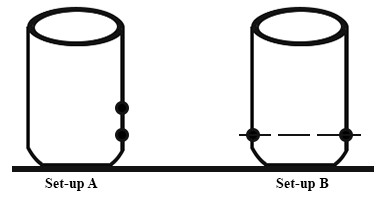 (ii) Explain the observations in set-up A and set-up B. (iii) What is the aim of set-up A? (iv) What is the aim of set-up B?
(b) In an experiment, equal volumes of dilute hydrochloric acid (Solution A) and dilute sodium hydroxide (Solution B) are mixed together to form solution C.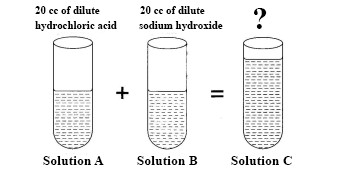
(i) What is the volume of solution C? (ii) Red litmus paper and blue litmus paper are dipped in turns into solutions A, B and C. State the observations you will make in all six cases. (iii) Give the name of the reaction that took place between solution A and solution B. (iv) Identify solution C. (v) State what will happen when solution C is heated.
(c) The table below gives the steps that were followed in an experiment to test for starch in a green leaf freshly taken from a tree.
Stages in the test for starch:
I. Leaf is put into boiling water for 1 minute
II. Leaf is dipped in alcohol warmed in a hot water bath
III. Leaf is washed in cold water
IV. Leaf is dipped into iodine solution
(i) State the reason for carrying out each of the activities in stages I, II and III. (ii) What happens when the leaf is dipped in iodine solution? (iii) Give the colour changes of the leaf from the beginning of the experiment to the end of the experiment. (iv) Why is the alcohol warmed indirectly in a water bath? (v) Explain what will be observed if the test is carried out on a leaf taken from a plant kept in a dark room for 1 day. - (a) (i) Define respiration. (ii) Give two differences between photosynthesis and respiration.
(b) (i) List the chemicals used in the preparation of carbon dioxide in the laboratory. (ii) How would you test for carbon dioxide in the laboratory?
(c) (i) State four effects of a force on a body. (ii) A horizontal force of 250 N is applied to pull a piece of wood lying on a smooth surface through a distance of 20 m. Calculate the work done. - (a) (i) Give two differences between a vein and an artery. (ii) State two functions of red blood cells. (iii) Mention two diseases associated with the circulatory system.
(b) (i) Classify the following processes as physical or chemical changes: Cooking of food; Melting of candle; Melting of ice; Rusting of iron; Dissolution of sugar in water; Burning of wood into ash.
(ii) Explain the basis of the classification in (b)(i).
(c) (i) State the laws of reflection. (ii) Draw a ray diagram of light incident at an angle of 40° on the surface of a plane mirror. - (a) (i) Explain vegetative reproduction. (ii) State two differences between sexual and vegetative reproduction. (iii) Give one advantage of vegetative reproduction.
(b) (i) Name suitable solvents for the following substances: oil paint, fat, common salt, plant pigments. (ii) What is the name of a substance dissolved by a solvent?
(c) The diagram below represents a simple machine.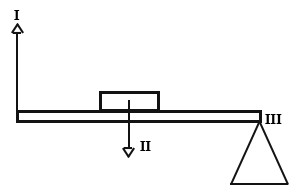
(i) What class of simple machine does it represent? (ii) Name the parts labelled I, II, and III. (iii) Give two examples of machines used in everyday life that work on the same principle as the system illustrated above. - (a) (i) Give two differences between a parasite and a vector.
(ii) Write down the names of three endo-parasites and their hosts.
(b) An atom has eight protons and nine neutrons.
(i) Draw the atomic structure of the atom.
(ii) If the atom gains two extra electrons what will be the charge of the ion formed? (Show working)
(c) (i) Three insoluble liquids X, Y and Z are shaken together in a bottle and allowed to settle. The densities of the liquids are as follows:
X = 1.5 g/cm3
Y = 3.0 g/cm3
Z = 1.0 g/cm3
Draw a sketch to show the various layers into which the liquids settle.
(ii) The density of petrol is 0.9 g/cm3. Calculate the volume of 300 g of petrol.
Worked solutions to the theory questions are free in the app.
More BECE Integrated Science papers
All 38 Integrated Science papers
 All answers free on Google Play