 BECE Past Questions
BECE 2003 Integrated Science Past Questions and Answers
40 objective questions and 4 theory questions from the 2003 BECE Integrated Science paper. Answers and worked solutions for questions 1 to 10 are below; the rest are free in the app.
Practise this paper free, online or offline


On an iPhone? Download on the App Store
On Android? Get it on Google Play
Paper 1: Objectives
-
The method used to separate an insoluble solid from a liquid is
- A. Crystallization
- B. Distillation
- C. Filtration
- D. Sublimation
Answer: C -
The scent of a perfume sprayed at one corner of a room fills the entire room through
- A. Conduction
- B. Diffusion
- C. Osmosis
- D. Radiation
Answer: B -
Which of the following processes is a physical change?
- A. Rusting of iron
- B. Burning of wood
- C. Formation of water from hydrogen and oxygen
- D. Solidification of water into ice
Answer: D -
Atoms of the same element have the same
I. number of electrons
II. number of protons
III. chemical properties- A. I and II only
- B. II and III only
- C. I and III only
- D. I, II and III
Answer: D -
The unit of measurement of energy is
- A. Joule
- B. Kelvin
- C. Newton
- D. Watt
Answer: A -
Which of the following energy transformations takes place at a hydroelectric power station?
- A. Potential energy → Kinetic energy → Electrical energy
- B. Potential energy → Sound energy → Electrical energy
- C. Kinetic energy → Sound energy → Electrical energy
- D. Electrical energy → Light energy → Heat energy
Answer: A -
A drawing of magnetic line of force provides information on the
- A. Source of the field
- B. Type of magnet
- C. Strength of the field
- D. Length of the magnet
Answer: C -
A bottle of water removed from a refrigerator soon becomes covered with droplets of water because the
- A. Bottle is porous
- B. Bottle is full of water
- C. Water in the surrounding atmosphere is colder than the water in the bottle
- D. Water in the surrounding atmosphere is warmer than the water in the bottle
Answer: D -
The volume of a metal ball was determined by dropping it into a measuring cylinder containing 20 cm³ of water, and the water level rose to 35 cm³. If the mass of the ball is 35 g, calculate its density.
- A. 1.0 g/cm³
- B. 1.6 g/cm³
- C. 1.8 g/cm³
- D. 2.3 g/cm³
Answer: D -
A boy stepped on a banana peel on the ground and fell because the
- A. Boy was not wearing shoes
- B. Ground was too hard
- C. Banana peel reduced the friction on the ground
- D. Banana peel increased the friction on the ground
Answer: C
Answers and solutions for questions 11 to 40 are free in the BECE Past Questions app, with timed practice and offline study.
-
Which of the following conditions describes a first-class lever?
- A. The load is between the effort and pivot
- B. The pivot is between the effort and the load
- C. The effort is between the pivot and the load
- D. The load arm is equal to the effort arm
-
A man did 75 J of work by lifting a 50 N load from the floor onto a shelf. Calculate the height of the shelf.
- A. 0.67 m
- B. 1.50 m
- C. 25.00 m
- D. 125.00 m
-
The lion is a carnivore because it eats
- A. Flesh
- B. Grass
- C. Fruits
- D. Uncooked food
-
The structure which helps a fish to breathe under water is the
- A. Gill
- B. Air sac
- C. Operculum
- D. Mouth
-
The thorns found on some plants are used for
- A. Breathing
- B. Protection
- C. Absorbing water from the air
- D. Resisting bush fires
-
The following characteristics are features of all living things except ability to
- A. Bring forth young ones
- B. Excrete
- C. Grow
- D. Move from place to place
-
Which of the following parasites lives on field animals?
- A. Aphid
- B. Plasmodium
- C. Tick
- D. Tapeworm
-
The greatest danger faced by mammals living on land is
- A. Becoming too cold
- B. Becoming too hot
- C. Losing water through evaporation
- D. Gaining too much water through absorption
-
The insect responsible for the spread of malaria is the
- A. Female anopheles mosquito
- B. Housefly
- C. Male anopheles mosquito
- D. Tsetse fly
-
Which of the following substances is added to the soil to reduce its acidity?
- A. Charcoal
- B. Humus
- C. Lime
- D. Manure
-
The figure below shows the arrangement of parts of the soil when some soil sample was shaken with water in a glass cylinder and allowed to settle.
Use it to answer the questions 21 and 22 below.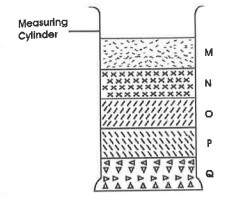
Which of the labelled layers contains organic matter?- A. M
- B. N
- C. O
- D. P
-
The figure below shows the arrangement of parts of the soil when some soil sample was shaken with water in a glass cylinder and allowed to settle.
Use it to answer the questions 21 and 22 below.
The layer which does not have the ability to retain much water is- A. N
- B. O
- C. P
- D. Q
-
Which of the following characteristics applies to only plants?
- A. Excretion of waste materials
- B. Response to stimuli
- C. Ability to manufacture food from simple substances
- D. Ability to respire
-
The waste products of respiration are
- A. glucose and oxygen
- B. carbon dioxide and water
- C. carbon dioxide and heat
- D. oxygen and water
-
The function of the lungs is to
- A. maintain a constant amount of water in the body
- B. absorb oxygen from the blood
- C. absorb carbon dioxide from the blood
- D. maintain the temperature of the body constant
-
Which of the following plants reproduce(s) vegetatively?
I. Banana
II. Mango
III. Ginger- A. II only
- B. I and II only
- C. I and III only
- D. III only
-
The process which takes place in all living cells is
- A. digestion
- B. fertilization
- C. photosynthesis
- D. respiration
-
The food substance found in yam is
- A. carbohydrate
- B. oil
- C. protein
- D. vitamin
-
The end-products of the digestion of fats and oils are
- A. amino acids and glucose
- B. amino acids and glycerol
- C. fatty acids and glycerol
- D. fatty acids and amino acids
-
Which of the following factors promote plant germination?
I. Adequate temperature
II. Moisture
III. Good soil- A. I and II only
- B. I and III only
- C. II and III only
- D. I, II and III
-
The female part of a flower is the
- A. calyx
- B. pistil
- C. petal
- D. stamen
-
Which of the following substances breaks down fats into tiny droplets during digestion?
- A. Bile
- B. Gastric juice
- C. Pancreatic juice
- D. Saliva
-
Blood in the urine is a symptom of
- A. bilharzia
- B. cholera
- C. gonorrhoea
- D. typhoid
-
A free movement of the bowels is aided by
- A. sleeping at least 6 hours a day
- B. washing one's body at least twice a day
- C. eating fatty foods
- D. eating foods containing fibre
-
Which of the following diseases is spread through air?
- A. AIDS
- B. Measles
- C. Typhoid
- D. Yaws
-
How many days in a month does the moon appear?
- A. 7 days
- B. 14 days
- C. 21 days
- D. 28 days
-
The earth moves completely round the sun once in every
- A. 1 day
- B. 28 days
- C. 30 days
- D. 365 days
-
A smaller heavenly body, which orbits a bigger one could be described as a
- A. comet
- B. meteor
- C. moon
- D. sun
-
Which of the following parasites is a plant?
- A. Aphid
- B. Dodder
- C. Flea
- D. Jigger
-
Which of the following substances is not a constituent of a balanced diet?
- A. Carbohydrate
- B. Protein
- C. Table salt
- D. Vitamins
Paper 2: Theory
- (a) (i) Define photosynthesis.
(ii) Give two ways in which photosynthesis is important to animals.
(b) Name three sources of chemical energy.
(c) Describe how you would separate a mixture of sodium chloride and sand.
(d) Complete and balance the following chemical reaction: CaCO3 + HCl →
(e) Two dry cells, a switch, and a bulb are connected in series. Draw and label a circuit diagram of the arrangement. - (a) State two precautions that should be taken to prevent the spread of each of the following diseases:
(i) cholera
(ii) smallpox
(b) Describe how you would test for starch in a leaf.
(c) (i) Explain why an inclined plane is classified as a machine.
(ii) Give two reasons why the output energy of a machine is always less than the input energy.
(d) Draw and label the structure of an atom containing three electrons. Indicate the charges of the particles. - (a) Name the two processes that lead to the formation of seeds in a flowering plant.
(b) (i) Give five components of blood.
(ii) State three functions of blood.
(c) (i) What is an electrical insulator?
(ii) Mention three examples of insulators.
(iii) Give two characteristics of an insulator that explain its behavior.
(d) Classify the following substances under the three states of matter: petrol, palm oil, soap, carbon dioxide, corn flour, smoke. - (a) (i) What is a deficiency disease?
(ii) Give two deficiency diseases and their causes.
(b) (i) State the importance of excretion in living organisms.
(ii) Name two excretory organs of the human body and the substances they excrete.
(c) (i) Explain why gases are more compressible than solids.
(ii) Give two areas where the compressible nature of a gas is applied.
(d) A piece of stone is dropped from a height to the ground. State the energies possessed by the stone:
(i) just before it was released from the maximum point;
(ii) midway between the fall;
(iii) just before it hit the ground.
Worked solutions to the theory questions are free in the app.
More BECE Integrated Science papers
All 38 Integrated Science papers
 All answers free on Google Play