 BECE Past Questions
BECE 2004 Integrated Science Past Questions and Answers
40 objective questions and 5 theory questions from the 2004 BECE Integrated Science paper. Answers and worked solutions for questions 1 to 10 are below; the rest are free in the app.
Practise this paper free, online or offline


On an iPhone? Download on the App Store
On Android? Get it on Google Play
Paper 1: Objectives
-
Which of the following processes of conversion of the states of matter is correct?
- A. Solid (heat) → gas (heat) → liquid
- B. Solid (cool) → liquid (cool) → gas
- C. Gas (heat) → liquid (heat) → solid
- D. Gas (cool) → liquid (cool) → solid
Answer: D -
The types of energy produced when the hands are vigorously rubbed against each other are
- A. Chemical and electrical energy
- B. Heat and sound energy
- C. Heat and light energy
- D. Electrical and light energy
Answer: B -
When a thermometer is put in hot water, the mercury level rises because the mercury increases in
- A. Density
- B. Mass
- C. Volume
- D. Weight
Answer: C -
The modes of heat transfer involved in the process of heating water in a bucket, from the bottom until it boils are
- A. Conduction and convection
- B. Conduction and radiation
- C. Convection and radiation
- D. Conduction, convection and radiation
Answer: A -
Which of the following items converts chemical energy to electrical energy?
- A. Dry cell
- B. Electric bulb
- C. Loudspeaker
- D. Microphone
Answer: A -
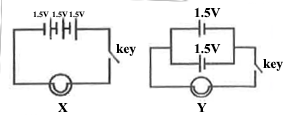
Which of the following statements is correct about the circuit diagrams above? The cells in diagram- A. X are in series and the key is open
- B. X are in parallel and the key is open
- C. Y are in series and the key is closed
- D. Y are in parallel and the key is closed
Answer: A -
The total emf of the cells in diagram Y is- A. 4.50 V
- B. 3.00 V
- C. 1.50 V
- D. 0.75 V
Answer: C -
It is easier to move a heavy load with a crowbar when the
- A. Effort distance is shorter than the load distance
- B. Effort distance is longer than the load distance
- C. Effort distance is equal to the load distance
- D. Effort is equal to the load
Answer: B -
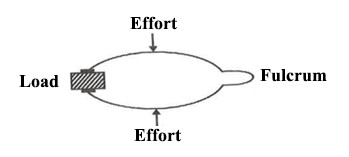
The type of lever shown above is a- A. First class lever
- B. Second class lever
- C. Third class lever
- D. Combination of first and second class levers
Answer: C -
A balanced diet is one which is made up of
- A. Right proportions of protein, carbohydrates and oil
- B. Equal amounts of protein, carbohydrates and oil
- C. Enough water and iodated salt
- D. Vegetables, fruits and water
Answer: A
Answers and solutions for questions 11 to 40 are free in the BECE Past Questions app, with timed practice and offline study.
-
Benedict's solution was added to a mixture in a test tube and it turned brick red when heated. The mixture is likely to contain
- A. Glucose
- B. Oil
- C. Protein
- D. Vitamin
-
The main food substance present in the albumen of an egg is
- A. Carbohydrate
- B. Fat
- C. Protein
- D. Vitamin
-
One characteristic which is not common to all living things is the ability to
- A. Grow
- B. Move about
- C. Respire
- D. Respond to stimuli
-
The ovules in a flower develop to form the
- A. Fruit
- B. Leaves
- C. Seeds
- D. Stem
-
Onions are planted by means of
- A. Bulbs
- B. Corms
- C. Suckers
- D. Rhizomes
-
The testis in mammals produces
- A. Blood
- B. Lymph
- C. Sperms
- D. Urine
-
Which of the following structures takes part in human digestion?
- A. Caecum
- B. Kidney
- C. Larynx
- D. Pancreas
-
Which of the following diseases is contracted through sex?
- A. HIV/AIDS
- B. Asthma
- C. Tuberculosis
- D. Goitre
-
Chlorine gas is an example of
- A. An atom
- B. An element
- C. A compound
- D. A molecule
-
The bad smell that comes out of a urinal is due to the presence of
- A. Ammonia
- B. Hydrogen
- C. Carbon dioxide
- D. Nitrogen
-
The systematic name of the compound FeS is
- A. iron (I) sulphide
- B. iron (II) sulphide
- C. iron (III) sulphide
- D. iron (IV) sulphide
-
Which of the following elements is a liquid at room temperature?
- A. Carbon
- B. Mercury
- C. Silver
- D. Sulphur
-
The type of cloud that gives rain is
- A. Cumulus
- B. Cirrus
- C. Nimbus
- D. Stratus
-
Water drains faster through sand than clay because
- A. sand particles are rougher
- B. sand contains more air spaces
- C. clay particles are smoother
- D. clay particles are bigger
-
Which of the following organisms is not an animal parasite?
- A. Tick
- B. Tapeworm
- C. Plasmodium
- D. Weevil
-
The housefly is an agent for the spread of
- A. Cholera
- B. Malaria
- C. Measles
- D. Tuberculosis
-
The best method for checking erosion on a slope is
- A. cover cropping
- B. mixed cropping
- C. contour ploughing
- D. mulching
-
It is not advisable to sleep in a closed dark room with green plants because the plants
- A. produce heat
- B. compete with human beings for oxygen
- C. absorb water vapour
- D. produce carbon dioxide
-
The process whereby soil is formed by the breakdown of rocks is called
- A. Composting
- B. Erosion
- C. Leaching
- D. Weathering
-
Kerosene is able to reach the other end of a wick by
- A. Diffusion
- B. Suction pressure
- C. Capillary action
- D. Osmosis
-
The force, which opposes the motion of one body on another body is called
- A. Adhesion
- B. Cohesion
- C. Friction
- D. Tension
-
The work done when a force moves a body through a distance of 12 m is 720 J. The force applied is
- A. 8640 N
- B. 732 N
- C. 708 N
- D. 60 N
-
Food substances are transported from the leaves to various parts of a plant through the
- A. Cambium
- B. Epidermis
- C. Phloem
- D. Xylem
-
Which of the following substances are carried by the blood?
I. Nutrients
II. Urine
III. Oxygen
IV. Carbon dioxide- A. II and III only
- B. I, II and IV only
- C. I and III only
- D. I, III and IV only
-
A uniform mixture of two or more metals is called
- A. An alloy
- B. A coiled
- C. An aerosol
- D. A compound
-
Gold is usually used to make jewellery because it is
- A. Precious
- B. Expensive
- C. Less reactive with air
- D. A good conductor of heat
-
Which of the following substances is a non-metal?
- A. Diamond
- B. Mercury
- C. Sodium
- D. Steel
-
Alum is added to water during treatment to
- A. Kill germs
- B. Help suspended particles to settle
- C. Make the water colourless
- D. Give taste to the water
-
Which of the following types of water would be most contaminated by waste substances?
- A. Rain water
- B. Stream water
- C. Borehole water
- D. Pipe borne water
-
The method of preserving food by drying is similar to salting because in both cases germs are
- A. Deprived of the air needed for growth
- B. Deprived of the water needed for growth
- C. Destroyed at high temperatures
- D. Destroyed at low temperatures
Paper 2: Theory
- (a) Study the simple circuit diagram shown below and answer the questions that follow.
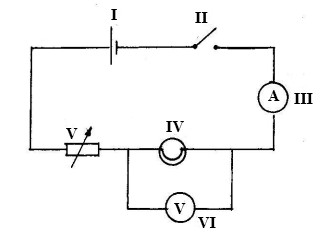
(i) Identify the components labelled I, II, III, IV, V and VI
(ii) Which component is used to close the circuit?
(iii) State the observation that will be made when the circuit is closed.
(iv) State the energy transformations that take place when the circuit is closed.
(v) Give the name of the circuit connection between components IV and VI
(b) The diagram below is an illustration of an experimental set-up used for separating a mixture of water and alcohol. Study the diagram carefully and answer the questions that follow.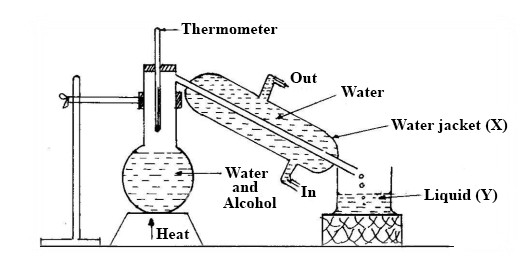
(i) State the method of separation shown in the set-up.
(ii) Identify liquid Y, with reasons.
(iii) Give the functions of the thermometer and the water jacket X
(iv) What physical processes are involved in the method of separating the mixture?
(v) State the physical property which makes it possible to separate the water and alcohol.
(c) A student performed tests on food substances A, B and C and made the following observations.Food substance Test Observation A Few drops of iodine solution was added to A The iodine solution turns blue-black B A drop of B was applied to a white sheet of paper A translucent patch was seen on the paper C Benedict's solution was added to C and the mixture boiled Benedict's solution turns from blue to brick-red
(i) Identify food substances A, B and C.
(ii) Give the products of digestion of A, B and C.
(iii) In which parts of the alimentary canal does the digestion of each of food substances A, B and C start?
(iv) In which part of the alimentary canal is food substance C absorbed after digestion? - (a) (i) List four parts of a plant that are used for asexual reproduction.
(ii) Give two reasons why sexual reproduction is more advantageous than asexual reproduction.
(b) (i) Explain why atoms are electrically neutral.
(ii) Write the systematic names of the following substances: α) CuO β) SO2
(c) (i) What is dispersion of light?
(ii) Draw and label a diagram of dispersion of light through a triangular glass prism. - (a) (i) What is soil erosion?
(ii) Give two types of soil erosion.
(b) Write the name and chemical formula of the compounds formed when the following elements combine:
(i) zinc and oxygen
(ii) calcium and chlorine
(c) (i) Distinguish between heat and temperature.
(ii) Draw and label the mercury-in-glass thermometer.
(iii) What mode of heat transfer is involved in the use of a thermometer? - (a) (i) What is a hormone?
(ii) Copy and complete the following table.
Name of hormone, Organ secreting hormone, Function of hormone
Adrenalin, Thyroxin, Insulin
(b) Ammonia gas is prepared in the laboratory by heating ammonium chloride and calcium hydroxide.
(i) Write a balanced equation for the reaction.
(ii) How is ammonia gas tested in the laboratory?
(iii) State one use of ammonia.
(c) (i) Name four types of forces.
(ii) A boy used a catapult to kill a bird which was on a tree and it fell to the ground. Give two forces involved in this process. - (a) (i) Distinguish between a rhizome and a stem tuber.
(ii) Give one example each of a rhizome and a stem tuber.
(b) State the method which could be used to separate each of the following mixtures and explain your answer in each case:
(i) salt and water
(ii) sawdust and iron filings
(iii) powdered charcoal and water.
(c) (i) Define density of a substance.
(ii) Explain how a body which sinks in water could be made to float.
Worked solutions to the theory questions are free in the app.
More BECE Integrated Science papers
All 38 Integrated Science papers
 All answers free on Google Play