 BECE Past Questions
BECE 2002 (Paper B) Integrated Science Past Questions and Answers
40 objective questions and 4 theory questions from the 2002 (Paper B) BECE Integrated Science paper. Answers and worked solutions for questions 1 to 10 are below; the rest are free in the app.
Practise this paper free, online or offline


On an iPhone? Download on the App Store
On Android? Get it on Google Play
Paper 1: Objectives
-
Which of the following substances is made up of only one kind of atom?
- A. Iron
- B. Salt
- C. Steel
- D. Water
Answer: A -
Ice is able to float on water because the ice
- A. Is colder than water
- B. Is denser than water
- C. Has a greater mass for the same volume of water
- D. Has a greater volume for the same mass of water
Answer: D -
Which of the following statements about the state of matter is correct?
- A. Molecules in a solid are disorderly arranged
- B. Solids are highly compressible
- C. Liquids have definite form and volume
- D. Molecules in a gas move faster than those in a liquid
Answer: D -
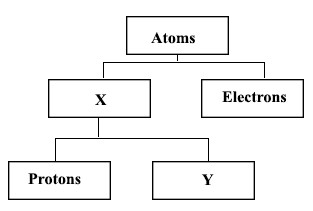
The above diagram illustrates the structure of an atom.The components labeled X and Y in the atom diagram are respectively- A. Neutrons and shells
- B. Ions and neutrons
- C. Neutrons and nucleus
- D. Nucleus and neutrons
Answer: D -
The force which opposes the motion of one object on another object is known as
- A. Friction
- B. Gravity
- C. Tension
- D. Weight
Answer: A -
When the brakes of a bicycle in motion are applied for a long time, the wheels become hot due to a change of energy from
- A. Kinetic energy to potential energy
- B. Kinetic energy to heat energy
- C. Potential energy to heat energy
- D. Potential energy to kinetic energy
Answer: B -
A man applied a force of 50 N to push a wheelbarrow through a distance of 6 m. Calculate the work done.
- A. 300 J
- B. 56 J
- C. 44 J
- D. 30 J
Answer: A -
In which of the following situations is work said to be done?
- A. Walking with a load on the head in an upright position
- B. Getting up from a chair
- C. Pushing against a wall which does not move
- D. Sitting still behind a desk
Answer: A -
The energy stored in food is
- A. Electrostatic energy
- B. Chemical energy
- C. Solar energy
- D. Thermal energy
Answer: B -
A machine which has an energy loss of 10% will have an efficiency of
- A. 100%
- B. 90%
- C. 55%
- D. 10%
Answer: B
Answers and solutions for questions 11 to 40 are free in the BECE Past Questions app, with timed practice and offline study.
-
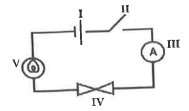
The switch in the electric circuit is represented by- A. IV
- B. III
- C. II
- D. I
-
The component labeled V in the electric circuit is a/an- A. Ammeter
- B. Battery
- C. Lamp
- D. Voltmeter
-
The purpose of the component labeled IV in the electric circuit is to
- A. Supply energy to the circuit
- B. Measure the voltage of the battery
- C. Prevent too much current from flowing
- D. Close the circuit
-
Which of the following diseases is spread by a mosquito?
- A. Blindness
- B. Cholera
- C. Dysentery
- D. Elephantiasis
-
The intermediate host of the worm that causes bilharzia is
- A. Man
- B. Mosquito
- C. Tsetse fly
- D. Water snail
-
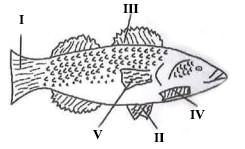
The function of the part labelled IV in the fish diagram is to enable the fish to- A. Sink in water
- B. Absorb oxygen from the water
- C. Protect itself from attack
- D. Detect smell in water
-
The part labelled V in the fish diagram is used for- A. Balancing
- B. Steering
- C. Surfacing
- D. Paddling
-
Which of the following arrangements is a probable food chain?
- A. Grass → Grasshopper → Toad → Snake → Crow
- B. Grasshopper → Grass → Goad → Lion → Man
- C. Crow → Snake → Toad → Grasshopper → Grass
- D. Grass → Goat → Lion → Man → Snake
-
One disease which can be transmitted through eating half-cooked meat is
- A. Guinea worm
- B. Hook worm
- C. Thread worm
- D. Tape worm
-
Which of the following characteristics are common to all living things?
I. Response to stimuli
II. Respiration
III. Movement from place to place
IV. Growth- A. I and II only
- B. I and III only
- C. I, II and III only
- D. I, II and IV only
-
The part of sugar cane that is usually used for planting is the
- A. corm
- B. leaf
- C. stem
- D. sucker
-
Excess carbohydrate in the human body is stored as
- A. amino acid
- B. fatty acid
- C. glycogen
- D. glucose
-
Carbon dioxide in the blood is removed from the body through the
- A. kidneys
- B. lungs
- C. mouth
- D. skin
-
The end-product of protein digestion is
- A. amino acid
- B. glycerol
- C. glycogen
- D. peptide
-
The liquid component of the blood is known as
- A. cytoplasm
- B. haemoglobin
- C. plasma
- D. platelets
-
Digested food substances are absorbed into the blood stream in the
- A. kidneys
- B. liver
- C. stomach
- D. ileum
-
The part of the human ear which collects and directs sound waves is the
- A. ear drum
- B. ear lobe
- C. ear canal
- D. semi circular canal
-
The process by which waste substances are removed from the body is called
- A. egestion
- B. excretion
- C. perspiration
- D. respiration
-
The embryo of a mammal develops from
- A. eggs fertilized inside the body
- B. eggs fertilized outside the body
- C. self fertilized eggs
- D. only female sex cells
-
Which of the following gases is given out during photosynthesis?
- A. Carbon dioxide
- B. Carbon monoxide
- C. Nitrogen
- D. Oxygen
-
The component of the soil which is made up of the finest particle is
- A. clay
- B. humus
- C. loam
- D. sand
-
The soil type which is able to retain the highest amount of water is
- A. clay
- B. loam
- C. gravel
- D. sand
-
The formation of humus is aided by
- A. earthworms
- B. insects
- C. rats
- D. wind
-
The major cause of pollution at a stone quarry is
- A. dust
- B. human waste
- C. acid disposal
- D. smoke
-
Ringworm is a skin disease, which is caused by
- A. bacteria
- B. fungi
- C. insects
- D. worm
-
Which of the following habits will help in the control of diseases contracted through air?
I. Not throwing human wastes into rivers
II. Washing of hands after visiting the toilet
III. Not spitting about in public places
IV. Keeping foods always covered- A. I and II only
- B. II and III only
- C. III only
- D. I, II and IV only
-
Soup which is not well-heated gets spoilt when kept for some time because the
- A. salt in the soup is too small
- B. water in the soup do not all evaporate
- C. heat in the soup is not enough to kill all bacteria
- D. water condenses back into the soup
-
The measure of the amount of water vapour in the air is known as
- A. cloud
- B. dew
- C. humidity
- D. temperature
-
Which of the following heavenly bodies is a star?
- A. Earth
- B. Moon
- C. Sun
- D. Milky way
-
The planet in our solar system which has the largest orbit is
- A. Jupiter
- B. Mars
- C. Pluto
- D. Venus
Paper 2: Theory
- (a) Classify each of the following substances as colloids, suspension or solution: Smoke, breast milk, powdered milk in water, sea water, mist, steel.
(b) (i) Define valency
(ii) State the valencies of the following elements and radicals: α) Iron β) Zinc γ) Hydroxyl λ) Carbonate
(c) Give one difference between plants and animals in terms of:
(i) feeding
(ii) excretion
(iii) sensitivity
(d) (i) Draw and label a diagram to show how an image is formed in a pinhole camera.
(ii) State the characteristics of the image formed. - (a) State three differences between molecules in a solid state and liquid state.
(b) (i) What is a solution?
(ii) Difference between solutions and mixtures in terms of particle sizes.
(c) Name the elements which make up the following compounds:
(i) water
(ii) common salt
(iii) ammonia
(d) Copy and complete the table below:
Disease, Vector, Causative agent, Symptoms
Malaria, Sleeping sickness
(e) (i) What is a man-made satellite?
(ii) Give two examples of natural satellites.
(iii) Mention two applications of man-made satellites. - (a) Name the four main parts of a flower.
(b) Give two external features of plants pollinated by wind.
(c) Construct a food chain using any four of the organisms listed below: Goat, lizard, bird, snake, earthworm, grasscutter, grass, ant, cassava.
(d) (i) The energy input of a machine is 7.5 J and the output energy is 5.0 J. Calculate the efficiency of the machine.
(ii) Explain why the efficiency of a machine is always less than 1. - (a) (i) What is an embryo?
(ii) Where does an embryo develop in the female mammal?
(iii) Describe briefly how a developing embryo breathes in oxygen.
(b) Name three plant nutrients.
(c) (i) What is an electrical insulator?
(ii) Explain how a comb rubbed vigorously on dry hair attracts small pieces of paper.
(d) (i) List the chemical substances that are used in the preparation of ammonia gas in the laboratory.
(ii) Write down a balanced chemical equation for the reaction.
Worked solutions to the theory questions are free in the app.
More BECE Integrated Science papers
All 38 Integrated Science papers
 All answers free on Google Play