 BECE Past Questions
BECE 2003 Social Studies Past Questions and Answers
40 objective questions and 6 theory questions from the 2003 BECE Social Studies paper. Answers and worked solutions for questions 1 to 10 are below; the rest are free in the app.
Practise this paper free, online or offline


On an iPhone? Download on the App Store
On Android? Get it on Google Play
Paper 1: Objectives
-
Countries in North Africa are noted for the production of
- A. iron ore
- B. gold
- C. crude oil
- D. diamond
Answer: C -
Using a scale of 1:100,000 find the actual distance between two towns which are 4.5 centimetres apart on a map
- A. 4 km 50 m
- B. 4 km 450 m
- C. 4 km 500 m
- D. 5 km 50 m
Answer: C -
The revolution of the earth results in
- A. high and low tides
- B. day and night
- C. the four seasons
- D. wind directions
Answer: C -
The most suitable physical feature for the construction of a dam is a
- A. gorge
- B. ridge
- C. valley
- D. plateau
Answer: A -
A football match between Ghana (Longitude 0°) and Nigeria (Longitude 15°E) start in Lagos at 4 o'clock pm. At what time will the telecast of the match start in Ghana?
- A. 3 o'clock pm
- B. 4 o'clock pm
- C. 5 o'clock pm
- D. 6 o'clock pm
Answer: A -
Which of the following is a chemically formed sedimentary rock?
- A. Granite
- B. Coal
- C. Potash
- D. Lignite
Answer: C -
Axim in the Western Region of Ghana is influenced by the
- A. South-East Polar winds
- B. South-West Monsoon winds
- C. North-East Monsoon winds
- D. North-East Polar winds
Answer: B -
The following are instruments used in measuring the elements of the weather and climate except
- A. barometer
- B. thermometer
- C. clinometers
- D. anemometer
Answer: C -
How many times in a year is the sun vertically overhead at the equator?
- A. Once
- B. Twice
- C. Three times
- D. Four times
Answer: B -
The conventional sign
 shown on a topographical map refers to a
- A. path
- B. dam
- C. bridge
- D. waterfall
Answer: C
Answers and solutions for questions 11 to 40 are free in the BECE Past Questions app, with timed practice and offline study.
-
Which of the following groups is not Ga-Adangme?
- A. Krobo people
- B. Kpone people
- C. Takla people
- D. Osudoku people
-
The beast of burden which was used to increase the volume of the Trans-Saharan Trade was the
- A. camel
- B. ass
- C. bull
- D. donkey
-
The insect responsible for spreading river blindness is the
- A. tsetsefly
- B. simulium fly
- C. mosquito
- D. housefly
-
Which of the following ethnic groups celebrates the Kundum festival?
- A. The Asante
- B. The Ewe
- C. The Ga
- D. The Nzema
-
People running away from Liberia because of the war to stay at Budumburam near Accra become
- A. victims
- B. armed robbers
- C. soldiers
- D. refugees
-
Government of the people, by the people and for the people is referred to as
- A. socialism
- B. monarchy
- C. democracy
- D. apartheid
-
Until independence the Coat-of-Arms of the Gold Coast (Ghana) was
- A. a stool and a crown
- B. an elephant and a palm tree
- C. an eagle
- D. a black star
-
Ghana’s earth satellite station is located in Greater Accra region at
- A. Aburi
- B. Kuntunse
- C. Tema
- D. Prampram
-
Gold in ancient Ghana was mined at
- A. Wangara
- B. Timbuktu
- C. Jenne
- D. Gao
-
Which of the following agencies cater for the welfare of women and children in the country?
- A. National Council for Civic Education (NCCE)
- B. National Council on Women and Development (NCWD)
- C. Non-Formal Education (NFED)
- D. Electoral Commission (EC)
-
The Gonja under the leadership of Ndewura Jakpa migrated from
- A. Liberia
- B. Senegal
- C. Mali
- D. Chad
-
Which of the following personalities was not a member of the Convention People's Party
- A. Kojo Botsio
- B. N. A. Welbeck
- C. K. A. Gbedemah
- D. Dr. K. A. Busia
-
The Fante Confederation agreed to have an assembly at
- A. Komenda
- B. Elmina
- C. Mankesim
- D. Cape Coast
-
Which of the following was the immediate cause of the 1948 disturbances in Ghana?
- A. The defects in the Burns Constitution of 1946
- B. Low wages of workers
- C. The shooting and killing of three ex-soldiers
- D. High prices of consumer goods
-
The first political party which was formed in Ghana in 1947 was the
- A. National Liberation Movement (NLM)
- B. United Gold Coast Convention (UGCC)
- C. Convention People's Party (CPP)
- D. Northern People's Party (NPP)
-
The Aborigines' Rights Protection Society was formed in the Gold Coast to protect
- A. political interest of the chiefs
- B. lands and minerals
- C. traditional religious practices
- D. the golden stool from the British
-
Which of the following is not an ethnic group in Ghana?
- A. Dagomba
- B. Hausa
- C. Gonja
- D. Fante
-
The date AD 1852 falls within the
- A. sixteenth century
- B. seventeenth century
- C. eighteenth century
- D. nineteenth century
-
Which of the following political parties advocated for federalism in Ghana in 1957?
- A. The National Liberation Movement (NLM)
- B. The Convention People's Party (CPP)
- C. The Northern People's Party (NPP)
- D. The Togoland Congress (TP)
-
All the following people inherit patrilineally except the
- A. Asante
- B. Adangme
- C. Ewe
- D. Ga
-
The Second World War was fought between
- A. 1914 – 1918
- B. 1919 – 1925
- C. 1939 – 1945
- D. 1957 – 1960
-
Which of the following countries is the largest producer of rice in the world?
- A. India
- B. Thailand
- C. China
- D. Indonesia
-
The leading producer of coal in Africa is
- A. Zambia
- B. Morocco
- C. Botswana
- D. South Africa
-
The only country in West Africa which did not come under colonial rule is
- A. Liberia
- B. Gambia
- C. Senegal
- D. Guinea
-
In which of the following countries is Lake Nasser located?
- A. Tanzania
- B. Uganda
- C. Ethiopia
- D. Egypt
-
One of the reasons for the partition of West Africa by the Europeans was to
- A. stop the slave trade
- B. protect the indigenous people
- C. protect their places of trade
- D. spread the gospel
-
Non-permanent members of the Security Council of the United Nations Organization (UNO) hold office for a period
- A. two years
- B. three years
- C. four years
- D. five years
-
Which of the following minerals is non-metallic?
- A. Copper
- B. Bauxite
- C. Diamond
- D. Manganese
-
Harvested food crops are best preserved in
- A. silos
- B. barns
- C. sacks
- D. farms
-
Which of the following organizations was the first to be formed?
- A. Organization of African Unity (OAU)
- B. League of Nations
- C. Economic Community of West African States (ECOWAS)
- D. United Nations Organization (UNO)
Paper 2: Theory
- Use the map of Cham District to answer Question 1
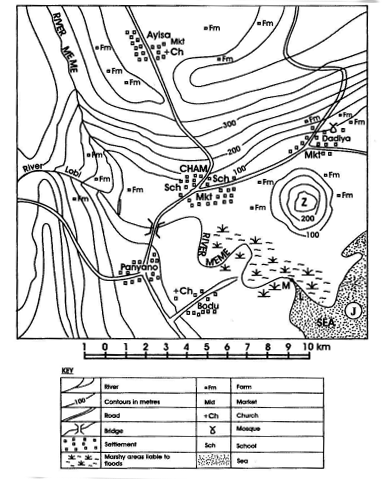
a) i) Contour intervals in metres.
ii) Direction of Dadiya from Panyano.
iii) Distance by road from the road junction of Panyano to the road junction to Cham.
iv) Direction of flow of River Meme.
b) Name the features marked M, L, J, and Z.
c) i) What type of settlement is Dadiya?
ii) Name any two crops which will grow well in the swampy areas of the map. - a) Name three types of rainfall.
b) With the help of a diagram describe how any one type of rainfall is formed. - a) Name the three arms of Government.
b) State two functions of each of the three arms of Government.
c) Mention four sources of revenue for the district assemblies in Ghana. - a) Name four plantation farms and their locations in Ghana.
b) State four effects of plantation farming in Ghana. - a) State any four aims of the United Nations Organization.
b) Explain two problems facing the United Nations Organization. - What five major problems face the Economic Community of West African States (ECOWAS)?
Worked solutions to the theory questions are free in the app.
 All answers free on Google Play