 BECE Past Questions
BECE 2009 Mathematics Past Questions and Answers
40 objective questions and 6 theory questions from the 2009 BECE Mathematics paper. Answers and worked solutions for questions 1 to 10 are below; the rest are free in the app.
Practise this paper free, online or offline


On an iPhone? Download on the App Store
On Android? Get it on Google Play
Paper 1: Objectives
-
Given that 𝐀 = {𝟏, 𝟐, 𝟑, 𝟒, 𝟓, 𝟔} and 𝐁 = {𝟑, 𝟔, 𝟗, 𝟏𝟐}, find 𝐀 ∪ 𝐁.
- A. {𝟑, 𝟔}
- B. {𝟔, 𝟏𝟐}
- C. {𝟐, 𝟑, 𝟒, 𝟓, 𝟗, 𝟏𝟐}
- D. {𝟏, 𝟐, 𝟑, 𝟒, 𝟓, 𝟔, 𝟗, 𝟏𝟐}
Answer: DUnion (∪) includes all unique elements in both sets: {𝟏, 𝟐, 𝟑, 𝟒, 𝟓, 𝟔, 𝟗, 𝟏𝟐}. -
Write 𝟐𝟑𝟒𝟎𝟎𝟎𝟎 in standard form.
- A. 𝟐.𝟑𝟒 × 𝟏𝟎⁵
- B. 𝟐.𝟑𝟒 × 𝟏𝟎⁴
- C. 𝟐.𝟑𝟒 × 𝟏𝟎⁶
- D. 𝟐.𝟑𝟒 × 𝟏𝟎⁷
Answer: CMoving the decimal left 6 places yields 𝟐.𝟑𝟒 × 𝟏𝟎⁶. -
How many faces does a cuboid have?
- A. 𝟏𝟐
- B. 𝟖
- C. 𝟔
- D. 𝟒
Answer: CA cuboid has 6 faces. -
Subtract 𝟏𝟐𝟓.𝟒𝟕 from 𝟐𝟎𝟑.𝟗𝟎.
- A. 𝟕𝟖.𝟓𝟕
- B. 𝟕𝟖.𝟒𝟑
- C. -𝟏𝟐𝟏.𝟓𝟕
- D. -𝟏𝟐𝟐.𝟑𝟖
Answer: B𝟐𝟎𝟑.𝟗𝟎 - 𝟏𝟐𝟓.𝟒𝟕 = 𝟕𝟖.𝟒𝟑. -
Simplify (𝟓𝑚 + 𝟑𝑛) - (𝟐𝑚 - 𝑛).
- A. 𝟓𝑚 - 𝟒𝑛
- B. 𝟑𝑚 + 𝟒𝑛
- C. 𝟑𝑚 - 𝟐𝑛
- D. 𝟕𝑚 + 𝟒𝑛
Answer: B(𝟓𝑚 + 𝟑𝑛) - (𝟐𝑚 - 𝑛) = 𝟑𝑚 + 𝟒𝑛. -
Which of the following sets is equal to {𝟏, 𝟐, 𝟑, 𝟒}?
- A. {𝟐, 𝟒, 𝟏, 𝟓}
- B. {𝟐, 𝟏, 𝟒, 𝟑}
- C. {𝟏, 𝟐, 𝟑, 𝟒, ... }
- D. {𝟐, 𝟑, 𝟒, 𝟓, ... }
Answer: BTwo sets are equal when they contain the same elements: {𝟐, 𝟏, 𝟒, 𝟑}. -
In a town of 𝟒𝟐,𝟖𝟎𝟎 inhabitants, 𝟒𝟖% are male. How many more females are there than males?
- A. 𝟐𝟐,𝟐𝟓𝟔
- B. 𝟐𝟎,𝟓𝟒𝟒
- C. 𝟏,𝟕𝟏𝟐
- D. 𝟏,𝟔𝟏𝟐
Answer: CPercentage difference is 4% of 𝟒𝟐,𝟖𝟎𝟎, which is 𝟏,𝟕𝟏𝟐. -
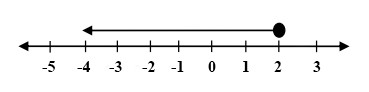
What set does the following graph represent: (-∞, 𝟐]?- A. {𝐱:𝐱 < 𝟐}
- B. {𝐱:𝐱 ≤ 𝟐}
- C. {𝐱:𝐱 > 𝟐}
- D. {𝐱:𝐱 ≥ 𝟐}
Answer: BThe shaded circle indicates inclusion (≤). -
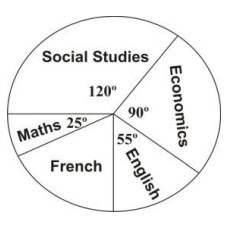
In a pie chart showing Kate’s exam scores, what is the angle for French?- A. 𝟏𝟐𝟎°
- B. 𝟏𝟎𝟎°
- C. 𝟕𝟎°
- D. 𝟑𝟓°
Answer: C360° - (120° + 90° + 55° + 25°) = 70°. -
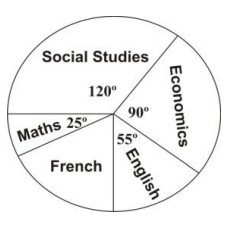
If Kate scored 60% in Social Studies, what was her score in Economics?- A. 45%
- B. 54%
- C. 72%
- D. 90%
Answer: AUsing the angle ratio: 90° = 45%.
Answers and solutions for questions 11 to 40 are free in the BECE Past Questions app, with timed practice and offline study.
-
A teacher is to be chosen from 6 male and 2 female teachers. What is the probability of choosing a female?
- A. 𝟑/𝟒
- B. 𝟐/𝟑
- C. 𝟏/𝟑
- D. 𝟏/𝟒
-
Solve the equation: 2𝑥 - 3(𝑥 - 1) = 6.
- A. 3
- B. -3
- C. -7
- D. -9
-
If 𝑚 = 3 and 𝑛 = -3, evaluate 𝟏/𝟐 (3𝑚 - 𝑛).
- A. 6
- B. 3
- C. 0
- D. -6
-
Which set of angles form a right-angled triangle?
- A. {20°, 50°, 90°}
- B. {80°, 60°, 90°}
- C. {45°, 45°, 90°}
- D. {65°, 90°, 35°}
-
What is the rule for the mapping given by the table?
𝑥 0 1 2 3 4 𝑦 0 1/4 1/2 3/4 1 - A. 𝑥 → 𝑥/4
- B. 𝑥 → 𝑥/2
- C. 𝑥 → 3𝑥/4
- D. 𝑥 → 1/(2𝑥)
-
A rectangle has an area of 36 cm² and a width of 3 cm. Find its perimeter.
- A. 12 cm
- B. 18 cm
- C. 24 cm
- D. 30 cm
-
Find the value of 4 + 𝑥⁰.
- A. 3
- B. 4
- C. 5
- D. 6
-
A van travels 154 km in 1¾ hours. Find its speed in km/h.
- A. 77 km/h
- B. 88 km/h
- C. 100 km/h
- D. 269.5 km/h
-
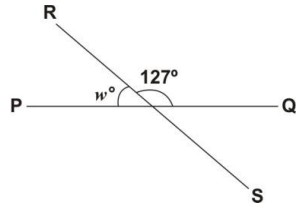
In the figure, PQ and RS are straight lines. Find angle 𝑤.- A. 27°
- B. 53°
- C. 63°
- D. 127°
-
If 𝑥 + 5 = -7, find 𝑥/6.
- A. -5
- B. -2
- C. 1
- D. 2
-
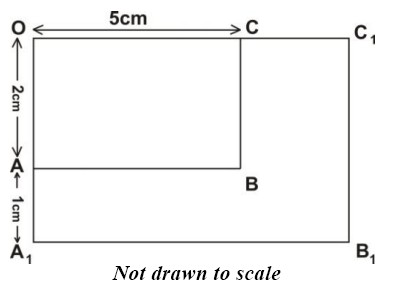
In the following diagram, rectangle OABC is enlarged into rectangle O'A'B'C' from center O. OC = 5 cm, OA = 2 cm, and A'A = 1 cm. Find the scale factor of the enlargement.- A. 1
- B. 1.5
- C. 2
- D. 2.5
-
Using the same diagram, calculate OC'.- A. 7.5 cm
- B. 8 cm
- C. 9 cm
- D. 12 cm
-
The height of a flag pole in a scale drawing is 5 cm. If the scale is 1 cm to 3 m, what is the actual height of the pole?
- A. 10 m
- B. 15 m
- C. 8 m
- D. 5 m
-
Factorize ax + 3x + a + 3.
- A. x(a + x)
- B. (x - a)(x + 3)
- C. x(a - x)
- D. (a + 3)(x + 1)
-
If y = (x + 8) / (x - 4), find the value of y when x = 2.
- A. 5
- B. -5
- C. 4
- D. -4
-
Find the Greatest Common Factor (GCF) of 90, 126, and 72.
- A. 6
- B. 9
- C. 18
- D. 24
-
Given that 1 : 3 = x : 21, find the value of x.
- A. 4
- B. 5
- C. 7
- D. 63
-
Find the difference between 432₅ and 143₅.
- A. 234₅
- B. 334₅
- C. 1130₅
- D. 1310₅
-
Simplify: 14 1/3 - 2 3/8 + 5 7/12.
- A. 6 3/8
- B. 7 5/12
- C. 17 5/12
- D. 17 13/24
-
Nine bottles of equal capacity hold 4 liters of water. How much do x bottles hold?
- A. (4x) / 9 liters
- B. 2x liters
- C. 20 liters
- D. 2 liters
-
A sales girl receives a 5% commission on all she sells. How much must she sell to receive GHC 15.00?
- A. GHC 750.00
- B. GHC 300.00
- C. GHC 75.00
- D. GHC 30.00
-
Arrange the following fractions in ascending order: 7/12, 3/5, 7/15, 3/4.
- A. 3/5, 7/15, 7/12, 3/4
- B. 7/12, 7/15, 3/5, 3/4
- C. 7/15, 7/12, 3/5, 3/4
- D. 3/5, 3/4, 7/12, 7/15
-
Add 2.5 to the product of 4.2 and 0.2.
- A. 13.4
- B. 10.9
- C. 3.34
- D. 1.34
-
What is the value of four in the number 7073.48?
- A. four tenths
- B. four
- C. forty
- D. four hundred
-
What is the modal age of children at a birthday party with ages [1, 2, 3, 4, 5, 6, 7, 8, 9, 10] and frequencies [3, 4, 2, 5, 4, 4, 6, 4, 2, 1]?
- A. 10
- B. 7
- C. 5
- D. 4
-
A child is selected at random; what is the probability that he or she is 4 years old?
- A. 4/35
- B. 1/7
- C. 2/5
- D. 4/5
-
How many children are 7 or more years old?
- A. 28
- B. 22
- C. 13
- D. 6
-
Write the vector (-6, -4) using Cartesian components.
- A. (-6, -4)
- B. (6, 4)
- C. (4, 6)
- D. (0, 0)
-
Simplify: 5 - 7 + 2(3 - 8).
- A. -12
- B. -8
- C. -5
- D. -4
-
If r = (-10, -3) and n = (8, -6), find n + r.
- A. (-2, -9)
- B. (2, -9)
- C. (18, 9)
- D. (-2, -3)
Paper 2: Theory
- (a) Simplify 1200 × 1260 ÷ 800 and write your answer in standard form.
(b) A plot of land measures 25 m by 12 m. A portion of this plot measuring 8 m by 8 m is used for the cultivation of vegetables. Find the area of the plot not cultivated.
(c) The table below shows the performance of Aisha in her final examination:
Subject: English Language (54%), Mathematics (36%), Ga (68%), Science (50%), Social Studies (32%).
Draw a pie chart to represent this information. - (a) The table below shows the scores of some students in an examination:
Scores: {0, 1, 2, 3, 4, 5, 6, 7, 8, 9, 10}
Frequency: {3, 5, 3, 2, 7, 6, 5, 4, 2, 2, 1}
Find:
(i) How many students wrote the examination;
(ii) The modal score;
(iii) The number of students that scored 7 or more;
(iv) The mean score correct to one decimal place. - (a) (i) Using a scale of 2 cm to 1 unit on both axes, draw two perpendicular axes OX and OY on a graph sheet.
(ii) Mark the x-axis from -5 to 5 and y-axis from -6 to 6.
(iii) Plot the points A(2, 5), B(2, 2), and C(4, 2). Join the points to form triangle ABC.
(iv) Using the y-axis as a mirror line, draw the image triangle A₁B₁C₁ of triangle ABC and write the coordinates of A₁, B₁, and C₁.
(v) Draw the image triangle A₂B₂C₂ of triangle ABC under an anticlockwise rotation of 180° about the origin and write the coordinates of A₂, B₂, and C₂.
(b) Simplify 2a - 3c + b - 4 where a = 2, b = -7, c = -5. - (a) The ratio of sheep to goats on a farm is 4:7. If there are 1,428 sheep, find how many goats are on the farm.
(b) Using a ruler and a pair of compasses only, construct a triangle ABC with AB = 6 cm, AC = 8 cm, and ∠BAC = 30°. Construct the bisector of ∠ACB to meet line AB at D.
(i) Measure [AD] and [BD].
(ii) Write down the ratio [AD]:[BD]. - (a) The diagram shows triangle ABC with side AC produced to D.
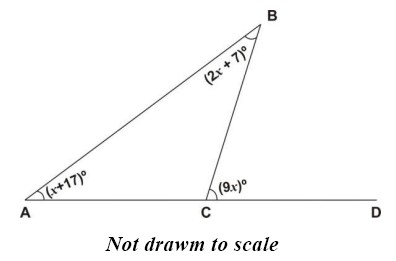
Find:
(i) The value of x;
(ii) ∠ACB.
(b) The simple interest formula, I = PRT/100, gives the interest, I, on a principal, P, invested at a rate, R, per annum for time, T, years.
(i) Find the simple interest on GHC 3,600.00 at 15% per annum for 2 years.
(ii) Make R the subject of the formula.
(iii) At what rate per annum will GHC 6,000.00 earn GHC 2,400.00 simple interest in 2 years? - (a) Given that C10,000 = GHC 1.00, complete the table relating cedis (x) to Ghana cedis (y):
Cedis: {10,000, 50,000, 150,000, 250,000, 350,000, 450,000}
Ghana Cedis: {1, 5, 15, 25, 35, 45}
(b) (i) On a graph sheet, draw two perpendicular axes OX and OY.
(ii) Using a scale of 2 cm to C50,000.00 on the OX axis and 2 cm to GHC 5.00 on the OY axis, plot the points and join them with a straight line.
(c) From the graph, find:
(i) GHC 8.00 in cedis;
(ii) GHC 35.00 in cedis;
(iii) C260,000.00 in Ghana cedis.
Worked solutions to the theory questions are free in the app.
 All answers free on Google Play