 BECE Past Questions
BECE 2015 Integrated Science Past Questions and Answers
40 objective questions and 6 theory questions from the 2015 BECE Integrated Science paper. Answers and worked solutions for questions 1 to 10 are below; the rest are free in the app.
Practise this paper free, online or offline


On an iPhone? Download on the App Store
On Android? Get it on Google Play
Paper 1: Objectives
-
Brass is an alloy of
- A. iron and carbon
- B. zinc and copper
- C. iron and copper
- D. copper and tin
Answer: B -
An example of inorganic fertilizer is
- A. ammonium nitrate
- B. cow dung
- C. farmyard manure
- D. poultry dropping
Answer: A -
The component of the human blood which transport oxygen to all parts of the body
- A. plasma
- B. platelets
- C. red blood cells
- D. white blood cells
Answer: C -
The importance of fuse in an electrical circuit is to
- A. regulate the voltage
- B. prevent damage to electrical appliances
- C. alter the flow of current in the circuit
- D. minimize the use of current
Answer: B -
Which of the following step(s) is/are required in the scientific method?
I. Formulation of hypothesis
II. Identification of the problem
III. Experimentation- A. I only
- B. II only
- C. II and III only
- D. I, II and III
Answer: D -
Which of the following food items produces amino acids as end-product of digestion?
- A. Cabbage
- B. Fish
- C. Margarine
- D. Rice
Answer: B -
The process of increasing the strength of a signal using a transistor is known as
- A. amplification
- B. biasing
- C. doping
- D. switching
Answer: A -
The physical arrangement of soil particles into aggregate is termed
- A. soil porosity
- B. soil structure
- C. soil profile
- D. soil texture
Answer: B -
The solvent which is most effective in washing bitumen from the hand is
- A. acid
- B. alcohol
- C. kerosene
- D. water
Answer: C -
A piece of stone could be classified as an opaque material because it
- A. absorbs all the light incident on it
- B. does not absorb light incident on it
- C. allows all the light incident on it to pass through it
- D. does not allow light incident on it to pass through it
Answer: D
Answers and solutions for questions 11 to 40 are free in the BECE Past Questions app, with timed practice and offline study.
-
Fish swims in water with little resistance because it possesses
- A. gills
- B. scales
- C. caudal fins
- D. streamlined body
-
Which of the following conditions promote(s) rusting of iron?
I. Air
II. Moisture
III. Oil- A. I only
- B. II only
- C. I and II only
- D. II and III only
-
The change in the volume of water when a piece of stone is dropped into it is equal to the
- A. density of the stone
- B. mass of the stone
- C. volume of the stone
- D. weight of the stone
-
The second stage in the life cycle of a mosquito is the
- A. egg
- B. imago
- C. larva
- D. pupa
-
Which of the following objects could be attracted by a magnet?
- A. Copper chain
- B. Gold chain
- C. Steel blade
- D. Aluminium
-
The knowledge of soil texture is important because it
- A. influences plant population
- B. determines the planting distance
- C. determines the type of plant to be grown
- D. influences the method of pest control
-
How many atoms are present in CaCl₂?
- A. 2
- B. 3
- C. 4
- D. 5
-
The transfer of heat from the bottom to the top of a beaker containing water is by
- A. absorption
- B. conduction
- C. convection
- D. radiation
-
An example of chemical compound is
- A. aluminium
- B. ammonia
- C. oxygen
- D. phosphorus
-
The type of the human teeth used for biting food substance is
- A. canines
- B. incisors
- C. molars
- D. premolars
-
Which of the following heavenly bodies is a star?
- A. Jupiter
- B. Moon
- C. Sun
- D. Venus
-
Which of the following organisms is an endoparasite?
- A. Fleas
- B. Louse
- C. Tapeworm
- D. Tick
-
The part of the plant where pollination occurs is the
- A. Flowers
- B. Leaves
- C. Roots
- D. Stems
-
Which of the following substances is capable of neutralizing an acid?
- A. Vinegar
- B. Water
- C. Sodium chloride
- D. Sodium hydroxide
-
Droplet infection is the method by which
- A. Diseases are transmitted from animals to plants.
- B. Infected animals are processed.
- C. Human beings protect themselves from diseases.
- D. Diseases are spread through the air.
-
An example of a derived quantity is
- A. Length
- B. Mass
- C. Time
- D. Velocity
-
A structure in the human reproductive system which stores sperms temporarily is the
- A. Epididymis
- B. Penis
- C. Scrotum
- D. Vulva
-
Which of the following statements about diffusion is/are correct?
I. It involves the movement of water molecules only
II. It occurs in both gases and liquids
III. It involves a semi-permeable membrane- A. I only
- B. II only
- C. I and II only
- D. I, II and III
-
A farming system which requires at least three years programme is
- A. Mixed cropping
- B. Crop rotation
- C. Organic farming
- D. Mixed farming
-
The component of a living cell responsible for respiration is
- A. Chloroplast
- B. Mitochondrion
- C. Nucleus
- D. Vacuole
-
Which of the following statements about a second class lever is correct? The
- A. Pivot is between the load and the effort.
- B. Pivot and the load are at the same position.
- C. Load is between the effort and the pivot.
- D. Effort is between the load and the pivot.
-
One advantage of soft water over hard water is that soft water
- A. Has a pleasant taste
- B. Can prevent heart diseases
- C. Does not waste soap
- D. Forms scales in kettle
-
The gas produced when glucose is oxidized during aerobic respiration is
- A. Hydrogen
- B. Nitrogen
- C. Oxygen
- D. Carbon dioxide
-
The systematic name for N2O is
- A. Nitrogen (I) oxide
- B. Nitrogen (II) oxide
- C. Nitrogen (III) oxide
- D. Nitrogen (IV) oxide
-
A husbandry practice which involves the removal of unwanted plant parts is
- A. Mulching
- B. Pruning
- C. Thinning
- D. Pricking out
-
The number of p-n junctions in a transistor is
- A. 1
- B. 2
- C. 3
- D. 4
-
Fruits dispersed by wind
- A. Have hairs
- B. Are sticky
- C. Are succulent
- D. Have hooks
-
Substances that burn living tissues when they come into contact with these tissues are considered
- A. Corrosive
- B. Flammable
- C. Irritant
- D. Toxic
-
The function of the platelets in the circulatory system of humans is to
- A. Transport oxygen
- B. Transport carbon dioxide
- C. Clot blood
- D. Defend the blood
-
Energy is the
- A. Force to move an object.
- B. Weight of the body.
- C. Ability to do work.
- D. Power to carry an object.
Paper 2: Theory
- (a) The diagram below is an illustration of a cocoa pod infected by a disease.
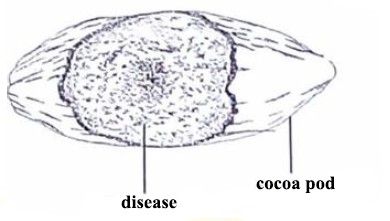
(i) Name the disease illustrated on the pod.
(ii) Mention the causative organism of the disease.
(iii) Describe one symptom of the disease.
(iv) State one farm practice that promotes the spread of the disease.
(v) Give one practice farmers could adopt to control the disease.
(b) The diagram below is an illustration of a cuboid with faces A, B and C and sides a, b and c.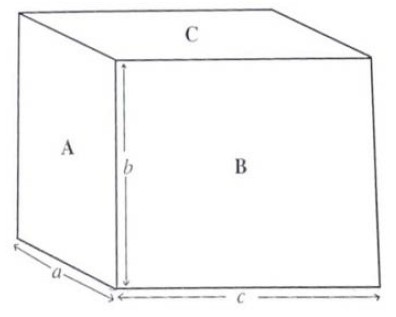
(i) Measure and record the length of each side a, b, and c.
(ii) Determine the area of faces A and B.
(iii) If the weight of the cuboid is 100N, determine the pressure exerted when it lies on:
(α) face A, (β) face B.
(iv) Explain how pressure exerted by a body changes with area.
(c) The diagram below is an illustration of three types of teeth, labelled A, B, and C.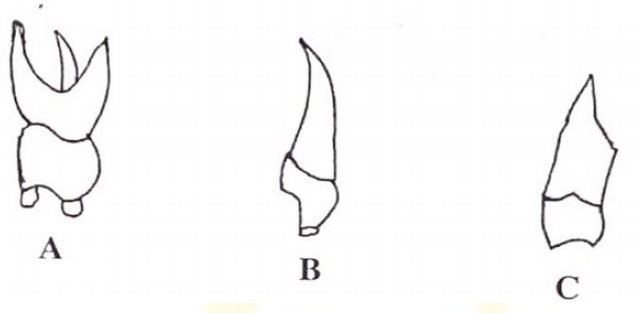
(i) Name each type of teeth.
(ii) State one function of each type.
(iii) State two observable differences between A and B.
(iv) Mention two ways to ensure proper dental care.
(d) The diagram below is an experimental set-up to separate water and salt from a salt solution.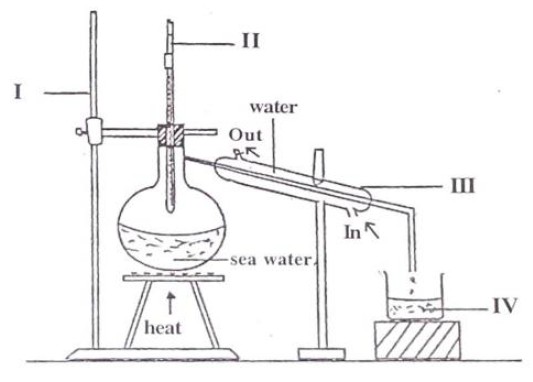
(i) Name each part labelled I, II, III, and IV.
(ii) Name the method of separation used.
(iii) State one function of each part labelled II and III.
(iv) Name three physical processes involved in the separation. - (a) (i) What is technology?
(ii) State two differences between science and technology.
(b) Draw potassium atom and show the distribution of electrons in its shells. [K=19]
(c) State the energy transformations in the following:
(i) Flashlight battery, (ii) Microphone addressing gathering.
(d) List three components of soil. - (a) (i) Mention the junctions of a transistor.
(ii) Draw the circuit symbol for n-p-n transistor.
(b) State one function of each part of the human circulatory system:
(i) Blood, (ii) Blood vessels, (iii) Heart.
(c) Classify each substance as element, compound, or mixture:
(i) Air, (ii) Brass, (iii) Chlorine, (iv) Gold, (v) Water.
(d) State three ways of caring for farm machines. - (a) (i) State two physical properties of water.
(ii) Using litmus paper, explain why water is neutral.
(b) Give one function of each plant nutrient:
(i) Nitrogen, (ii) Potassium.
(c) (i) State two human activities that disrupt the carbon cycle.
(ii) State two effects of carbon cycle disruption.
(d) (i) Define density.
(ii) A body of mass 50 kg has a density of 2 kg/m³. Calculate the volume. - (a) Define vegetable crop.
(b) (i) What is air pollution?
(ii) State two human activities that cause air pollution.
(c) (i) List three modes of heat transfer.
(ii) Name the medium for each mode.
(d) Give three reasons why proteins are important in the diet of mammals. - (a) State one function of each part of the human reproductive system:
(i) Penis, (ii) Ovary, (iii) Oviduct, (iv) Testis, (v) Uterus.
(b) (i) Define electrical conductor.
(ii) List two substances that are insulators.
(c) State three ways to maintain soil fertility.
(d) Write word equations for each chemical reaction:
(i) Oxygen and hydrogen, (ii) Nitrogen and hydrogen, (iii) Sodium and chlorine.
Worked solutions to the theory questions are free in the app.
More BECE Integrated Science papers
All 38 Integrated Science papers
 All answers free on Google Play