 BECE Past Questions
BECE 2013 Integrated Science Past Questions and Answers
40 objective questions and 6 theory questions from the 2013 BECE Integrated Science paper. Answers and worked solutions for questions 1 to 10 are below; the rest are free in the app.
Practise this paper free, online or offline


On an iPhone? Download on the App Store
On Android? Get it on Google Play
Paper 1: Objectives
-
The S.I unit of temperature is
- A. Candela
- B. Degree Celsius
- C. Joule
- D. Kelvin
Answer: D -
Air is an example of
- A. gas in gas mixture
- B. liquid in liquid mixture
- C. solid in liquid mixture
- D. solid in solid mixture
Answer: A -
Which of the following activities are involved in the rearing of tilapia?
I. Feeding of fish
II. Pond stocking
III. Pest control- A. I and II only
- B. I and III only
- C. II and III only
- D. I, II and III
Answer: A -
The part of the flower that contains nectar is called
- A. anther
- B. petal
- C. ovary
- D. sepal
Answer: B -
Which of the following methods protects pure iron from rusting by coating with zinc?
- A. Alloying
- B. Galvanizing
- C. Greasing
- D. Painting
Answer: B -
Leaching of nutrients from the soil leads to soil
- A. acidity
- B. alkalinity
- C. erosion
- D. porosity
Answer: A -
The hereditary material that is passed on from parents to offspring is known as
- A. gene
- B. sperm
- C. red blood cell
- D. white blood cell
Answer: A -
The solar system is made up of the
- A. earth, moon and stars
- B. sun, comets and meteors
- C. sun, earth and moon
- D. sun, planets and other heavenly bodies
Answer: D -
The type of management system which allows farm animals to roam about freely is known as
- A. extensive system
- B. intensive system
- C. semi-extensive system
- D. semi-intensive system
Answer: A -
External respiration in living organisms is also known as
- A. aerobic respiration
- B. anaerobic respiration
- C. gaseous respiration
- D. tissue respiration
Answer: C
Answers and solutions for questions 11 to 40 are free in the BECE Past Questions app, with timed practice and offline study.
-
A rigid bar which is capable of turning about a fixed point is a/an
- A. inclined plane
- B. lever
- C. screw
- D. wheel and axle
-
A positively charged ion is called
- A. anion
- B. cation
- C. neutron
- D. proton
-
One way of ensuring that organisms are not endangered is to
- A. allow them to be hunted
- B. allow their predators to outnumber them
- C. protect their habitats
- D. pollute their habitats
-
A good thermometer liquid must
- A. be colourless
- B. boil at 100°C and freeze at 0°C
- C. cling to the walls of the glass
- D. expand evenly and regularly
-
Which of the following metals will produce a gas when placed in lime juice?
- A. Copper
- B. Lead
- C. Magnesium
- D. Silver
-
The physical property of a soil which is determined by the feel method is soil
- A. structure
- B. temperature
- C. texture
- D. water
-
The reason why gaps are left in the joints of railway lines is to allow for
- A. cooling
- B. contraction
- C. expansion
- D. maintenance
-
Which of the following effects are caused by rusting?
I. Loss of strength
II. Loss of structure
III. Loss of electrical conductivity- A. I and II only
- B. I and III only
- C. II and III only
- D. I, II and III
-
Leguminous crops may often be cultivated to add
- A. carbon to the soil
- B. nitrogen to the soil
- C. protein to the soil
- D. potassium to the soil
-
A place where an organism can live and interbreed successfully is called
- A. community
- B. ecosystem
- C. environment
- D. habitat
-
Which of the following methods of treating water makes it soft?
- A. Addition of alum
- B. Addition of sodium carbonate
- C. Chlorination
- D. Filtration
-
Dehusking and shelling are both activities carried out in the processing of
- A. Cowpea
- B. Groundnut
- C. Maize
- D. Rice
-
Typhoid fever is transmitted through
- A. Contact with contaminated skin wounds
- B. Eating contaminated food
- C. Eating uncooked food
- D. Drinking treated water
-
One advantage of friction is that it
- A. Enables cutting tools to be sharpened
- B. Increases the efficiency of machines
- C. Produces a lot of heat in machines
- D. Wears off the sole of shoes
-
Sickle is a farm tool used for
- A. Harvesting rice
- B. Trimming hedges
- C. Transplanting seedlings
- D. Watering crops
-
One characteristic of the image formed in a pin-hole camera is that the image is
- A. Diminished
- B. Magnified
- C. Upright
- D. Virtual
-
Transplanting of seedlings is usually done in the evening because
- A. Darkness promotes rapid growth
- B. Pest attack is minimal
- C. Transpiration is minimal
- D. Seedlings require less nutrients
-
Which of the following statements about molecules is/are correct? Molecules
I. are chemically combined group of atoms
II. are physically combined group of atoms
III. can exist on their own- A. I only
- B. II only
- C. I and III only
- D. I, II and III
-
Fruits which are dispersed by wind are likely to be
- A. Dry
- B. Hairy
- C. Juicy
- D. Sticky
-
Which of the following materials allows electric current to pass through easily?
- A. Aluminium
- B. Carbon
- C. Glass
- D. Water
-
Water contains two elements, hydrogen and oxygen, in the ratio of
- A. 1:2
- B. 1:3
- C. 2:1
- D. 3:1
-
In the digestive system of ruminants, vitamins are synthesized in the
- A. Abomasum
- B. Omasum
- C. Reticulum
- D. Rumen
-
The best way of protecting oneself from high blood pressure is to
- A. Consume alcoholic drinks
- B. Eat high carbohydrate diet
- C. Engage in smoking
- D. Exercise regularly
-
The property of metals which makes them to be easily drawn into thin wires is known as
- A. Conductivity
- B. Ductility
- C. Malleability
- D. Resistivity
-
An atom of an element is represented as ²⁷₁₃X. How many neutrons are in the nucleus of the atom?
- A. 13
- B. 14
- C. 27
- D. 40
-
Viable seeds are ones that
- A. Are able to germinate under suitable conditions
- B. Are eaten by animals after planting
- C. Contain a lot of oil
- D. Have hard seed coat
-
Which of the following processes can occur at all temperatures?
- A. Boiling
- B. Evaporation
- C. Melting
- D. Sublimation
-
Which of the following human activities maintains the carbon cycle?
- A. Bush burning
- B. Felling of trees
- C. Release of fumes from factories
- D. Replanting of trees felled as timber
-
The farming system which involves the growing of one type of crop on the same piece of land every season is known as
- A. Mixed cropping
- B. Mixed farming
- C. Monocropping
- D. Monoculture
-
The presence of chlorophyll in green plants is a necessary condition for photosynthesis because it
- A. Absorbs oxygen
- B. Absorbs solar energy
- C. Produces carbon dioxide
- D. Produces water vapour
Paper 2: Theory
- (a) The diagrams below illustrate an experiment demonstrating a biological principle.
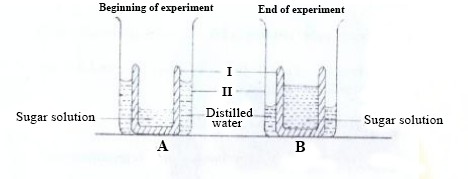
(i) Name the parts labelled I and II.
(ii) State two differences between the set-ups A and B.
(iii) What role does part I play in the experiment?
(iv) Name the biological principle demonstrated.
(v) State one way plants benefit from this principle.
(vi) State one way animals benefit from this principle.
(b) In an experiment to investigate the reactivity of zinc, a piece of the metal was dropped into a test tube containing dilute hydrochloric acid.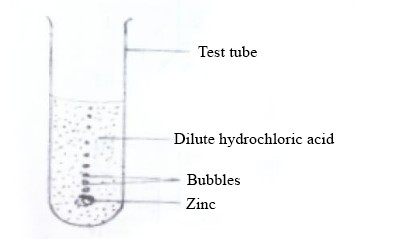
(i) Write a balanced chemical equation for the reaction.
(ii) Name the gas evolved.
(iii) List two metals that react similarly to zinc.
(iv) List two metals that do not react similarly to zinc.
(v) Name two glass apparatus that could replace the test tube.
(c) The diagram below is a thermos flask.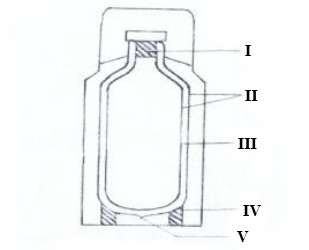
(i) Name the parts I, II, III, IV, and V.
(ii) How does the device minimize heat loss or gain through conduction, convection, and radiation?
(iii) State one use of the thermos flask.
(d) The diagrams illustrate an experiment on a physical property of soil using soil types X, Y, and Z.
(i) Name parts I, II, III, and IV.
(ii) Which soil type has the highest and least water holding capacity?
(iii) Name each soil type X, Y, and Z.
(iv) Suggest a suitable title for the experiment. - (a) List the three particles that make up matter.
(b) State four hereditary features in humans.
(c) State the energy transformation in each activity:
(i) Dry cell in use, (ii) Solar panel in use, (iii) Electric stove in use, (iv) Hammering metal.
(d) State two ways each that the following cultural practices are important in vegetable production:
(i) Staking, (ii) Pruning. - (a) (i) What is indiscriminate sex?
(ii) Give two reasons why teenagers indulge in indiscriminate sex.
(b) Name two sources each of:
(i) natural light, (ii) artificial light.
(c) State three ways soil texture is important in crop production.
(d) Write down the systematic name of the following compounds:
(i) FeS, (ii) CO, (iii) Cu₂O, (iv) NaOH. - (a) (i) What do the symbols L, N, and E represent in an electric plug?
(ii) What is the function of the fuse box in household wiring?
(b) Mention four classes of insect pests based on their feeding habits.
(c) Classify the first four elements of the periodic table as metals and non-metals.
(d) Name the three types of blood vessels in humans. - (a) (i) State the difference between organic and inorganic fertilizer.
(ii) State two effects of inorganic fertilizer on the environment.
(b) Classify the following as acids or bases:
(i) Unripe lemon juice, (ii) Wood ash, (iii) Liquid in car battery, (iv) Bicarbonate of soda.
(c) (i) What is a fruit?
(ii) State two differences between a fruit and a seed.
(d) State the effect of heat on:
(i) Plastics, (ii) Alcohol, (iii) Metal rod. - (a) Classify the following chemical substances based on their uses:
- Milk of magnesia, Alcohol, Paracetamol, Sodium hydroxide, N.P.K.
(b) State one use each of the following weather instruments:
(i) Rain gauge, (ii) Hygrometer, (iii) Anemometer.
(c) (i) Name two types of transistors.
(ii) Draw and label the circuit symbols of the transistors named.
(d) State three reasons why vegetable farming is important.
Worked solutions to the theory questions are free in the app.
More BECE Integrated Science papers
All 38 Integrated Science papers
 All answers free on Google Play