 BECE Past Questions
BECE 2013 Social Studies Past Questions and Answers
40 objective questions and 6 theory questions from the 2013 BECE Social Studies paper. Answers and worked solutions for questions 1 to 10 are below; the rest are free in the app.
Practise this paper free, online or offline


On an iPhone? Download on the App Store
On Android? Get it on Google Play
Paper 1: Objectives
-
The environment can best be described as
- A. man and his surrounding.
- B. animals and non-living things.
- C. vegetation and non-living things.
- D. man and the vegetation around him.
Answer: A -
The social environment includes
- A. settlements, churches and rivers.
- B. settlements, festivals and political parties.
- C. festivals, political parties and religious groups.
- D. festivals, churches and tourist sites.
Answer: C -
Which of the following statements is true? The
- A. social and physical environments are inter-dependent.
- B. physical environment is independent of the social environment.
- C. physical environment is never affected by the social environment.
- D. social environment is more important than the physical environment.
Answer: A -
A major environmental problem facing municipal and metropolitan assemblies in Ghana is
- A. waste management.
- B. air pollution.
- C. deforestation.
- D. gully erosion
Answer: A -
Adolescent reproductive health aims at providing education on
- A. good nutrition.
- B. sexuality.
- C. good marriage.
- D. security.
Answer: B -
The period of adolescence is
- A. 10 - 19 years.
- B. 10 - 14 years.
- C. 15 - 19 years.
- D. 12 - 19 years.
Answer: A -
One way of managing conflict in the Ghanaian society is
- A. arbitration.
- B. confrontation.
- C. mediation.
- D. consultation.
Answer: C -
Adolescent chastity is important because it prevents
- A. contraction of HIV/AIDS by the youth.
- B. contraction of malaria by the youth.
- C. the effect of peer pressure on the youth.
- D. the occurrence of broken homes.
Answer: A -
Adolescents who engage in early sex, risk
- A. dropping out of school.
- B. increasing the size of their family.
- C. looking older than their age.
- D. losing their parents.
Answer: A -
The part of one's income which is not spent is one's
- A. insurance.
- B. account.
- C. deposit.
- D. savings.
Answer: D
Answers and solutions for questions 11 to 40 are free in the BECE Past Questions app, with timed practice and offline study.
-
During their migration, the Akan first settled at
- A. Bono Manso.
- B. Dormaa Ahenkro.
- C. Asante Manso.
- D. Denykira.
-
Ethnic conflicts must be avoided because they slow down
- A. economic development.
- B. rural-urban migration.
- C. tribal disintegration.
- D. urban-rural migration.
-
Unity among Ghanaians can best be promoted through
- A. inter-ethnic marriages.
- B. formal education.
- C. opinion leaders.
- D. good environmental practice.
-
Which of the following represents the earth's surface or part of it drawn to scale?
- A. Layout
- B. Sketch
- C. Map
- D. Landmark
-
Which of the towns in the sketch below lies directly south of Miva?
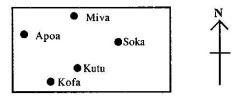
- A. Kofa
- B. Aposa
- C. Soka
- D. Kutu
-
An important feature which can be used to show direction in a locality is called
- A. landmark
- B. bearing
- C. compass
- D. scale
-
The ratio between distance measured on a map and the actual distance on the ground is a
- A. scale
- B. layout
- C. statement
- D. sketch
-
The diagram below illustrates a

- A. linear scale.
- B. statement scale.
- C. representative fraction.
- D. railway line.
-
If the scale of a map is 1:10,000 cm and the distance on the map is 20cm, then the actual distance on the ground is
- A. 20km
- B. 0.2km
- C. 2km
- D. 20,000km
-
The principle of checks and balances prevents
- A. constitutionalism
- B. democracy
- C. dictatorship
- D. patriotism
-
One way of sustaining unity among the ethnic groups in Ghana is by
- A. selecting leaders through elections.
- B. allowing people to enjoy free movement.
- C. appreciating the cultural practices of other people.
- D. keeping troublemakers in prison.
-
One reason for the migration of many ethnic groups into Ghana is
- A. education
- B. security
- C. marriage
- D. religion
-
Which of the following is a symbol of national unity in Ghana? The
- A. National anthem
- B. Akosombo Dam
- C. Gye Nyame
- D. Judiciary
-
The integrity of the nation can be defended by
- A. encouraging immigration.
- B. reporting saboteurs.
- C. educating the youth.
- D. cleaning the environment.
-
Ghana lies between latitudes
- A. 5°S and 11°N.
- B. 5°N and 11°N.
- C. 5°N and 5°S.
- D. 5°N and 11°S.
-
To promote national unity, Ghanaians are expected to be
- A. patriotic.
- B. well paid.
- C. hardworking.
- D. highly educated.
-
The people of British Togoland joined Ghana through
- A. conquest.
- B. persuasion.
- C. voting.
- D. declaration.
-
The Head of State of Ghana at independence in 1957 was
- A. Kwame Nkrumah.
- B. The Queen of Britain.
- C. Gordon Guggisberg.
- D. Edward Akuffo-Addo.
-
The process by which one country takes control of the administration of another is known as
- A. acculturation.
- B. colonization.
- C. socialization.
- D. assimilation.
-
One way by which Ghana cooperates with other countries is by
- A. sending ambassadors and commissioners to them.
- B. lending large sums of money to them.
- C. allowing them to establish military bases in Ghana.
- D. removing all taxes on goods imported from them.
-
The first political event leading to the formal establishment of British colonial rule in the Gold Coast was the
- A. signing of the bond of 1844.
- B. declaration of Sagrenti war.
- C. introduction of the poll Tax ordinance.
- D. disturbances of 1948.
-
To ensure their continuous survival, private enterprises must do all the following except
- A. producing quality goods.
- B. keeping proper records.
- C. paying taxes regularly.
- D. using only foreign labour.
-
The rotation of the earth causes
- A. the seasons.
- B. day and night.
- C. eclipse of the moon.
- D. changes in vegetation.
-
According to the 1992 Constitution of Ghana, an individual can claim Ghanaian citizenship if
- A. his/her grandparents are Ghanaians.
- B. he/she attends school in Ghana.
- C. he/she works in Ghana.
- D. his/her parents reside in Ghana.
-
When two air masses of different temperatures meet, it results in
- A. the formation of relief rainfall.
- B. the formation of cyclonic rainfall.
- C. thunder and lightning.
- D. rain shadow zone.
-
A child of not more than seven years of age found in Ghana, and whose parents cannot be traced is a Ghanaian by
- A. birth.
- B. adoption.
- C. registration.
- D. conferment.
-
One basic right of every Ghanaian is the right to
- A. vote in general elections.
- B. personal liberty.
- C. fair wages.
- D. stand for elections.
-
Which of the following can constitute human rights abuse in Ghana?
- A. Child labour
- B. Employing an 18 year old girl
- C. Dropping out of school
- D. Drug abuse
-
The right to life is an example of
- A. economic right.
- B. natural right.
- C. legal right.
- D. political right.
-
When one behaves in an honest and just manner, one performs his/her
- A. civic right.
- B. civic responsibility.
- C. natural responsibility.
- D. social right.
Paper 2: Theory
- a) Study the map of Ghana shown below and identify the administrative regions marked I, II, III, IV, V.
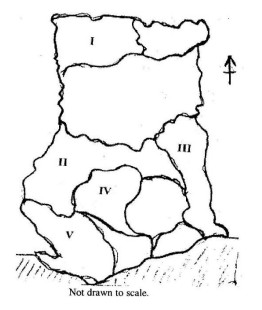
b) Outline five ways in which mountains and highlands are important. - a) List four features of a slum.
b) Enumerate four measures that can be taken to prevent slums in the urban towns of Ghana. - a) Match the political events listed below with their corresponding activities in the table that follows:
- The Poll Tax Ordinance of 1852
- The Bond of 1844
- The 'Sagrenti' war of 1874
- The 1948 riots
- The Yaa Asantewaa war of 1901Political Activity Event I An agreement signed between the British government and some chiefs of the Gold Coast II The war fought by the British soldiers under their leader Sir Garnet Wolsley and the people of Ashanti III The disturbances that occurred in the Gold Coast after the shooting of the ex-service men by the British soldier IV The introduction of a law to collect taxes from the people of the Gold Coast
b) Outline four attitudes and values needed to prevent conflict in the community. - a) List any four ethnic groups in Ghana.
b) Explain any four ways of sustaining unity among the different ethnic groups in Ghana. - Explain five measures that can be adopted to improve the quality of life in rural areas.
- a) What is the difference between education and training?
b) Enumerate four advantages of using modern technology in the production of goods and services.
Worked solutions to the theory questions are free in the app.
 All answers free on Google Play