 BECE Past Questions
BECE 2012 Integrated Science Past Questions and Answers
40 objective questions and 6 theory questions from the 2012 BECE Integrated Science paper. Answers and worked solutions for questions 1 to 10 are below; the rest are free in the app.
Practise this paper free, online or offline


On an iPhone? Download on the App Store
On Android? Get it on Google Play
Paper 1: Objectives
-
The S.I unit for measuring the work done by a force is
- A. J
- B. K
- C. N
- D. W
Answer: A -
The chemical formula of a compound describes the
- A. number of molecules in the compound
- B. type of bonding in the compound
- C. ratio in which the elements are combined
- D. state of the compound
Answer: C -
Which of the following life processes is represented by the equation glucose + oxygen → carbon dioxide + water + energy?
- A. Digestion
- B. Excretion
- C. Photosynthesis
- D. Respiration
Answer: D -
Each layer of soil profile is known as
- A. horizon
- B. litter
- C. regolith
- D. solum
Answer: A -
When the p-n junction of a transistor is reversed biased
- A. current flows from the p-type to the n-type
- B. no current flows from the p-type to the n-type
- C. conduction of current occurs
- D. current flows from the n-type to the p-type
Answer: B -
When a solid-liquid mixture is filtered, the liquid that separates out into the container is called
- A. filtrate
- B. residue
- C. sediment
- D. solution
Answer: A -
Which of the following processes involves the solid state of matter?
- A. Boiling
- B. Condensation
- C. Evaporation
- D. Melting
Answer: D -
Which of the following farming systems is most effective in maintaining soil fertility?
- A. Crop rotation
- B. Land rotation
- C. Mixed cropping
- D. Monoculture
Answer: A -
The disease in humans which is associated with insufficient intake of calcium is
- A. goiter
- B. kwashiorkor
- C. rickets
- D. scurvy
Answer: C -
The arrow in the circuit symbol of either n-p-n or p-n-p transistor is always on the
- A. base lead
- B. collector lead
- C. emitter lead
- D. receiver lead
Answer: C
Answers and solutions for questions 11 to 40 are free in the BECE Past Questions app, with timed practice and offline study.
-
Which of the following insect pests of crops has piercing and sucking mouthparts?
- A. Aphids
- B. Grasshoppers
- C. Stemborers
- D. Termites
-
A reflex action involves the
- A. brain and muscles
- B. brain and nerves
- C. spinal cord and muscles
- D. spinal cord and nerves
-
The type of image formed in a plane mirror is always
- A. diminished
- B. enlarged
- C. real
- D. virtual
-
Which of the following statements about acids are correct?
I. They turn red litmus paper blue
II. They can be classified as either organic or mineral acids
III. They can be neutralized by bases- A. I and II only
- B. I and III only
- C. II and III only
- D. I, II and III
-
A transistor is said to operate in an active region when
- A. one p-n junction is forward biased and the other is reverse biased
- B. base-emitter junctions are reverse biased
- C. both p-n junctions are reverse biased
- D. base-collector junction is forward biased
-
Tuberculosis is spread
- A. through eating of contaminated food
- B. when an infected person coughs openly into the air
- C. through shaking of hands of infected persons
- D. through sharing of contaminated syringes
-
One function of engine oil in the engine of a tractor is to
- A. warm the engine
- B. enhance air intake
- C. ensure proper mixing of fuel
- D. lubricate the engine parts
-
Black pod is a disease of
- A. cocoa
- B. coffee
- C. guava
- D. mango
-
The efficiency of a machine is always less than 100% because part of the energy input is used to
- A. stop the machine after working
- B. perform useful work of the load
- C. overcome friction
- D. lift the machine up
-
Which of the following electronic components are used to produce oscillator circuits?
I. Transistor
II. Inductor
III. Capacitor- A. I and II only
- B. I and III only
- C. II and III only
- D. I, II and III
-
Which of the following sources of light is natural?
- A. Filament bulb
- B. Fluorescent tube
- C. Glow worm
- D. Fire cracker
-
Which of the following substances are carried by the blood?
I. Hormones
II. Urine
III. Oxygen
IV. Carbon dioxide- A. I and III only
- B. II and III only
- C. I, II and IV only
- D. I, III and IV only
-
The practice of starting new organization in response to identified opportunities is termed
- A. Agribusiness
- B. Business enterprise
- C. Entrepreneurship
- D. Management
-
The sub-atomic particle with zero charge in the nucleus of an atom is called
- A. Electron
- B. Ion
- C. Neutron
- D. Proton
-
Which of the following management practices greatly helps in record keeping?
- A. Culling
- B. Debeaking
- C. Dehorning
- D. Identification
-
In a pin-hole camera, when the size of the pin-hole is increased, the image formed is
- A. Blurred
- B. Erect
- C. Magnified
- D. Virtual
-
Non-reactive metals are preferred in making ornaments and jewellery because they
- A. Are attractive
- B. Do not react with atmospheric oxygen
- C. Do not retain their luster
- D. Are corrosive
-
Producers in an ecosystem are plants that
- A. Attract insects
- B. Feed on other plants
- C. Manufacture their own food
- D. Trap insects
-
The use of resistant varieties of crop in controlling diseases is described as
- A. Biological control method
- B. Chemical control method
- C. Cultural control method
- D. Physical control method
-
The chemical formula for aluminium oxide is represented as AlxOy. The values of x and y are respectively
- A. 3 and 2
- B. 3 and 1
- C. 1 and 3
- D. 2 and 3
-
In electrical circuits, the component that protects appliances against high currents is the
- A. Capacitor
- B. Fuse
- C. Resistor
- D. Switch
-
One benefit of technology to industrialization is
- A. Environmental pollution
- B. Reduction in skilful labour
- C. Provision of machinery
- D. Increase in cost of production of goods
-
Which of the following factors contribute to early parenthood?
I. Poverty
II. Illiteracy
III. Lack of parental care
IV. Peer pressure- A. I and II only
- B. II and III only
- C. III and IV only
- D. I, II, III and IV
-
Which of the following examples of fertilizers improves soil texture?
- A. Compost
- B. N.P.K.
- C. Sulphate of ammonia
- D. Urea
-
The reaction between hydrochloric acid and sodium hydroxide produces
- A. Sodium oxide only
- B. Sodium chloride only
- C. Sodium oxide and water
- D. Sodium chloride and water
-
In modern electrical wirings the colour code for the live wire is
- A. Blue
- B. Brown
- C. Green
- D. Green and yellow
-
An example of soil minor nutrient is
- A. Calcium
- B. Iron
- C. Nitrogen
- D. Phosphorus
-
The complete development of a human foetus in the womb normally takes
- A. 7 months
- B. 8 months
- C. 9 months
- D. 10 months
-
A material that allows a small amount of light energy to pass through it but cannot be seen through is referred to as
- A. Opaque
- B. Reflective
- C. Translucent
- D. Transparent
-
The leads of the transistor responsible for activation is the
- A. Amplifier
- B. Base
- C. Collector
- D. Emitter
Paper 2: Theory
- (a) The diagrams show an experiment with a stone, a cork (4.0g), and water.
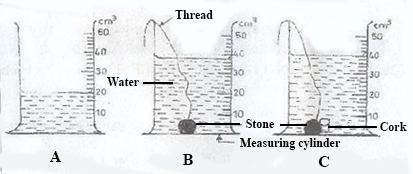
(i) Why did the water level rise when the stone was lowered?
(ii) Why attach the stone to the cork before lowering?
(iii) What would happen if only the cork were lowered?
(iv) Calculate the volume of the stone and cork.
(v) Calculate the density of the cork.
(vi) Why lower the materials gently into the water?
(b) Salt solution preparation experiment.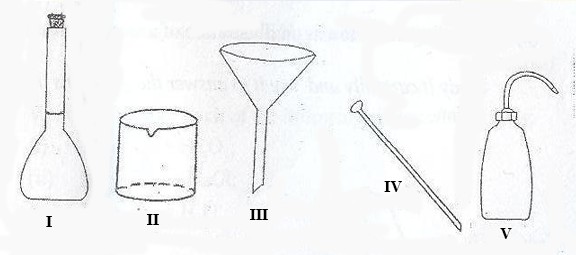
(i) Name each apparatus I, II, III, IV, and V.
(ii) State one function of each.
(c)Study the diagram below carefully and use it to answer the questions that follow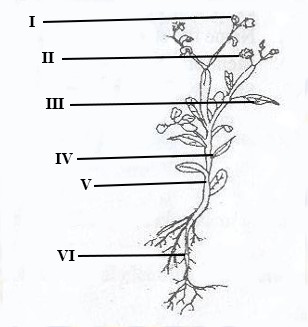
(i) Name the parts I, II, III, IV, V, VI.
(ii) State one function for each part I, II, III, V, and VI.
(iii) Name the two main parts of a flowering plant.
(d)Study the diagram below carefully and use it to answer the questions that follow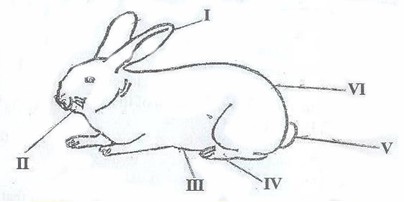
(i) Identify the animal.
(ii) Name each part I, II, III, IV, V, and VI.
(iii) Name the structure where the animal is kept.
(iv) Mention three breeds of this animal.
(v) State two management practices for controlling diseases and pests. - (a) (i) Define technology.
(ii) State one use of technology in communication.
(b) Write balanced chemical equations for:
(i) Fe + O₂ → Fe₂O₃
(ii) Na + Cl₂ → NaCl
(iii) H₂ + O₂ → H₂O
(c) State one function for each cell component:
(i) nucleus,
(ii) chloroplast,
(iii) mitochondrion.
(d) Mention four cultural practices in vegetable crop production.
(e) Name two agencies in food safety in Ghana. - (a) Why does a tomato plant wilt with excess fertilizer?
(b) (i) Differences between insulators and conductors.
(ii) Effects of illegal electrical connections.
(c) Explain:
(i) condensation,
(ii) freezing.
(d) (i) Name two circulatory diseases.
(ii) How to prevent each. - (a) (i) What is a transistor?
(ii) Uses of a transistor.
(b) Suitable solvent for:
(i) grease,
(ii) ink stain,
(iii) starch,
(iv) cube sugar,
(v) oil paint,
(vi) iodine.
(c) (i) Define respiratory organ.
(ii) Name two structures of the respiratory system.
(d) (i) Define agricultural chain.
(ii) Types of agricultural chains. - (a) (i) What are stars?
(ii) Arrange the first four planets from the sun.
(b) (i) Differences between plants and animals.
(ii) Similarities between plants and animals.
(c) Farming systems:
(i) pastoral farming,
(ii) ecological farming.
(d) Properties of water by:
(i) odour,
(ii) taste,
(iii) effect on litmus. - (a) (i) Define annual plants.
(ii) Define perennial plants.
(b) Danger of:
(i) eating in the lab,
(ii) washing hands with unknown liquid,
(iii) walking barefooted.
(c) (i) Define digestive enzyme.
(ii) Examples of digestive enzymes in humans.
(d) Differences between conduction and radiation.
Worked solutions to the theory questions are free in the app.
More BECE Integrated Science papers
All 38 Integrated Science papers
 All answers free on Google Play