 BECE Past Questions
BECE 2011 Integrated Science Past Questions and Answers
40 objective questions and 6 theory questions from the 2011 BECE Integrated Science paper. Answers and worked solutions for questions 1 to 10 are below; the rest are free in the app.
Practise this paper free, online or offline


On an iPhone? Download on the App Store
On Android? Get it on Google Play
Paper 1: Objectives
-
An example of a noble gas is
- A. chlorine
- B. neon
- C. nitrogen
- D. oxygen
Answer: B -
The structure that stores sperms temporarily in the male reproductive system of humans is
- A. epididymis
- B. scrotal disc
- C. sperm duct
- D. testes
Answer: A -
Which of the following properties of alcohol as a thermometric liquid is correct?
- A. It is opaque
- B. It does not wet glass
- C. It has a very low freezing point
- D. It has a high freezing point
Answer: C -
In which of the following vegetation of Ghana does millet and sorghum grow well?
- A. Costal savannah
- B. Forest zone
- C. Guinea savannah
- D. Transition zone
Answer: C -
Which of the following methods is/are used for preserving fish?
I. Canning
II. Frying
III. Smoking- A. I only
- B. I and II only
- C. II and III only
- D. I, II and III
Answer: D -
Which of the following practices in the home can prevent disease infection?
- A. Covering one's food
- B. Drinking unclean water
- C. Keeping one's surrounding untidy
- D. Sharing towels and sponges
Answer: A -
An example of a semimetal is
- A. calcium
- B. lithium
- C. silicon
- D. sodium
Answer: C -
Which kind of energy transformation takes place in an electric motor?
- A. Chemical energy to electrical energy
- B. Chemical energy to mechanical energy
- C. Electrical energy to light energy
- D. Electrical energy to mechanical energy
Answer: D -
Landrace is a breed of
- A. cattle
- B. goats
- C. pigs
- D. sheep
Answer: C -
In flowering plants, the stamen is made up of
- A. anther and stigma
- B. anther and filament
- C. stigma and filament
- D. stigma and style
Answer: B
Answers and solutions for questions 11 to 40 are free in the BECE Past Questions app, with timed practice and offline study.
-
Which of the following statements about a transistor is correct?
- A. It can be used to amplify current
- B. It is similar to three diodes
- C. It consists of two leads only
- D. It has three junctions
-
An atom has 6 protons and 7 neutrons in its nucleus. What is the mass number?
- A. 1
- B. 6
- C. 7
- D. 13
-
A record of daily activities on a farm is termed
- A. labour record
- B. inventory record
- C. farm diary
- D. production record
-
Which of the following devices work(s) on the principle of transmission pressure in fluids?
I. Water pumps
II. Syringes
III. Bicycle brakes- A. I only
- B. I and II only
- C. II and III only
- D. I, II and III
-
Which of the following crops is not correctly matched with its group?
- A. Cowpea - cereal crop
- B. Cocoa - beverage crop
- C. Coconut - oil crop
- D. Cocoyam - tuber crop
-
Which of the following substances is a salt?
- A. H2SO4
- B. NaOH
- C. HCl
- D. CaCl2
-
In which part of the digestive system of a fowl does grinding of feed take place?
- A. Crop
- B. Gizzard
- C. Oesophagus
- D. Proventriculus
-
The parts of a bony fish that are used to control the level at which the fish swims are known as
- A. dorsal and caudal fins
- B. caudal and pectoral fins
- C. pectoral and pelvic fins
- D. dorsal and pectoral fins
-
Millon's reagent is used to test for
- A. carbohydrates
- B. fats
- C. proteins
- D. vitamins
-
In an n-p-n transistor, the n-type collector is connected to the positive terminal of the battery thus making the
- A. base-collector junction reverse biased
- B. base-collector junction forward biased
- C. base-emitter junction reverse biased
- D. base-emitter junction forward biased
-
Which type of vegetation favours both wet and hot environmental conditions?
- A. Strand and mangrove
- B. Coastal savannah
- C. Guinea savannah
- D. Tropical forest
-
During drought, some plants dry out because of high
I. atmospheric temperature
II. humidity
III. rate of evaporation- A. III only
- B. I and II only
- C. I and III only
- D. I, II and III
-
Soil erosion on sloppy farmlands is best controlled by
- A. Cover cropping
- B. Mulching
- C. Strip cropping
- D. Terracing
-
A viable seed is one that
- A. Germinates under suitable conditions
- B. Contains oil
- C. Develops from fertilized ovary
- D. Has a pericarp
-
Which of the following pairs of structures form part of the female reproductive system of humans?
- A. Urethra and uterus
- B. Cervix and uterus
- C. Ureter and uterus
- D. Cervix and ureter
-
Which of the following chemical symbols is that of a metal?
- A. Ca
- B. Ne
- C. P
- D. S
-
All the living and non-living things that surround an organism constitute its
- A. Community
- B. Ecosystem
- C. Environment
- D. Habitat
-
Which of the following crops should be planted after cassava in crop rotation?
- A. Cocoyam
- B. Cowpea
- C. Onion
- D. Yam
-
Endoparasites in farm animals can be controlled by
- A. Drenching
- B. Dipping
- C. Dusting
- D. Spraying
-
Which of the following devices requires the use of transistors in its operation?
- A. Computer
- B. Electric heater
- C. Microphone
- D. Wall clock
-
Feel Method is used to determine soil
- A. Air
- B. Colour
- C. Structure
- D. Texture
-
Which of the following modes of heat transfer is the thermos flask designed to minimize?
I. Conduction
II. Convection
III. Radiation- A. I and II only
- B. I and III only
- C. II and III only
- D. I, II and III
-
An atom of an element is represented as ²⁵₁₂X. What is the respective number of neutrons and protons in the atom?
- A. 12 and 13
- B. 12 and 25
- C. 13 and 12
- D. 25 and 12
-
The anemometer is an instrument used in determining
- A. Amount of rainfall
- B. Speed of wind
- C. Relative humidity
- D. Intensity of light
-
Which of the following subjects is/are considered as applied science?
I. Biology
II. Medicine
III. Psychology- A. I only
- B. I and II only
- C. I and III only
- D. II and III
-
Chinchilla is a breed of
- A. Goats
- B. Pigs
- C. Rabbits
- D. Sheep
-
Which of the following characters is not acquired through heredity?
- A. Language spoken
- B. Shape of nose
- C. Colour of eyes
- D. Temperament
-
The food nutrient which ensures good health in farm animals is
- A. Carbohydrates
- B. Minerals
- C. Proteins
- D. Vitamins
-
The use of resistant breeds of farm animals to control pests is a
- A. Biological method
- B. Chemical method
- C. Cultural method
- D. Physical method
-
Which of the following arrangements show the correct order of increasing complexity of structures in living organisms.
- A. Cells → organs → tissues → systems
- B. Cells → tissues → organs → systems
- C. Cells → systems → tissues → organs
- D. Cells → tissues → systems → organs
Paper 2: Theory
- (a) In an experiment to demonstrate a property of light, three cardboards, A, B, and C with holes in their centers are arranged in a straight line between a lighted bulb and an observer.
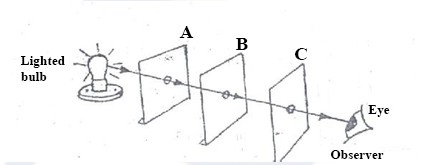
(i) What would the observer see from the position shown?
(ii) What would the observer see when cardboard B is slightly displaced from the line?
(iii) Explain the observation made in (a)(ii) above.
(iv) What would be observed when the cardboard B is brought back to its original position?
(v) What property of light is being demonstrated in this experiment?
(vi) Mention:
α) two natural occurrences explained by the property of light demonstrated.
β) one device that works on the property of light demonstrated.
(b) The diagrams below show hazard symbols.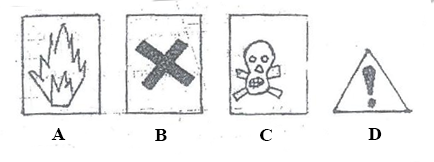
(i) What does each symbol A, B, C, and D represent?
(ii) Name one substance associated with each of the symbols A, B, and C.
(iii) Name one place where symbol D can be found.
(iv) State two advantages of hazard symbols.
(c) The diagrams below show different types of teeth in humans.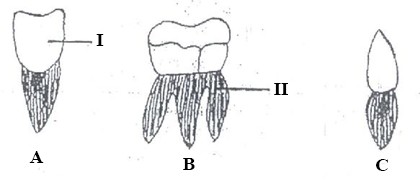
(i) Identify each type of tooth labeled A, B, and C.
(ii) Describe the shape of each of the teeth labeled A, B, and C.
(iii) State one function of each of the teeth labeled A, B, and C.
(iv) Name the parts of the teeth labeled I and II.
(d) The diagrams below show some farm tools.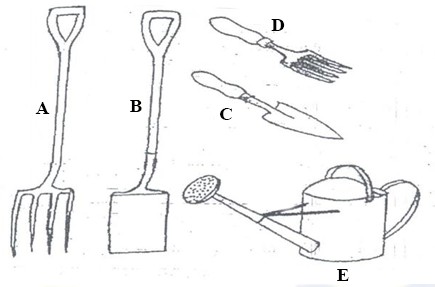
(i) Identify each of the tools labeled A, B, C, D, and E.
(ii) Mention one use of each tool labeled A, B, C, D, and E. - (a) (i) What are ruminants?
(ii) Give two examples of ruminants.
(b) (i) What is force?
(ii) State two effects of force on a body.
(c) (i) Mention two ways to maintain the carbon cycle.
(ii) State one environmental effect of disrupting the carbon cycle.
(d) (i) Name the three sub-atomic particles.
(ii) State the relative charge on each of the three sub-atomic particles.
(iii) Name the particle formed when an atom loses an electron. - (a) (i) What is a mixture?
(ii) Why are some mixtures thoroughly stirred before use?
(b) (i) What is reflection of light?
(ii) State two characteristics of images formed by plane mirrors.
(c) (i) What is a fertilizer?
(ii) Give one example of an inorganic fertilizer.
(d) (i) What is indiscriminate sex?
(ii) State two dangers of indiscriminate sex on humans. - (a) (i) What is a simple machine?
(ii) Give two examples of a simple machine.
(b) (i) What is rusting?
(ii) State two effects of rusting.
(c) (i) What are food nutrients?
(ii) Classify the following items as carbohydrate, fats and oil, or protein: Beans, palm fruits, meat, margarine, bread, maize.
(d) (i) State two effects of malnutrition in farm animals.
(ii) Mention one viral disease of farm animals. - (a) (i) What is soil erosion?
(ii) Name two methods of controlling soil erosion.
(b) Explain the following ecological terms:
α) Adaptation;
β) Endangered species.
(c) (i) Give one example of hard water.
(ii) Why is it advisable to drink hard water?
(d) (i) What is a magnetic field?
(ii) State two methods of making magnets. - (a) (i) Define:
α) Solvent;
β) Solute.
(ii) Name one common solvent used in the home.
(b) Explain the following terms in animal production:
(i) Ration;
(ii) Dehorning.
(c) (i) What is an element?
(ii) Write down the symbols for:
α) Potassium;
β) Sulphur.
(d) Explain each of the following terms:
(i) Mixed farming;
(ii) Mixed cropping.
Worked solutions to the theory questions are free in the app.
More BECE Integrated Science papers
All 38 Integrated Science papers
 All answers free on Google Play