 BECE Past Questions
BECE 2011 Social Studies Past Questions and Answers
40 objective questions and 6 theory questions from the 2011 BECE Social Studies paper. Answers and worked solutions for questions 1 to 10 are below; the rest are free in the app.
Practise this paper free, online or offline


On an iPhone? Download on the App Store
On Android? Get it on Google Play
Paper 1: Objectives
-
The purpose of naming ceremonies in traditional Ghanaian homes, is to
- A. give the child an identity
- B. offer gifts to the parents by friends and relatives
- C. make parents popular
- D. let the child taste alcohol for the first time
Answer: A -
Which of the following officials are not elected through general elections in Ghana?
- A. Members of Parliament
- B. President of Ghana
- C. Assembly members
- D. Ministers of state
Answer: D -
Festivals are important in Ghana because they enable the people to
- A. remember important past events
- B. show their wealth
- C. appoint traditional priests for the shrines
- D. determine the number of people in the community
Answer: A -
The instrument used in measuring the rate of evaporation is
- A. barometer
- B. evaporimeter
- C. anemometer
- D. hydrometer
Answer: B -
In which vegetational belt is Ghana's cocoa mostly grown?
- A. Mangrove swamp
- B. Sudan savanna
- C. Semi-deciduous forest
- D. Guinea savanna
Answer: C -
Equal hours of day and night are experienced in Ghana when the sun is overhead on
- A. Latitude 0°
- B. Latitude 23 ½ ° North
- C. Longitude 180°
- D. Longitude 0°
Answer: A -
One of the aims of the African Union (AU) is to
- A. eliminate cultural differences in Africa
- B. increase the size of foreign aid to Africa
- C. increase the growth of Africa’s population
- D. eliminate conflicts in Africa
Answer: D -
The eagles in Ghana's Coat of Arms signify
- A. the wealth of the nation
- B. protection of the people
- C. unity of the people
- D. a continued link with the Commonwealth
Answer: B -
The head of government of the second Republic of Ghana was the
- A. Attorney General
- B. Head of State
- C. Prime Minister
- D. Chief Justice
Answer: C -
Which of the following oceans lies between Africa and America?
- A. Arctic
- B. Atlantic
- C. Pacific
- D. Indian
Answer: B
Answers and solutions for questions 11 to 40 are free in the BECE Past Questions app, with timed practice and offline study.
-
Ghana can minimize the importation of goods mainly by
- A. increasing subsidies on local products
- B. increasing taxes on imports
- C. controlling the rate of inflation
- D. decreasing advertisement of local products
-
An important source of locally generated revenue for District Assemblies in Ghana is
- A. the common fund
- B. court fines
- C. market tolls
- D. road tolls
-
Indecent dressing among the youth should be discouraged because it
- A. leads to increased social crime
- B. increases peer pressure
- C. makes them unpopular
- D. makes them lose dignity
-
The Domestic Violence and Victims Support Unit (DOVVSU) in Ghana is responsible for resolving problems relating to
- A. work place disputes
- B. family welfare
- C. the chieftaincy institution
- D. tribal conflicts
-
Ghana's high indebtedness to foreign countries can be reduced by
- A. increasing tax revenue
- B. using locally produced goods
- C. investing more in education
- D. ensuring good neighbourliness with other countries
-
One major reason for the migration of ethnic groups into modern Ghana was the search for
- A. means of livelihood
- B. religious protection
- C. military weapons
- D. good neighbours
-
Laws are mainly made to ensure
- A. better education
- B. instant justice
- C. social conformity
- D. family unity
-
Public corporations are set up by the government mainly to provide
- A. youth employment
- B. emergency services
- C. entrepreneurial skills
- D. utility services
-
The most important factor that can help improve productivity in state enterprises is
- A. working throughout the year
- B. working for longer hours
- C. by increasing public holidays
- D. proper supervision
-
Floods in our communities can best be controlled through
- A. harvesting rain water
- B. planned layout
- C. tarring of roads
- D. construction of boreholes
-
The interpretation of the constitution of Ghana is a function of the
- A. legislature
- B. executive
- C. judiciary
- D. cabinet
-
Free movement of people, goods and services is one of the main aims of the
- A. Non-Aligned Movement
- B. United Nations Organisation
- C. Economic Community of West African States
- D. Commonwealth
-
Industries must be located outside residential areas to
- A. avoid pollution
- B. encourage competition among firms
- C. reduce cost of production
- D. reduce industrial accidents
-
Which of the following vegetation types experiences high temperature and heavy rainfall throughout the year?
- A. Mangrove forest
- B. Tropical vegetation forest
- C. Semi deciduous forest
- D. Woodland savanna
-
The state can promote the growth of private enterprises by
- A. taking over their control and management
- B. increasing taxes on their earnings
- C. increasing imports of similar products
- D. organizing training sessions for their managers
-
When the scale of a map is expressed in the form of a ratio, it is known as
- A. diagonal
- B. statement
- C. linear
- D. representative fraction
-
The main reason for encouraging farmers in Ghana to produce more cocoa is to
- A. generate more foreign exchange
- B. help determine the best cocoa farmer
- C. set up more cocoa factories
- D. promote the manufacturing of more cocoa products
-
Which of the following is not a product of the forest zone in Ghana?
- A. Palm nut
- B. Shea nut
- C. Cocoa
- D. Coffee
-
One moral value that is stressed during an outdooring and naming ceremony of a child is
- A. truthfulness
- B. love
- C. hard work
- D. respect
-
The tertiary sector of the Ghanaian economy provides
- A. services
- B. raw materials
- C. finished goods
- D. industrial machinery
-
The Djebobo and Torogbani mountains are located in the
- A. Gambaga escarpment
- B. Atiwa-Atwredu ranges
- C. Akwapim-Togo ranges
- D. Kwahu plateau
-
Productivity in the mining sector can be increased in Ghana through
- A. improvement in the land tenure system
- B. the employment of more labourers
- C. the application of modern technology
- D. the use of locally manufactured tools
-
One main reason for the abolition of the slave trade was
- A. lack of finance for the traders
- B. lack of market for slaves
- C. the inhuman nature of the trade
- D. lack of cultural support
-
The first African country to allow herself to be assessed under the New Partnership for African Development (NEPAD) was
- A. Ghana
- B. South Africa
- C. Nigeria
- D. Rwanda
-
The African Union (AU) was officially launched on 9th July, 2002 in
- A. South Africa
- B. Libya
- C. Nigeria
- D. Ethiopia
-
One problem hindering the effective functioning of District Assemblies in Ghana is
- A. rapid population growth
- B. mobilizing funds for development
- C. interference by traditional rulers
- D. maintaining law and order
-
Which of the following economic activities does not cause deforestation in Ghana?
- A. Crop growing
- B. Lumbering
- C. Fishing
- D. Charcoal burning
-
A major effect of lateness to school and work is that it
- A. increases the cost of living
- B. takes away leisure time
- C. causes ill feeling among colleagues
- D. reduces productivity
-
Which of the following business units raises its capital through the sale of shares?
- A. Public Corporations
- B. Joint-stock Companies
- C. Partnership
- D. Co-operative societies
-
One benefit that Ghana derives from co-operating with international bodies is
- A. payment of dues to such bodies
- B. contributing soldiers to peace keeping
- C. accepting refugees
- D. technology transfer
Paper 2: Theory
- Use the map below to answer the questions
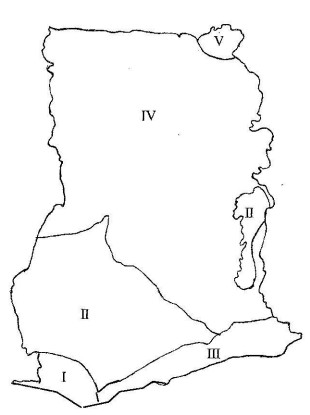
a) Identify the vegetation types numbered on the map as follows: I, II, III, IV and V.
b) Highlight five benefits of water bodies in Ghana. - a) What is cultural change?
b) Explain four factors responsible for cultural change in Ghana. - a) Highlight any four contributions of Ghana to the United Nations Organization.
b) In what four ways has Ghana benefited from the United Nations Organization? - a) What is separation of powers?
b) Outline four advantages of separation of powers. - In what five ways can Ghana reduce her dependency on foreign financial support?
- a) Describe four ways through which human resource can be developed in Ghana.
b) State two reasons why labour is not fully used in Ghana.
Worked solutions to the theory questions are free in the app.
 All answers free on Google Play