 BECE Past Questions
BECE 2024 Integrated Science Past Questions and Answers
40 objective questions and 5 theory questions from the 2024 BECE Integrated Science paper. Answers and worked solutions for questions 1 to 10 are below; the rest are free in the app.
Practise this paper free, online or offline


On an iPhone? Download on the App Store
On Android? Get it on Google Play
Paper 1: Objectives
-
Which of the following sources of energy is non-renewable?
I. Coal
II. Solar
III. Wind
IV. Uranium-236- A. I, II and III only
- B. II, III and IV only
- C. I and IV only
- D. II and III only
Answer: C -
The building block of a material with the smallest unit of matter that retains the properties of an element is
- A. an ion
- B. an atom
- C. a molecule
- D. a proton
Answer: B -
Oil from a mechanic workshop accidentally spilled into a pool of water which was breeding mosquitoes. After sometime, the pool of water was no longer breeding mosquitoes. Which control method may have been deployed?
- A. Biological control
- B. Chemical control
- C. Environmental control
- D. Genetic control
Answer: B -
Grasshopper management is crucial because of all the following reasons except
- A. damage to crops
- B. incomplete metamorphosis
- C. ecosystem disruption
- D. livestock harm
Answer: BDamage to crops, harm to livestock and disruption of the ecosystem are reasons to manage grasshoppers. Incomplete metamorphosis is a fact about the grasshopper's life cycle, not a reason for managing it. -
A hunter experiences a backward force upon firing a gun. Which of Newton's laws of motion is demonstrated in the situation?
- A. First law
- B. Second law
- C. Third law
- D. Law of inertia
Answer: C -
Which of the following sets of devices operate on the principle of magnetism?
- A. Loudspeakers, compass, alarms
- B. Loudspeakers, alarms, LCD TV
- C. Compass, loudspeakers, LCD TV
- D. Compass, loudspeakers, LCD TV
Answer: A -
Which of the following elements has four electron shells?
- A. 19K
- B. 13Al
- C. 15P
- D. 5B
Answer: A -
A livestock farmer wants to achieve good health for animals being reared. Which of the following activities should be undertaken by the farmer?
I. Have vaccination schedules for the animals
II. Provide balanced ration to the animals III. Provide good sanitation for the animals- A. I and II only
- B. II and III only
- C. I and III only
- D. I, II and III
Answer: D -
Canned foods and drinks have expiry dates on them. The hazard involved in taking an expired drink is
- A. food poisoning
- B. impaired hearing
- C. poor circulation of blood
- D. suffocation
Answer: A -
Two unknown solutions labelled A and B were brought to a JHS 3 class. It was observed that in solution A, red litmus paper changed colour to blue, whiles in solution B, red litmus paper retained its colour. What could be the content of solution A?
- A. Car battery fluid
- B. Salt solution
- C. Baking soda
- D. Orange juice
Answer: C
Answers and solutions for questions 11 to 40 are free in the BECE Past Questions app, with timed practice and offline study.
-
A student who complained of stomach upset was given first aid with Mg(OH)₂ boldly written on it. What could be the common name of the first aid the student was given?
- A. Milk of aluminium
- B. Milk of magnesia
- C. Trisilicate
- D. Martins liver salt
-
A bowl of water on a gas stove was initially cold. It became warm after sometime. What was the mode of heat transfer in the water?
- A. Convection
- B. Radiation
- C. Emission
- D. Conduction
-
The portion of air which acts as a solvent is
- A. Oxygen
- B. Carbon (IV) oxide
- C. Nitrogen
- D. An inert gas
-
A natural phenomenon that illustrates the dispersal of light is
- A. A rainbow
- B. An eclipse
- C. A rainfall
- D. An echo
-
When a stick is dipped into a pool of water, it appears to
- A. be longer than its length
- B. bend away from the surface
- C. be seen straight in the water
- D. bend towards the surface
-
Which of the following electrical appliances can convert electrical energy to heat energy?
I. Electric iron
II. Kettle III. Water heater- A. I, II and III
- B. I and III only
- C. II and III only
- D. I and II only
-
The consequences of the greenhouse effect on humans include
I. flooding of coastal cities
II. desertification of fertile areas III. increased number of storms IV. increased use of fossil fuels- A. I, II, III and IV
- B. II and III only
- C. I, II and III only
- D. I and II only
-
Cockroaches in a cupboard were killed after an insecticide had been sprayed. The insecticide reached the cockroaches by the process of
- A. Osmosis
- B. Absorption
- C. Diffusion
- D. Radiation
-
Which of the following nursery beds is suitable for a flood-prone area?
- A. Plain bed
- B. Sunken bed
- C. Raised bed
- D. Flat bed
-
Which of the following natural cycles directly involves the sun?
I. Carbon cycle
II. Water cycle
III. Nitrogen cycle- A. I, II and III
- B. I and II only
- C. II and III only
- D. I and III only
-
The primary purpose of respiration in man is to
I. take in oxygen.
II. release carbon dioxide.
III. regulate body temperature.- A. I, II and III
- B. I and II only
- C. II and III only
- D. I only
-
Nitrogen deficiency in soils causes
- A. poor seed formation
- B. yellowing of leaves
- C. purple colouration
- D. fruit drop
-
An electric bulb is rated 0.5 A, 120 V. Determine the power produced when the bulb is turned on.
- A. 60 kW
- B. 60 W
- C. 30 kW
- D. 30 W
-
The following processes are chemical changes except
- A. crumpling of paper
- B. burning of wood
- C. mixing of an acid and a base
- D. rusting of iron
-
Which of the following statements best describes the term green economy? It includes
- A. reduced ecological services
- B. loss of biodiversity
- C. reduced carbon emissions
- D. degrading the environment
-
The energy transformation that occurs when sodium hydroxide is dissolved in water is
- A. heat to potential energy
- B. chemical to light energy
- C. chemical to heat energy
- D. heat to kinetic energy
-
Digestion of rice in humans starts from the
- A. stomach
- B. gullet
- C. mouth
- D. colon
-
A substance that could be used in large scale treatment of domestic water is
- A. Nitrogen
- B. Hydrogen sulphide
- C. Carbon dioxide
- D. Chlorine
-
Chlorophyll helps plants absorb energy from the sun as they undergo the process of photosynthesis. It is located in a structure called
- A. chloroplast
- B. mitochondrion
- C. vacuole
- D. nucleus
-
An electrical engineer was in your school to replace a 20 W bulb with a 50 W bulb.
The unit inscribed on the bulb measures its- A. energy
- B. workdone
- C. power
- D. electricity
-
An electrical engineer was in your school to replace a 20 W bulb with a 50 W bulb.
The 50 W bulb is likely to
I. increase the brightness in the room.
II. increase the amount of electricity consumed.
III. destroy the habitat of pests.- A. I, II and III
- B. I and III only
- C. II and III only
- D. I and II only
-
The following devices work based on the principle of pressure in fluids except
- A. siphons
- B. flutes
- C. drinking straws
- D. water pumps
-
In making ornaments and jewellery, non-reactive metals are preferred because they
- A. are corrosive
- B. are attractive
- C. do not retain their lustre
- D. do not react with atmospheric oxygen
-
A metallic ladle was left in a boiling soup. After sometime, the handle became hot. This is because the particles in the ladle
- A. undergo rapid, random motion
- B. contain free electrons which are able to transfer heat energy
- C. are separated by large distances
- D. circulate as a result of the temperature differences
-
The simplest way of making well water suitable for laundry is by
- A. adding copper sulphate
- B. filtering
- C. boiling
- D. adding chlorine
-
A poultry farmer observed that the layers were producing thin-shelled eggs.
The defect identified is mostly caused by a deficiency in- A. zinc
- B. phosphorus
- C. magnesium
- D. calcium
-
A poultry farmer observed that the layers were producing thin-shelled eggs.
What ingredient could be added to the feed to correct the defect?- A. Maize
- B. Soya bean meal
- C. Cowpea
- D. Oyster shell meal
-
Which of the following pairs of energy sources is environmentally friendly?
- A. Coal and thermal energy
- B. Wind and biogas
- C. Wind and coal
- D. Biogas and thermal energy
-
A student is to measure 20 cm3 of a sodium hydroxide solution. What instrument could be used?
- A. Measuring tape
- B. Hygrometer
- C. Measuring cylinder
- D. Hydrometer
-
A mother took her child to the hospital and upon investigation, it was noticed that the child's diet was lacking in zinc. What could this result in?
I. Decreased growth in the child
II. Anaemia and constipation
III. Inability of the body to fight infection- A. I, II and III
- B. I and III only
- C. II and III only
- D. I and II only
Paper 2: Theory
Section A
Answer Question 1 in Section A and any other three questions in Section B. Answer all the questions in your answer booklet. Credit will be given for clarity of expression and orderly presentation of material.
- (a) Fig. 1(a) is an illustration of the longitudinal section of the mammalian heart. Study it carefully and answer the questions that follow.
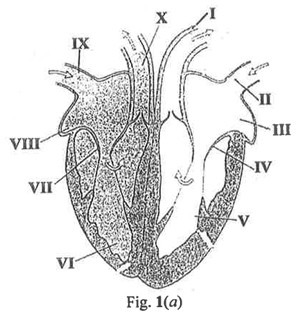
(i) State one function for each of the parts labelled I, II, IX, and X.
(ii) Explain briefly why the left lower part of the heart has a thicker muscle.
(iii) State two ways by which the flow of blood to and from the mammalian heart as shown in Fig 1(a) can be kept at acceptable levels.
(iv) Name two parts of the heart where oxygenated blood can be found.
(b) Fig. 1(b) is an illustration of three sets of plant parts labelled P (maize grains), Q (tomato seedlings), and R (cassava cutting). Study it carefully and answer the questions that follow.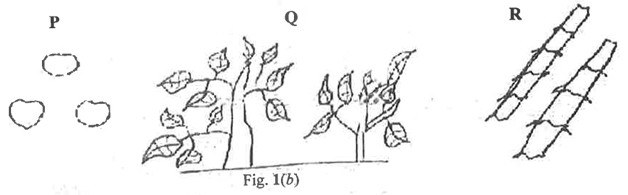
(i) Describe briefly how each of the parts labelled P, Q, and R are planted on seedbed.
(ii) State four conditions under which R can be cultivated to produce high yield.
(c) Fig. 1(c) is an electric circuit diagram. Study it carefully and answer the questions that follow.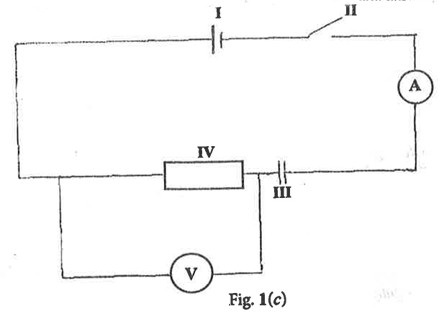
(i) State one function for each of the parts labelled I, II, III, and IV.
(ii) If the voltmeter reads 2.4 V and the ammeter reads 0.8 A when the circuit is closed, calculate the value of the part labelled IV.
(iii) State one way of conserving the value of the part labelled I in the circuit.
(iv) State two observations that can be made when the circuit is closed.
(d) Fig. 1(d) illustrates an experiment performed to separate the components of a mixture. Study it carefully and answer the questions that follow.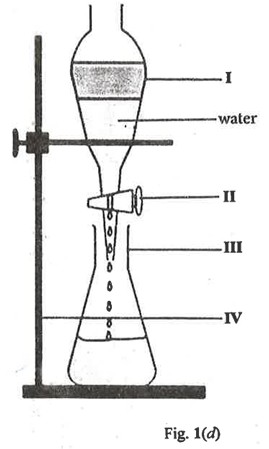
(i) Describe briefly the process of this experiment.
(ii) State one function for each of the parts labelled II and IV.
(iii) State two precautions that should be taken to obtain reliable results when performing this experiment. - (a) (i) Given a flashlight, a tennis ball and a screen, draw a diagram to show how a shadow can be formed.
(ii) A student seeking to determine the volume of an irregular body of mass 4 kg used a graduated cylinder in an experiment. Fig. 2 illustrates two key stages of the experiment.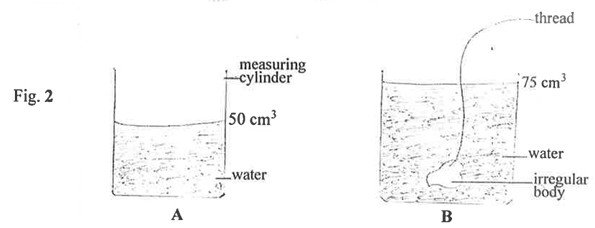
Determine the density of the irregular body.
(iii) State two precautions that must be taken to obtain reliable results.
(b) State three safety precautions to prevent accidents during the use of liquefied petroleum gas in the home.
(c) Explain briefly the scientific principle underlying each of the following waste management practices:
(i) Composting
(ii) Recycling
(iii) Incineration
(d) The digestive systems of two domestic animals were provided. One is a goat, the other a rabbit.
Outline three features that would help to differentiate between the two digestive systems. - (a) You have been given maize, cowpea, cassava and cabbage to cultivate on a piece of land using crop rotation system.
(i) Design a 4-year rotational program using the given crops.
(ii) Give two reasons for the sequence given in (a)(i).
(b) A student is suspected of having contracted COVID-19.
(i) Give three symptoms that the student may exhibit to confirm this suspicion.
(ii) Suggest two ways to prevent the spread of COVID-19 in the school.
(iii) Give two reasons why COVID-19 was declared a pandemic.
(c) The mass of a vehicle is 1000 kg and travels at 100 m/s. If the vehicle accelerates to 150 m/s in 10 s, calculate the:
(i) acceleration of the vehicle
(ii) force that acts on the vehicle
(iii) final momentum when the vehicle comes to a stop. - (a) A student who went to bed immediately after eating complained of stomach upset the next morning. A doctor prescribed a liver salt, whose major composition is NaHCO3 as the medication.
Using a balanced chemical equation, explain how the liver salt would relieve the student from this discomfort.
(b) Fig. 4 is an illustration of a body of mass 20 kg placed on top of a wall of height 10 m. Calculate the energy of the body.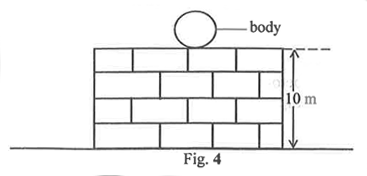
(c) (i) Define the term light-emitting diode (LED).
(ii) Mention two devices that use LED in their operation.
(d) A student was tasked to prepare a raised nursery bed for nursing tomato seeds.
(i) Suggest two simple tools that could be used in the nursery bed preparation.
(ii) State one function each of the tools listed in (d(i).
(e) (i) State three observable features of an animal cell.
(ii) State two functions of a nerve cell. - (a) Fig. 5 is an electrical circuit diagram.
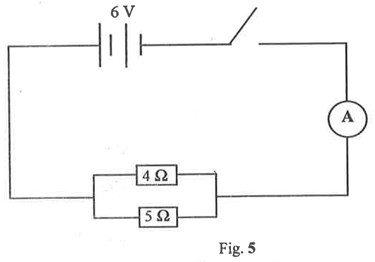
(i) Calculate the effective resistance in the circuit when it is closed.
(ii) Calculate the current that will flow through the circuit when it is closed.
(b) (i) Differentiate between an organic fertilizer and an inorganic fertilizer.
(ii) Outline briefly the steps involved in preparing raised beds.
(c) (i) State one function each of the following components of blood:
(α) red blood cells
(β) white blood cells
(γ) blood plasma
(ii) Explain briefly the impact of each of the following organisms on humans:
(α) housefly
(β) grasshopper
(d) Describe briefly the formation of an ammonia molecule after an interaction between 1H and 7N atoms.
Worked solutions to the theory questions are free in the app.
More BECE Integrated Science papers
All 38 Integrated Science papers
 All answers free on Google Play