 BECE Past Questions
BECE 1999 Mathematics Past Questions and Answers
40 objective questions and 5 theory questions from the 1999 BECE Mathematics paper. Answers and worked solutions for questions 1 to 10 are below; the rest are free in the app.
Practise this paper free, online or offline


On an iPhone? Download on the App Store
On Android? Get it on Google Play
Paper 1: Objectives
-
Set A is called ________ of set B, when all the numbers of set A are also members of set B.
- A. the universal set
- B. the union set
- C. the null set
- D. a subset
- E. an empty set
Answer: D -
M = {multiples of 3 between 10 and 20} and N = {even numbers between 10 and 20}. Find M ∩ N.
- A. {12, 18}
- B. {12, 15, 18}
- C. {12, 14, 16, 18}
- D. {12, 14, 15, 16, 18}
- E. {10, 12, 14, 15, 18, 20}
Answer: AM = {12, 15, 18} and N = {12, 14, 16, 18}. Intersection (∩) are elements found in both sets: M ∩ N = {12, 18}. -
Express 24 as a product of prime factors.
- A. 2 × 3
- B. 2² × 3
- C. 2³ × 3
- D. 2² × 3²
- E. 2² × 3³
Answer: CPrime factors of 24 = 2 × 2 × 2 × 3 = 2³ × 3. -
Write 1342 in standard form.
- A. 0.1342 × 10⁻³
- B. 0.1342 × 10⁻⁴
- C. 13.42 × 10²
- D. 1.342 × 10³
- E. 1.342 × 10⁴
Answer: D1342 in standard form is 1.342 × 10³. -
Change 10111₂ to base ten.
- A. 15
- B. 17
- C. 23
- D. 25
- E. 29
Answer: C10111₂ = 1×2⁴ + 0×2³ + 1×2² + 1×2¹ + 1×2⁰ = 23. -
If Y = 595 and Z = 7071, find the sum of Y and Z.
- A. 6466
- B. 7566
- C. 7666
- D. 12,021
- E. 13,021
Answer: CY + Z = 595 + 7071 = 7666. -
Simplify: ¹/₂ - ¹/₄ + ¹/₈.
- A. ¹/₈
- B. ¹/₆
- C. ³/₈
- D. ⁵/₈
- E. ⁷/₈
Answer: C¹/₂ - ¹/₄ + ¹/₈ = ³/₈. -
A ribbon is 4 m long. How many pieces, each 30 cm long, can be cut from the ribbon?
- A. 7
- B. 11
- C. 12
- D. 13
- E. 14
Answer: D4 m = 400 cm; 400 ÷ 30 ≈ 13.33, so 13 pieces. -
Find the integers within the interval 5 < x < 9.
- A. {5,6,7}
- B. {5,6,7,8}
- C. {5,6,7,8,9}
- D. {6,7,8}
- E. {6,7,8,9}
Answer: DThe integers within the range 5 < x < 9 are {6, 7, 8}. -
Calculate, correct to two decimal places, 0.61 ÷ 0.8.
- A. 0.07
- B. 0.08
- C. 0.76
- D. 0.83
- E. 7.62
Answer: C0.61 ÷ 0.8 = 0.76 (two decimal places).
Answers and solutions for questions 11 to 40 are free in the BECE Past Questions app, with timed practice and offline study.
-
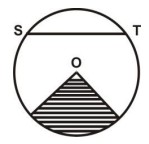
The diagram below shows a circle with centre O. S and T are points on the circle. What name is given to the shaded region?- A. sector
- B. segment
- C. radii
- D. arc
- E. cone
-
The line ST in a circle with centre O is called?- A. an arc
- B. a chord
- C. a diameter
- D. a radius
- E. a segment
-
Simplify: 2 × 3² × 3⁴.
- A. 2 × 3⁵
- B. 2 × 3⁶
- C. 2 × 3⁸
- D. 2 × 9⁶
- E. 2 × 9⁸
-
Which of the following fractions is the greatest? ¹/₆, ¹/₄, ¹/₂, ¹/₃, ¹/₅.
- A. ¹/₆
- B. ¹/₅
- C. ¹/₄
- D. ¹/₃
- E. ¹/₂
-
The sum of the ages of a man and his wife is 81 years. The ratio of their ages is 5:4. Find the age of the younger person.
- A. 30 years
- B. 36 years
- C. 45 years
- D. 51 years
- E. 65 years
-
A car is travelling at 40 km per hour. How far does it travel in 2 ¹/₂ hours?
- A. 16 km
- B. 80 km
- C. 90 km
- D. 100 km
- E. 140 km
-
There are 6 girls and 18 boys in a class. What percentage of the class are girls?
- A. 14.40%
- B. 25.00%
- C. 33.33%
- D. 66.67%
- E. 75.00%
-
Find the missing numbers in the sequence 4, 8, 12, _, _, _, 28.
- A. 14, 16, 22
- B. 14, 18, 22
- C. 6, 18, 22
- D. 16, 20, 24
- E. 16, 22, 24
-
A shop increased all its prices by 10%. Calculate the new price for an article previously sold for ₵7,500.00.
- A. ₵6,750.00
- B. ₵7,575.00
- C. ₵7,800.00
- D. ₵8,250.00
- E. ₵8,350.00
-
Simplify: 7(y + 1) – 2(2y + 3).
- A. 3y – 5
- B. 3y – 2
- C. 3y + 1
- D. 3y + 4
- E. 3y + 13
-
The table below shows the average monthly rainfall at Nankese from March, 1996 to August, 1996.
Month Mar Apr May Jun Jul Aug Rainfall (mm) 99 145 227 450 267 142
Which month recorded the highest amount of rainfall?- A. March
- B. April
- C. May
- D. June
- E. July
-
The table below shows the average monthly rainfall at Nankese from March, 1996 to August, 1996.
Month Mar Apr May Jun Jul Aug Rainfall (mm) 99 145 227 450 267 142
What was the total amount of rainfall recorded in April, May and July?- A. 422 mm
- B. 639 mm
- C. 72 mm
- D. 994 mm
- E. 1,139 mm
-
Find the median of the following numbers: 1, -1, -5, 3 and -4
- A. -1
- B. -4
- C. -5
- D. 1
- E. 3
-
There are 15 red and 25 black balls in a bag. Find the probability of selecting a black ball from the bag.
- A. ¹∕₂₅
- B. ¹∕₁₅
- C. ³∕₈
- D. ³∕₅
- E. ⁵∕₈
-
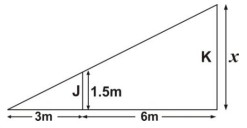
In the diagram, K is an enlargement of J. Calculate the scale factor.- A. ⅓
- B. ½
- C. 2
- D. 3
- E. 9
-
In the diagram, K is an enlargement of J. Find the value of x.- A. 3.0 m
- B. 3.5 m
- C. 4.5 m
- D. 6.0 m
- E. 9.0 m
-
A trader received a commission of 25% on the sales he made in a month. His commission was ₵180,000.00. Find his total sales for the month.
- A. ₵135,000.00
- B. ₵150,000.00
- C. ₵240,000.00
- D. ₵540,000.00
- E. ₵720,000.00
-
Kwame traveled from Accra to Kumasi. He traveled ³∕₁₀ of the journey by lorry, ²∕₅ by taxi, and the rest by train. What fraction of the journey did he travel by train?
- A. ³∕₁₀
- B. ³∕₅
- C. ⁷∕₁₀
- D. ³∕₂₅
- E. ²²∕₅₅
-
If 4(m + 4) = 18, find the value of m.
- A. ½
- B. ³∕₂
- C. ⁵∕₂
- D. ⁷∕₂
- E. ¹⁷∕₂
-
What is the rule for the mapping where x = {1, 2, 3, 4} and y = {3, 5, 7, 9}?
- A. x → 4 - x
- B. x → x - 2
- C. x → 2x
- D. x → 2x + 1
- E. x → 3x
-
Find the value of y when x is 7 in the mapping x = {1, 2, 3, 4} and y = {3, 5, 7, 9}.
- A. -3
- B. 9
- C. 14
- D. 15
- E. 21
-
A square of side 6 cm has the same area as a rectangle of length 9 cm. Find the breadth of the rectangle.
- A. 3 cm
- B. 4 cm
- C. 6 cm
- D. 24 cm
- E. 36 cm
-
Factorize 3r²s - 9rs²
- A. rs(3r - s)
- B. 3rs(s - 3r)
- C. 3rs(r - 3s)
- D. r²s²(3r - 9s)
- E. 3r²s²(s - 3r)
-
The average mass of 4 boys is 45 kg. When a fifth boy joins, the average mass changes to 40 kg. Find the mass of the fifth boy.
- A. 5 kg
- B. 10 kg
- C. 15 kg
- D. 20 kg
- E. 25 kg
-
E is the point (4, 2) and F the point (2, 1). Calculate the gradient of the straight line EF.
- A. -½
- B. -2
- C. 2
- D. ½
- E. 0
-
L = (3, -1) and K = (-4, 2). Find L + K.
- A. (-1, -1)
- B. (-1, 1)
- C. (1, -1)
- D. (7, -1)
- E. (7, 1)
-
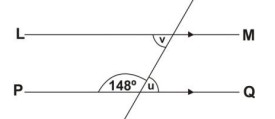
In the diagram, ML and PQ are parallel lines. Find the value of v.- A. 32°
- B. 40°
- C. 58°
- D. 140°
- E. 180°
-
Given the relation ¹∕ʸ = ¹∕꜀ + ¹∕ₓ, find y in terms of x and c.
- A. c + x
- B. 2cx
- C. (c + x)/2
- D. cx / (c + x)
- E. (c + x) / cx
-
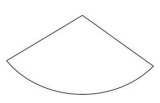
The figure above is the net of:- A. a cylinder
- B. a triangle
- C. a pyramid
- D. a cone
- E. a sphere
-
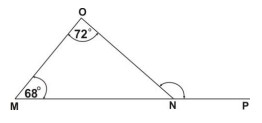
In triangle MNO, ∠MON = 72° and ∠OMN = 68°. Find angle ONP.- A. 40°
- B. 68°
- C. 72°
- D. 112°
- E. 140°
Paper 2: Theory
- a) Kofi and Kojo were given ₵38,000.00 to share. Kojo had ₵7,500.00 more than Kofi. Find:
(i) Kofi's share
(ii) Kojo's share
b) A trader paid ₵1,500.00 for 6 drinking cups. One of the cups got broken. He sold the remaining 5, making a profit of 10%. Calculate:
(i) the cost price of each of the six cups
(ii) the selling price of each of the five cups
(iii) the profit made on each cup sold. - a) Solve the inequality (2x ÷ 4) − (x ÷ 3) > 1.
b) Find the value of the expression 2x − 3y if x = 1/3 and y = −1/2.
c) 25 students in a class took an examination in Mathematics and Science. 17 of them passed in Science and 8 passed in both Mathematics and Science. 3 students did not pass in any of the subjects. Find:
(i) how many passed in Mathematics
(ii) the probability of meeting a student who passed in one subject only. - a) Using a pair of compasses and a ruler only:
(i) Construct triangle ABC such that |AB| = 10 cm, angle ABC = 30° and |BC| = 8 cm. Measure angle ACB.
(ii) Construct a perpendicular from C to meet line AB at D. Measure |CD|.
b) Calculate the area of triangle ABC. - a) Using a scale of 2 cm to 2 units on both axes:
(i) Draw two perpendicular axes OX and OY on a graph sheet.
(ii) Mark the x-axis from −10 to 10 and the y-axis from −12 to 12.
(iii) Plot the points A(0, 10), B(−6, −2), C(4, 3), and D(−3, −11). Use a ruler to join the points A to B and also point C to D.
b) (i) Draw the line x = −2 to meet AB at P and CD at Q.
(ii) Use a protractor to measure angles BPQ and PQC.
(iii) What is the common name given to angles BPQ and PQC?
(iv) State the relationship between lines AB and CD. - The table below shows the marks scored out of 10 by some candidates in a test:
Mark Number of Candidates 1 2 2 3 3 5 4 7 5 8 6 13 7 7 8 5
a) From the table, find:
(i) the modal mark
(ii) how many candidates took the test
(iii) the mean mark for the test
b) If 20% of the candidates failed:
(i) how many failed?
(ii) What is the least mark a candidate should score in order to pass?
Worked solutions to the theory questions are free in the app.
 All answers free on Google Play