 BECE Past Questions
BECE 2001 Integrated Science Past Questions and Answers
40 objective questions and 4 theory questions from the 2001 BECE Integrated Science paper. Answers and worked solutions for questions 1 to 10 are below; the rest are free in the app.
Practise this paper free, online or offline


On an iPhone? Download on the App Store
On Android? Get it on Google Play
Paper 1: Objectives
-
The main pollutant from domestic fires is
- A. Carbon monoxide
- B. Sulphur dioxide
- C. Water vapour
- D. Oxygen
- E. Ammonia
Answer: A -
Plantain is propagated vegetatively by
- A. Corms
- B. Stem cuttings
- C. Suckers
- D. Rhizomes
- E. Tubers
Answer: C -
Which of the following gases support combustion?
- A. Carbon dioxide
- B. Carbon monoxide
- C. Hydrogen
- D. Oxygen
- E. Sulphur dioxide
Answer: D -
The main function of petals in a flower is to
- A. Protect the ovary
- B. Produce seeds
- C. Attract insects
- D. Secrete nectar
- E. Produce sweet scent
Answer: C -
The organ in the human body which is responsible for the removal of urea is the
- A. Heart
- B. Kidney
- C. Lung
- D. Liver
- E. Bladder
Answer: B -
The sun and the planets form the
- A. Atmosphere
- B. Constellation
- C. Milky way
- D. Solar system
- E. Universe
Answer: D -
The bilharzia worm can enter the human body through the
- A. Anus
- B. Ear
- C. Mouth
- D. Nostrils
- E. Skin
Answer: E -
Brass is an alloy of copper and
- A. Aluminium
- B. Carbon
- C. Iron
- D. Tin
- E. Zinc
Answer: E -
Which of the following diseases is contracted through infected wounds?
- A. Chicken pox
- B. Diphtheria
- C. Mumps
- D. Tetanus
- E. Whooping cough
Answer: D -
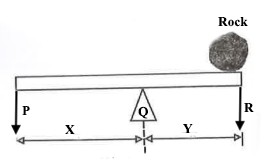
Which of the parts labelled represents the pivot?- A. P
- B. Q
- C. R
- D. X
- E. Y
Answer: B
Answers and solutions for questions 11 to 40 are free in the BECE Past Questions app, with timed practice and offline study.
-
The effort is represented by- A. P
- B. Q
- C. R
- D. X
- E. Y
-
Which of the following parts of the human body are sense organs?
I. Tongue
II. Hair
III. Nose
IV. Skin- A. I and IV only
- B. II and III only
- C. I, II and III only
- D. I, III and IV only
- E. I, II, III and IV
-
The function of the cotyledon is to
- A. Produce the radicle
- B. Store food
- C. Protect the seed
- D. Produce the plumule
- E. Produce the fruit
-
Which of the following substances are components of a fertile soil?
- A. Nitrogen and phosphorus
- B. Phosphorus and sulphur
- C. Phosphorus, calcium and sulphur
- D. Calcium, sulphur, nitrogen and phosphorus
- E. Nitrogen, calcium and phosphorus
-
Which of the following appliances transform(s) electrical energy to heat energy?
I. Swish oven
II. Hair drier
III. Refrigerator motor- A. I only
- B. I and II only
- C. II and III only
- D. I and III only
- E. I, II and III
-
A ray of light makes an angle of 20° with the surface of a plane mirror. Determine the angle of reflection.
- A. 20°
- B. 50°
- C. 70°
- D. 90°
- E. 120°
-
Seasonal changes are the result of the
- A. Rotation and tilting of the earth
- B. Revolution and tilting of the earth
- C. Revolution and rotation of the earth
- D. Revolution and tilting of the moon
- E. Revolution and rotation of the moon
-
Crystals of sugar were obtained when a hot solution of sugar was cooled to room temperature. What conclusion can be drawn from this observation?
- A. Sugar does not dissolve in cold water
- B. Sugar does not dissolve in hot water
- C. Sugar dissolves more in hot water than in cold water
- D. Sugar dissolves less in hot water than in cold water
- E. Sugar dissolves more in cold water than in hot water
-
Which of the following processes about all living things is/are true?
I. Reproduction
II. Respiration
III. Locomotion
IV. Excretion- A. I only
- B. I and II only
- C. III and IV only
- D. I, II and III only
- E. I, II and IV only
-
Tendrils in plants are adaptations that enable the plant to
- A. Climb
- B. Expire
- C. Store food
- D. Reproduce
- E. Propagate vegetatively
-
The density of a substance is 2.5 gcm-3. Calculate the volume of the substance if its mass is 25.0 g.
- A. 0.1 cm3
- B. 10.0 cm3
- C. 22.5 cm3
- D. 27.5 cm3
- E. 62.5 cm3
-
The food substance that promotes good health is
- A. carbohydrate
- B. fat
- C. protein
- D. vitamin
- E. water
-
The energy that causes the turbine of hydro-electric plant to rotate is
- A. chemical energy
- B. potential energy
- C. electrical energy
- D. kinetic energy
- E. heat energy
-
Which of the following pairs of organs are part of the central nervous system?
- A. Spinal cord and the eyes
- B. Brain and spinal cord
- C. Brain and the ears
- D. Eyes and the ears
- E. Eyes and brain
-
Plants manufacture their food using
I. carbon dioxide
II. oxygen
III. light
IV. chlorophyll- A. I only
- B. II only
- C. I and II only
- D. I, III and IV only
- E. I, II, III and IV
-
Which of the following crops improves soil fertility when cultivated continuously on the same piece of land?
- A. Carrot
- B. Cocoa
- C. Cassava
- D. Maize
- E. Peas
-
It is necessary to keep household refuse in covered containers in order to prevent
- A. the spread of tuberculosis
- B. the decomposition of the refuse
- C. the spread of measles
- D. entry of flies
- E. entry of bacteria
-
The fraction of the earth's surface that faces the sun at any particular time is
- A. 1/4
- B. 1/3
- C. 1/2
- D. 2/3
- E. 3/4
-
Which of the following is a micro-organism?
- A. Bread mould
- B. Bacteria
- C. Leech
- D. Termite
- E. Tick
-
Which of the following statements about machines is/are correct?
I. Machines help us to do work more easily
II. A force applied at one point of the machine overcomes a load at another point of the machine
III. All machines have engines- A. I only
- B. II only
- C. III only
- D. I and II only
- E. II and III only
-
The female part of a flower is called the
- A. filament
- B. petal
- C. pollen grain
- D. sepal
- E. style
-
Which of the following substances is a compound?
- A. Hydrogen
- B. Nitrogen
- C. Oxygen
- D. Sulphur
- E. Water
-
A solution in which no more solute will dissolve at a particular temperature is said to be
- A. concentrated
- B. dilute
- C. saturated
- D. insoluble
- E. unsaturated
-
The process of respiration could be represented by the following equation: Glucose + oxygen → water + carbon dioxide + X. What does X represent?
- A. Alcohol
- B. Hydrogen
- C. Heat
- D. Mineral salts
- E. Protein
-
When oil and water are shaken together they form a mixture called
- A. a solution
- B. an emulsion
- C. a solute
- D. a solvent
- E. a suspension
-
The organism which lives in the human blood as a parasite is
- A. louse
- B. plasmodium
- C. roundworm
- D. tapeworm
- E. tick
-
The fusion of an egg cell with sperm forms
- A. an ovum
- B. an embryo
- C. a zygote
- D. an ovary
- E. a placenta
-
The instrument used to measure current in an electric circuit is the
- A. ammeter
- B. anemometer
- C. barometer
- D. thermometer
- E. voltmeter
-
The atom of an element has 4 protons and 5 neutrons in its nucleus. How many shells are occupied in the atom?
- A. 1
- B. 2
- C. 3
- D. 4
- E. 5
-
The gaps left between railway lines is to allow for
- A. expansion
- B. cooling
- C. maintenance
- D. easy stopping
- E. gear changing
Paper 2: Theory
- (a) (i) What is surface tension?
(ii) Name two household devices that make use of surface tension.
(iii) Explain how the principle of surface tension operates in one of the devices you have named.
(b) (i) What is constipation?
(ii) State four ways by which constipation can be prevented.
(c) A block of mass 10kg is suspended from a spring. Calculate the force acting on the block. [g = 10ms-2]
(d) An amount of sodium hydroxide solution was put into a beaker and a piece of litmus paper was added. Dilute hydrochloric acid was added a little at a time with stirring until the litmus paper just turned purple. The resulting solution was evaporated to dryness.
(i) What was the colour of the litmus paper in the sodium hydroxide solution?
(ii) What does the colour change of the litmus paper indicate?
(iii) What substance was left after the evaporation?
(iv) Write a balanced equation for the reaction that took place. - (a) State and explain three ways by which plants protect themselves from danger.
(b) (i) What is an anion?
(ii) Give the names of the products formed when the following pairs of compounds react together:
α) NH4OH and dilute HCl
β) CaCO3 and dilute HCl
(c) (i) What is electromagnetism?
(ii) With the aid of a circuit diagram describe how a piece of metal can be magnetized. - (a) (i) State three characteristics of roots.
(ii) State two functions of roots.
(b) State two conditions necessary for the germination of seeds.
(c) Describe briefly how the volume of an irregular shaped metal ball could be determined.
(d) Write down the chemical formula for each of the following compounds:
(i) sodium chloride
(ii) copper sulphate
(iii) magnesium sulphate
(iv) potassium carbonate
(e) State the method that could be used to separate each of the following compounds:
(i) iodine and sand
(ii) ethanol and water - (a) (i) What is digestion?
(ii) Describe briefly how food is digested in the stomach.
(b) (i) What is meant by eclipse of the sun?
(ii) With the aid of a labelled diagram, distinguish between total eclipse and partial eclipse.
(c) (i) State the difference between a physical change and a chemical change.
(ii) Give one example of each of a physical change and a chemical change.
Worked solutions to the theory questions are free in the app.
More BECE Integrated Science papers
All 38 Integrated Science papers
 All answers free on Google Play